Concept: 1 out of 5 Execution: 0 out of 5 Yeah, but: Plot holes big enough to fly starships through. The Long Version:
"Star Trek Into Darkness" first hit theaters (or theatres) in May of 2013. It played well to its intended audiences around the world, racking up nearly a half billion dollars in ticket sales before its run was done. It scored a respectable 87 on Rotten Tomatoes. It was a generally entertaining enough movie, being released for a second round of studio money gorging with its release on Blue Ray later in September. It had the usual cast of characters, and it had Benedict Cumberbatch. What wasn't to like?
The plot, or more precisely, the plot holes. The most egregious occurred early on in the movie after Cumberbatch's character John Harrison, a.k.a. Khan, shot up Star Fleet's leadership while it was conveniently meeting high up in an insecure skyscraper. Harrison showed up in a small one-person aircraft and with his infinite ammunition gun proceeded to open fire on a completely un-defended conference room fronted by an equally convenient floor-to-ceiling window setting that stretched from one end of the conference room to the other, until Chris Pine as Jim Kirk managed to single-handedly cripple Harrison's ship and eventually cause it to crash.
But before it crashed, John Harrison managed to trigger a very magical transporter that was so small it fit into the same cockpit area as Harrison. So magical it managed to transport him to the Klingon home world of Qo'noS, a mythical world located some 112 light years away from Earth. Not only do you see Harrison transported away from an aircraft rapidly spinning out of control, but mere seconds later you see him transported to the surface of Qo'noS, none the worse for wear.
Let me make sure I have all this straight. Harrison is in possession of a small, portable transporter that can move him from a spinning machine on a rotating planet (Earth) orbiting a star (our Sun) with the whole ensemble traveling through intergalactic space in our galaxy, to another planet, rotating on its axis, orbiting a completely different star, and that whole ensemble moving in an independent but generally same direction, 112 light years from Earth.
With that kind of capability, why the hell do you need starships?
With that kind of a transporter, why not just use the same method to go and get him? Oh, wait. You only made one? And the one you found in the wreckage, the one that told Scotty where Harrison had fled to, wasn't working well enough to beam his pursuers to Qo'noS, or him back? How convenient!
In fact, why wasn't this particular type of transporter used to transport anti-matter weapons (or just raw bits of anti-matter) all over the surface of Qo'noS and just blow the planet to bits? What's amazing is that Harrison didn't invent this, Scotty did (with Spock Prime's help) in the first movie. I knew when Spock Prime beamed Scotty and Kirk back on board a star ship speeding at warp velocities in the first movie that JJ Abrams had managed, without really trying, to completely destroy any rational reason for his big starship in the whole series. With just a small scene in the second movie, JJ Abrams managed to make all his big shiny starships totally irrelevant. Every. Single. One.
The 2014 silly season for movies is about to start up again. I think, from this point out, I'm going to sit the whole thing out. At least anything from JJ Abrams and his kindred directors.
Concept: 1 out of 5 Execution: 0 out of 5 Yeah, but: Like Opus said, "Well maybe not THAT bad, but Lord, it wasn't good."
The Long Version: The Toronto Coach Terminal, which is home to Greyhound, Megabus, and Ontario Northland, among other bus lines, is an excellent example of how not to do things.
First, the good points: Inside the main doors is a large ticketing area, as well as a traveller's information kiosk that's occasionally staffed by (presumably) friendly, patient, and helpful people. There's a considerable amount of seating, which is eclectically arranged and cosy, even though much of it is roped off as an 'express' area. There are information screens that show which platform each bus will be departing from, and there are even storage lockers available, which is quite a luxury these days.
And that concludes the summation of the good points of Toronto's Bay Street bus terminal.
It's not glamorous, but restrooms are one of the most important consideration for travellers. These are absurdly small and in terrible repair – if there was any doubt that this building is owned and run by the TTC, this will remove it. Accommodating four people will make the Men's uncomfortably crowded, and the Women's is rumoured to be worse. For bonus points they're in the basement, far away and out of sight of the bus platforms. The up and down escalators are in different places, so you don't return to where you started, and neither one is convenient to the bus loading platforms. I'm trying to imagine a worse implementation of such a fundamental amenity, and keep coming up blank.
Also downstairs is a small convenience store selling touristy things and a poolhall to help pass the time. There are no food-equipped vending machines in the building, though, so when those are closed it's time to explore the neighbourhood. The basement does have a pedestrian passageway to the Atrium On Bay shopping complex, which mostly keeps office hours, but has a food court with much better washrooms and a McDonalds. That seems to be the best we can offer visitors with two kids, three suitcases, and half an hour left before they need to go stand outside in a garage.
Yes, dear reader, the best is yet to come.
The bus platforms don't deserve the term. Civilized bus stations have indoor waiting areas with seats and heat, and the people walk up to the bus when it's ready for them. Toronto does it backwards. People here are expected to line up – at least half an hour early, because buying a ticket doesn't guarantee a seat – and stand waiting in an outdoor garage. Metal railings mark the places for the queues, but a bus that can hold fifty or eighty people can create quite the line.
Did I mention that this is in Toronto? There is a roof that keeps most of the rain and snow out, but our weather is lousy for most of the year, being either too hot or too cold. And even on a pleasant day, spending it standing squished between buses with their engines running is nobody's idea of fun.
When a bus wants to reach the loading area it needs to drive through the lines of queueing people, who now need to shuffle themselves and their luggage out of the way. Did I mention that these massive vehicles need to turn to reach the correct positions, often with just a few feet of clearance? I can't imagine the stress this must put on long-distance drivers as they try to navigate a moving obstacle course of tired people pulling toddlers and wheeled suitcases.
And the crowning glory of the whole endeavour is just how busy the whole thing is. I've been waiting at a platform for the suggested half-hour prior to departure only to have two other buses depart from the same platform in that time. This leaves the bus drivers walking up and down the line calling out their destination. "Peterborough? Peterborough? Niagara Falls? Owen Sound?" I think the term I'm looking for is 'cluster farce', but I could be mixing up two expressions.
And once the bus is ready to go the experience still isn't quite over. The buses get to pull out onto a nice and wide public roadway, but it's also used for bus parking, which narrows it considerably. Having your bus need to do a three-point-turn is just the crowning touch on a congested and absurd experience.
This station needs to be torn down. It can't handle the passenger volume, which is increasing, but its replacement hasn't been a priority for the city planners. GO Transit has a more sensibly designed station farther south to serve its regional buses, but there's no way to add on significantly more service there, and the main inter-city bus station really needs to be in the city's core.
The fact is that a city will make the room, and find the money, for the things that it wants. Improving the TTC-owned Toronto Coach Terminal just doesn't rank highly enough to happen. The commercial district that houses the existing bus station has had massive redevelopment over the past decade, including a huge parking and shopping complex on an ideally-located prime intersection. It should have been an automatic choice for a transportation hub, but even with that opportunity missed, other block-scale development projects are not hard to find.
I can only hope that our next mayor can see beyond the suburbs.
Concept: 1 out of 5 Execution: 0 out of 5 Yeah, but: It makes Ed Wood's body of "work" look like William Shakespeare
The Long Version: Let's get the important part out of the way first. From its release on 29 June 2011 to 29 September 2011, "Dark of the Moon" has grossed $1.18 billion worldwide to become
the fifth highest-grossing film of all time,
the second highest grossing film of 2011 (behind Harry Potter and the Deathly Hallows – Part 2),
the highest grossing film in the Transformers series.
With a $198 million budget it grossed five times its production costs, which means it's a success. It will, in all likelihood, spawn yet another Transformer sequel. Heaven help us all.
I like my science fiction films one of two ways; either hard-core and fact-based, or good and trashy. For examples of enjoyable hard core I point to 1951's "The Day the Earth Stood Still", 1956's "Forbidden Planet", or 1968's "2001: A Space Odyssey". Good and trashy films, like "The Evil Dead", are minimally financed fun little movies with no pretensions, bad in a good way, fun to watch because you can see through the cheesy effects and the plot holes, but you don't care. There's a certain earnestness and honesty in those types of films. That's why I can watch "Plan 9 From Outer Space" repeatedly and find enjoyment each and every time. Especially in a group setting.
I didn't see "Dark of the Moon" when it was in the theaters because I was very busy. I felt no motivation to make the time because I've come to loathe the cineplex experience. Going to the movies now is like airline travel, but without the TSA. The few fixed times you can see a movie, the commute through traffic, finding a place to park, standing in line for expensive tickets, paying exorbitant soda and popcorn prices, then sitting through a good half-hour of ads and previews before the movie, the rude and noisy theater patrons, and on and on and on make a trip to the cineplex almost as bad as a trip to the airport. It's a far cheaper, far better experience to wait and watch a movie on Blu-ray (even a bad movie) in the comfort of your own home. That's why I waited to pick "Dark of the Moon" up at the local Walmart while grocery shopping this weekend. If the movie turned out to be truly bad, well, at least I was doing something useful besides just picking up a bad movie.
When I'm at home I might get to sit through an entire movie uninterrupted. Most of the time I don't, and this time was blessedly no exception. Watching "Dark of the Moon", at 2 hours and 34 minutes total length, took me over three hours in real time. That's because I needed to make the occasional stop, sometimes just to let my brain rest between the too-long pitilessly plotless and confusing stretches of the movie punctuated by the short chaotic sections of hyper-violent noise and action. I've sat through many long movies, some longer, but I've never had the need to just shut a movie down for a mental rest break. Even "2001", one of the most cryptic movies every made, seemed like a Pixar short compared to "Dark", and it clocks in at 2 hours 21 minutes.
Normally I'd write multiple paragraphs about the special effects, but not this time. Industrial Light and Magic, the effects house for "Dark", managed to render a world that looks overly complicated, muddy and just downright fake. It's difficult to see critical detail on the Transformer's, such as Sentinel Prime's face (voiced by Leonard Nimoy). The desire by the film's creators to overlay as much GCI action onto the live action locations (such as Chicago) makes it nigh impossible to accurately track the action, let alone sit back and enjoy the action. This is, in my opinion, ILM's worst work to date.
After re-reading the last five paragraphs I've come to realize there's nothing positive I can say about the film, so I'll just stop. I can't return the Blu-ray because of the store policy that says once the shrink-wrap is broken, I own the disc. But all is not lost; I can take it to a local Movie Stop and trade it for something else. That's probably the only good thing about this movie, and that is it'll go towards the purchase of something better to watch.
Concept: 1 out of 5 Execution: 0 out of 5 Yeah, but: It has to be seen to be believed.
The Long Version: The Tokina AT-X 16-28mm f/2.8 PRO FX clearly isn't a pretentious lens. With a list price around $1100 Canadian, it's Tokina's 'full-frame' version of their wildly popular 11-16/2.8, and is a welcome addition to the wide-angle options for the 24x36 set. I'm glad to see it and I wish it well; I've never really used the lens, but I've heard some nice things about it. This review is simply of its lens cap.
Made of a soft and flexible plastic, the Tokina 16-28's unbranded cap has shallow ridges that provide only a feeble grip on the hood some of the time. Other times the round hood mates with the round cap in a way that gives it no grip at all. None. I've done this trick with the caps on each of the three lenses that I've tested, including both Canon and Nikon mounts. Words can't convey the reality of it, so I've done an eighteen second MOS video.
Hands down, no question, without a doubt: this is the worst lens cap I've ever seen. You could use the metal cap from the Olympus 7-14 to prop up an artillery shell; the plastic caps from the Panasonic 7-14 and Nikon 14-24 aren't as impressive but they are still incredibly solid. Like the cap for the Tokina 16-28, all of these work to protect the bulging front element by attaching with a pressure-fit around the outside of the built-in petal hood. This design failure isn't the result of Tokina trying a daring new idea: even the press-on plastic tail cap from a Nikon 50/1.8D puts this front cap to shame.
The problems still don't stop when the Tokina cap is attached firmly enough that its own weight won't dislodge it. It can be knocked off by even a slight bump or nudge; I'd be mildly concerned about losing it if it wasn't guaranteed to fall off while the lens is still in the camera bag. The cap also isn't deep enough to completely cover the gaps in the petal-shaped lens hood, so it doesn't even protect against dust. This might also be a good time to point out that the lens can't take filters, and the width of its vision requires a shallow hood. The only real option to protect this lens, after spending a thousand dollars on it, is to spring a little extra for a neoprene Hood Hat. Nice.
There are certain things that I would like to take for granted, and the ability of a company with as much experience as Tokina – a division of Hoya, and a stablemate of Pentax – to design a lens cap that works properly shouldn't be too much to ask. Sure, Canon hasn't yet discovered the centre-pinch design, but this stuff shouldn't be pushing the state of the art. It boggles my mind that something this flawed made its way into the box of a shipping product, let alone a lens as expensive as this one. It can't be an accident that Tokina doesn't put their name on it.
updated: rumour has it that there is an improved mkII lens cap out there, and it can be ordered through an authorized dealer as a replacement for the one that I've reviewed here. It may even already be installed on some of the more recently made lenses. I would like to thank Tokina for giving people one more example of how important it is to buy from a real local camera store, and hope to have a further update once I've been able to try out the new design. updated once more: I've now seen the new design in person – both of them, in fact. One is a branded press-on cap that's deeper and made of rigid plastic, while the other is an elaborate design that clips into place and offers excellent protection. Lens caps can indeed be swapped out, but the store has to pay for the new caps up-front and is only reimbursed when the old models are sent back to them, and the cost isn't insignificant. Replacing the lousy design that I've reviewed here may not be all that easy.
Concept: 1 out of 5 Execution: 0 out of 5 Yeah, but: "What we've got here is (a) failure to communicate!" The Long Version: I really am glad that Photokina 2010 is finally over. I've been emotionally whip-sawed about by Olympus' announcements leading up to Photokina, first with their special E-P2 kits and two new M.Zuiko µ4/3rds zoomlenses, then with the announcement of the regular 4/3rds E-5, the follow-up to their three-year-old E-3. On the surface all those announcements sound wonderful. It's when you add the context and dig into the details that you realize it's anything but.
In happier times (15 July 2010) I wrote an opinion piece titled "Whither FourThirds?" In that editorial I wrote how I believed that Olympus knew what it was doing, that Olympus was working diligently to merge it's older 4/3rds line with its newer µ4/3rds camera line. Among other things, I wrote:
It all sounds wonderfully grim, and Olympus' critics are rubbing their hands with sadistic glee over what they see as another major Olympus failure in the making. The only problem with this delightfully grim prediction is that it's wrong. Olympus knows it can't just drop regular 4/3rds. They are painfully aware of the repercussions of another mount abandonment. If Olympus were to abandon 4/3rds then they might as well pull out of the entire camera market, because the repercussions of a second major mount abandonment would fatally taint every other camera product they would try to sell going forward...
I believe that Olympus is working hard to merge its two interchangeable lens lines into one, based exclusively around µ4/3rds. They will provide a seamless transition with existing 4/3rds-mount lenses. It's going to take time (I estimate 24 months), but we will see the road-map for this transition starting with Photokina this fall.
As I said, written in happier times, and making assumptions that have come back to haunt me.
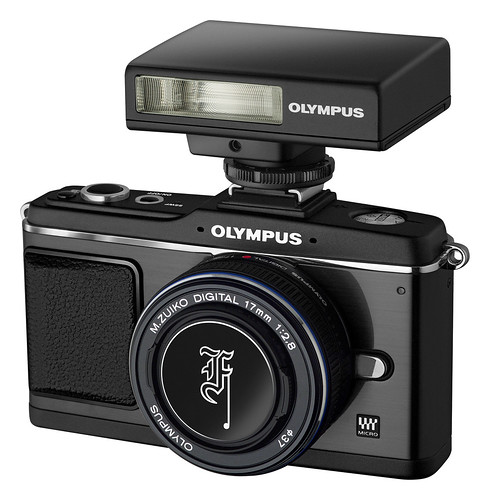
The start of my dissatisfaction came with the release of the two newest E-P2 kits. They cost more, anywhere from $200 to $350, than the original E-P2 kits released in December 2009. And for what? So that you could purchase a black version of the M.Zuiko 17mm f/2.8 with a Pen-branded lens cap, and with your choice of the VF-2 EVF or a black version of the FL-14 flash.
All new, all black E-P2 kit with fancy 17mm lens cover
and black FL-14 external flash.
What would have been far more useful to the Olympus faithful would have been an updated version of the E-P2 that included the sensor tweaks currently in the E-PL1 along with new camera firmware that allowed for faster autofocus with standard 4/3rds lenses.
Just how slow is autofocus with a regular 4/3rds lens mounted on an E-P2? Take, as an example, my ZD 12-60mm HG zoom. On my E-3, with the latest lens firmware upgrade, it snaps to focus so quickly as to be unmeasurable by anything other than fast instrumentation. Put it on my E-P2, however, and I can watch the sweep hand of my analogue watch count out two seconds before the lens finally locks onto focus. That's what I mean by slow. I'm well aware of the differences between phase detect autofocus in the E-3 and contrast detect autofocus in the E-P2 (and the other Pens as well). That's my point. Olympus could have begun to bridge between the two lines with advances in the Pens using a combination of firmware in the body and possibly a new, special adapter. Instead, we got marketing fluff.
Then came two new lenses, the M.Zuiko 40-150mm and 75-300mm. It was the later that raised my eyebrows because of its cost: a cool $900.
All new, all expensive, M.Zuiko 75-300mm f/4.8-6.3
That's a lot of cash for a mighty slow lens. I won't mention the kind of fast quality glass you can get in the regular HG 4/3rds line for that amount or a lot less. That would be pointless because of the slow autofocus performance of regular 4/3rds lenses on µ4/3rds bodies. Later in this post I'll get to why I keep harping on this point. But to continue...
Finally, on September 14th, Olympus announced to the world the new E-5. You can hit the link to read the particulars. Basically, the E-5 was pitched as an improved E-3 for $1,700, body only. Responses in the Olympus user community were almost immediate, and the majority of them weren't good. Ken Norton of Zone-10 best exemplified may reaction by writing the following:
Olympus officially introduces the new E-5. Essentially a warmed-over E-3 or an E-30 in E-3 body. Move along, people--nothing to see here.
On a personal note, I'm extremely disappointed with Olympus for two reasons:
After three years this is the best they could do?
Why didn't they do something like this with the E-1 in those four years before the E-3 came out?
Olympus, you are a creative company that has proven through the years to be the maverick in every industry you compete in. The E-5 is the opposite of what the very fabric of this company is all about.
But not all is bad. At least Olympus finally put a decent LCD on it. Way to step out!
If you are needing to buy a new pro-level Olympus DSLR, the E-5 is fine. In fact, it's probably quite good as it blends the best of the E-3 with the improved imaging capabilities seen in the E-PL1. It will definitely not be a slouch in image quality. However, it is obvious that Olympus has lost all interest in legacy FourThirds. The E-5 is a protection for existing investment in lenses and accessories, but at this point I won't be recommending any non Micro FourThirds products to anybody not already invested in the line.
Then came Simon Joinson's preview on DPReview, and these priceless pearls of witty observation:
Taking what could most politely be described as a 'considered' approach to product upgrades, Olympus has lifted the curtain on the third generation of its professional SLR, in the form of the much anticipated E-5. Olympus introduced the world to the first Four Thirds camera, the E-1, back in June 2003, and finally got round to updating it with the E-3 four years later. We got a sneak preview of the E-3's successor a couple of weeks back - we'll update this short article to a full review as soon as we get a production E-5 in the office.
It is perhaps indicative of where Olympus's priorities lie - or the way the market is headed - that whereas the E-3 took the E-1 back to the drawing board and introduced several new features, the E-5 is probably best described as a warm over of its predecessor. It's also interesting to note that it benefits from a 'trickle up' of technology from the latest developments in the company's Micro Four Thirds cameras - a situation unusual for what is, effectively, the hero product in the E-system range.
Into this swirling brew of disbelief and controversy was dumped a series of poorly translated (read: Google translated) interviews reported via other blogs where English was a second language at best. By the time the smoke had cleared on those little missives, I learned the following:
There would be no more development for new standard 4/3rd lenses. Olympus had decided, for whatever reason, that what they had was good enough, and that the E-5 would finally deliver the image quality the regular line (especially the SHG) were supposed to deliver with regards to sharpness and detail.
All regular 4/3rds DSLRs, from the E-30 on down (E-4x0, E-5x0, and E-6x0) would no longer be manufactured. The E-4x0 to E-6x0 were considered entry-level DSLRs; the Pens could easily substitute (and would be substituted) for them. The E-5 would subsume and replace the E-30 just as it was doing to the E-3.
So there you have it. Olympus showed I was wrong. They are abandoning (however slowly) regular 4/3rds. This time, unlike the OM line, they're providing a half-way transition from the 4/3rds to µ4/3rds lens mount with a mechanical adapter that pulls the electrical contacts straight through to the µ4/3rds mount. This at least gives some feedback for EXIF data as well as some control (slow autofocus, control of the aperture).
They've already started to abandon the Standard Grade lens line by reproducing many of the more popular zooms as M.Zuiko zooms (9-18mm, 40-150mm, 14-42mm, and 70-300mm (as the $900 75-300mm). None of the current Pens and M.Zuiko lenses are weather sealed. If you want weather sealed, then you're left with the lone E-5 (and remaining E-3s still in stock) with the High Grade and Super High Grade lenses.
What am I left with? A very sour taste in my mouth. I shoot primarily Olympus digital (E-3 and E-P2). I've written well of the gear I own (especially the E-P2), and it all continues to operate quite well. The problem is that this is all expensive gear that represents an investment of money and time. Quality gear costs money, and to wring the most out of that monetary investment requires a not-to-considerable personal investment of time and effort. When you make that kind of an investment in a camera brand, you expect the camera manufacturer to make a reciprocal investment in engineering, development, quality, and marketing. Especially marketing. Because, over time, I have this idea I want to add or replace what I have, based on my changing needs. And I'd like to do it with a vital brand and with it's supporting ecosystem.
I give points to Olympus engineering and quality, but their marketing is the worst I think I've ever seen. Instead of providing leadership and vision at this year's Photokina, they gave a series of scattershot interviews to a few enthusiast photography sites, then had to issue a few corrections from the Japanese mothership to tamp down the ensuing controversy. When it came to the E-5, I had to learn about its image quality via informal photographs on forums and at other enthusiast sites. The E-5 might be absolutely fabulous, the bees knees, and hold its own, IQ-wise, against the Canon 7D or the Nikon D300s at equivalent ISOs. And maybe we'll learn that when DPReview publishes its official review. But Olympus could have primed the pump with a full-court press of the E-5 including plenty of sample images and reviews ready to go at Photokina 2010. Instead they pissed away a golden opportunity.
So what about the future? As far as Olympus' future goes, I have absolutely no idea. If I had that kind of perceptive ability, I'd be super rich and this kind of a blog post would be moot. As it is I've barely enough ability to figure out my own future, much less a world-wide Japanese company's. As for myself, I have to echo Ken Norton's conclusion: I won't be recommending any regular 4/3rds equipment (body and lenses) to anyone who isn't already heavily invested. And I mean heavily invested. And I'm going to hold back my enthusiasm for µ4/3rds. Olympus' handling of regular 4/3rds and their lack of a detailed, cohesive and compelling vision regarding the evolution of regular 4/3rds to µ4/3rds has poisoned the well for all cameras for me. All I can say is, be very careful buying Olympus.
I have no idea where I might migrate to, and no desire to sit and slowly stew over all that's happened. I'd much rather go out and use the gear I've got. It still works, and works well. For me, photography is the best therapy.
Update 25 September
These are quotes from trusted sources meant to provide additional background to my rant. I wanted to document them, and then let the reader follow them and draw their own conclusions.
"Twelve megapixels is, I think, enough for covering most applications most customers need," said Akira Watanabe, manager of Olympus Imaging's SLR planning department, in an interview here at the Photo Marketing Association (PMA). "We have no intention to compete in the megapixel wars for E-System," Olympus' line of SLR cameras, he said.
Instead, Olympus will focus on other characteristics such as dynamic range, color reproduction, and a better ISO range for low-light shooting, he said...
"I personally believed, before starting the E-System, that 12 was enough," Watanabe said. "We interviewed many professional photographers, people in studios, about how many they needed in the future. Before we started, the system, we had a rough idea we'd be at a plateau at 12 megapixels. We gradually increased the pixel count," with the newer Olympus SLRs now reaching that level...
Watanabe, though, believes image sensor-based autofocus will outperform phase-detect systems in the future. That's important not just for compact cameras, but also for SLRs that today often have an awkward problem with composing a shot using the camera's LCD: when the sensor is in use to run the display, the phase-detect autofocus subsystem can't be used. That means live view on SLRs today is typically a frustratingly slow process.
"In terms of speed, phase detect is faster. But imager autofocus will exceed phase detect," Watanabe said.
And speed isn't of course the only factor. "In terms of accuracy, imager-based autofocus is much more advantageous. It directly focuses on the surface itself," the exact location where the image will eventually be recorded. "Phase detect focuses not on the real surface but on a virtual surface," the focusing subsystem reached via a moving mirror.
Imager-based autofocus doesn't require the full use of the image sensor area, so it doesn't directly increase power consumption concerns, he said. In Olympus's new midrange E-30 SLR, for example, autofocus uses only a few points on the sensor when autofocusing in live view mode.
In an interview at Photokina, reports quesabesde.com (relayed to us via 4/3 Rumors), Miguel Garcia , Marketing Managing Director of Olympus Europe, has confirmed that Olympus has stopped development of future lenses for reflex 4/3 cameras. Although the E-5 will not be the last 4/3 body, according to Garcia, Olympus will concentrate its future development on Micro 4/3. There will be a professional Micro 4/3 body in 2011, and the lower-end Micro 4/3 camera will be updated as well.
He mentioned that in Japan, mirrorless cameras have already captured 40% of the market, and he emphasized that Olympus has a big lead over some of its competitors in the development of these systems.
About Micro 4/3 lenses for the future, he said Olympus has lenses in development that will be "spectacular for all levels [of photographers], not just consumers."
Olympus will next month launch the Olympus E-5, a DSLR the firm admits may be the last of its traditional Four Thirds cameras as it signals a future without optical viewfinders.
The news appears to support controversial comments made by US DSLR manager Richard Pelkowski earlier this year.
Pelkowski had speculated that the Four Thirds system will be using a mirrorless viewfinder system within the next 24 months, as the quality of electronic viewfinders had improved so much. Speaking at the PMA trade show in the US, Pelkowski had explained that switching from a traditional mirror SLR system would save space and weight in Four Thirds cameras, and would make the incorporation of HD video functions much easier.
However, days later, Toshiyuki Terada, manager of the SLR planning for Olympus Tokyo, refuted Pelkowski's comments, telling AP that the Olympus Four Thirds camera range will continue to use mirror-type viewfinders.
Six months later, the Olympus E-5 is born, boasting the 'reliability' of the E-3 with the 'evolution' of a Pen, according to Olympus – but it could be the last E-series Four Thirds camera.
I would like to point out Olympus' past history with regards to releasing new cameras in a consistent and timely fashion; they don't. Consider the four year span between the E-1 and E-3, and the three year span between the E-3 and E-5. Or the vaporware 100mm Macro that stayed on the regular 4/3rds lens map for so long; it'll never be produced now.
So it's anybody's guess as to what Olympus may introduce in the "professional µ4/3rds" category. We may have to wait as long as PMA 2011 to find out, if ever. PMA 2011 starts in early September.
Update 26 September
On 21 September Focus Numérique posted an interview (Google translated) with Michiharu Uematsu of Panasonic. Keeping in mind this is a Google translation, the translation was clear enough to be interesting in its own right:
Digital Focus: You have to present a contrast detection autofocus very quickly. You announce that GH2 is even in some circumstances faster than some professional SLRs. Do you think these developments agree to end the autofocus system by phase correlation [system and Sony Alpha DSLR 55/33, Ed]?
Michiharu Uematsu: With our new sensor, and a new processor that analyzes 120 images per second instead of 60, we managed to make the autofocus GH2 two times faster than the previous model. In addition, the phase correlation is not very efficient with faint targets, leading to a shallow depth of field if you want a continuous autofocus, video for example. It also poses constraints of aircraft design (?) and precise adjustment of the detection system of phase with respect to the sensor is sensitive. However, on moving subjects and burst, the phase correlation is much higher...
Digital Focus: There are less than 6 months (see previous interview with Mr. Uematsu), you explain that a 12 megapixel sensor was more than enough for a camera public. Yet the GH2 now offers 16 megapixel ...
Michiharu Uematsu: Yes ... For my part, I still think that 12 MP are quite sufficient for our photographic use. In the case of GH2, it is primarily a marketing decision, not a technical choice. We must follow the market trends that impose even now augment the definition of our sensors.
In spite of the mangled translation, some of the points in the interview are clear enough. First is the doubling of autofocus performance in a contrast detect autofocus (CDAF) system. I've read several informal forum postings that the GH2's focus performance matches or exceeds that of the Canon 5D Mk2 and the E-5, which would be astounding if true. What's more interesting is the technical explanation: they have a new processor evaluating 120 frames/sec in order to achieve this. All things considered, I would expect a boost in overall power consumption, with a consequent drop in the number of exposures/battery.
What's more intriguing is the comment that Uematsu still considers 12 MP "quite sufficient", echoing Olympus' sentiments as well. I found it refreshingly honest that a representative of Panasonic admitted that the increase to 16MP was "primarily a marketing decision, not a technical choice."
Finally, there are some key statements with regards to mechanical shutters vs electronic shutters, and optical viewfinders vs electronic viewfinders. In both instances Uematsu noted they ran out of engineering resources to do a good job on both. With regards to the electronic viewfinders, Uematsu noted that "much work remains to achieve the quality of an optical viewfinder."
The problems that Panasonic ran into with the GH2 sensor and EVF probably played a critical part in Olympus' decision to remain conservative with the final design of the E-5.
Bottom line is that it appears that Olympus and Panasonic, at an engineering level, are in mutual agreement. Furthermore, pushing the envelope takes time and resources, where for practical reasons you have to choose which important problems you work on first. Finally, all these advances will take time and will cost when they are released. That means first adopters will pay a premium (as they always do), but reap the rewards earlier than more conservative users.
Video interview with Toshiyuki Terada, SLR Product Planning Manager, Photokina 2010.
Update 2 October
A second video interview with Toshiyuki Terada, SLR Product Planning Manager, Photokina 2010.
There are two new reviews that have caught my eye recently, and both are from Malaysia. The are:
The "On The Streets" review is interesting in that the reviewer finds the autofocus "extremely fast and reliable", the image quality to be "drastically" improved, and "awesome" out-of-camera JPEGs. He also expresses great appreciation for the new Dramatic art filter, which is Olympus' pseudo HDR ability. In particular, the reviewer stated
Another separate note for existing PEN users, now the E-5 can apply the Art-Filters directly with any other camera shooting modes, such as Programme Exposure, Aperture Priority and Shutter Priority. The processing speed for ALL the filters have been improved dramatically, and there was almost no lag at all shooting with Art-Filters. This is one improvement making the photographers’ life much easier, and enjoyable I must say.
The "Zuiko and E-5: Day 1" review, while less effusive, provides a series of test shots, two of which show the capability of the Dramatic art filter.
Standard image without Dramatic art filter.
Same image with Dramatic art filter applied.
Personally, I'm beginning to like what I see and hear about the camera. Some people still complain about the high initial price and the apparent abandonment of the regular 4/3rds line. I have only one comment to counter that; Leica.
I may very well wind up with an E-5 body. Or something very close to it. More to come, I'm sure.
Concept: 1 out of 5 Execution: 0 out of 5 Yeah, but: I seem to be the only one who cares.
The Long Version: I don't know if it's because of Star Trek, Dungeons and Dragons, or the critically-acclaimed cinematic masterpiece "Hollow Man", but many cyclists seem to think that being invisible is a good idea.
Now, if people decide that their safety isn't worth the $15-20 that a decent set of lights—or the fine for not having one—will cost, I'm not one to argue. But when cyclists choose to endanger my own safety by riding unlit, I have a big problem with that. It's enough to make me wish for a massive police enforcement effort—we seize the cars of people who drive too dangerously, don't we?
Although a certain amount of collective responsibility is inevitable on the roads, depending on someone else to ensure your own personal safety is inherently unsafe. Why not do everything possible to make things easier for the people that you depend on to not kill you?
Riding with only a tail light is a perfect example of someone who has half-considered their own protection. Cars that are overtaking bikes are going to be using their headlights, and have a much slower closing speed. That might be why it's only a front light that's required by law—for the rear of the bike a light or reflector is acceptable.
Cars that are crossing an intersection, or turning into or across traffic, can only see the narrow and quick front profile of an oncoming bike. From the cyclists perspective, they're also much more likely to appear without warning. Not having a front light is a way of putting both the driver and cyclist at a massive disadvantage.
Now it's also true that there are remarkably few collisions between bikes and cars, and that almost everyone gets home safely over and over again. But why should drivers and pedestrians need to use the extra vigilance and caution to make sure that that's the case?
Not using a front light also significantly increases the danger that bikes pose to pedestrians. Like drivers who choose an SUV in the hopes that they'll kill the other guy in a crash, trading someone else's safety for your own is reprehensible. But since these irresponsible cyclists are endangering themselves as well, I suppose they're just idiots.
Concept: 1 out of 5 Execution: 0 out of 5 Yeah, but: No buts.
The Long Version: There are two really bad ideas that cause untold misery despite being made years ago: the grip design on the Canon Rebel XTi and the decision to bring rock doves out of the Mediterranean.
I suppose at some level, pigeons do provide a moderately useful service as scavengers and garbage collectors. Unfortunately they themselves are nasty, messy, and destructive animals. I might prefer rats, probably prefer raccoons, and would certainly rather share my city sidewalks with seagulls.
What bothers me most about these so-called birds is their laziness and arrogance. Frequently too fat to fly, they know exactly how much space they need to stay safe, and think that they're smarter than everyone else. The worst part is that I can't prove them wrong.
Concept: How good the underlying idea is. Originality counts.
Execution: How well the idea has been realized. Bad ideas can be done perfectly, and vice-versa.
Unless explicitly and prominently noted, any products or services discussed here have been bought with our own money from normal retail channels, and the opinions offered are not sponsored, endorsed, paid for, or compensated in any way.
However, there's no such thing as a truly unbiased opinion. All thoughts here are simply those of the people who write them, and should be given the appropriate consideration and viewed in the context of the individuals' experience.






 Posts
Posts



