Showing posts with label Lens. Show all posts

2014-07-05

Sigma LH3-01 Lens Hood


Concept: 3 out of 5
Execution: 2 out of 5
Yeah, but: Lens hoods are cool.

The Long Version: The Sigma LH3-01 for the DP3 Merrill might be the most obscure camera accessory I've ever reviewed, given that it's a sold-separately $48 add-on for a cult camera that's at the end of its sales career. Lens hoods are not the most exciting accessory, it's true, but this is one of the more interesting ones that I've seen.

Cosmetically the hood is an appropriate match for the camera; it's smooth plastic instead of metal, but the lines match. It attaches with a bayonet mount, and when reversed extends almost all the way to the camera body. It really couldn't offer any better coverage without being dramatically harder to stow. That's great, but not particularly remarkable.


So here's the clever bit: the front of the lens hood is threaded for filters. The lens is a 52mm thread, and the hood has a 62mm thread on its front. It's a nice touch. The funny thing is, though, that putting a filter on the front of the hood actually negates a lot of the ant-glare benefits of having the hood in the first place. So who not just take the hood off? Why not, indeed.

Any filter that needs to be rotated – polarizer, variable or graduated neutral density – will benefit from the improved access of being on the front of the hood, and that slight increase in shading might still be worth the effort. Might. But any filters that don't need interaction, like the two- or three-stop ND filter that the DP3 should have had built-in, should still go on the lens.


There are some more exotic uses for the lens hood threads. A rubber lens hood pressed up against a window avoids most reflections, and attaching it to the end of the LH3 would be less restrictive than putting a really tiny one on the end of the lens itself. If the Sigma DP3M wasn't terrible in low light that might be useful for the local aquarium.

I suppose there's nothing stopping me from getting a 62-77 step-up ring so that I can use my big filters, and then buying a cheap screw-in hood to protect the filter from glare. That way the hood that's on the filter would still be able to rotate the filter that's on the hood, giving the best of both worlds. Or I could just buy a 52mm screw-on hood for $4.16 with free shipping – that would work, too.

I do appreciate that Sigma thought to add an extra feature to something mundane. But at some point, no matter how clever the idea is, there comes a point where workarounds and contraptionizing become more effort than they're worth. And if that isn't the motto for the entire Sigma DP series, well, maybe it should be.


Updated Forty Days Later: The idea of spending just a small amount of money on a screw-in lens hood that would let me rotate a polarizer just kept making sense, so I did it. It turns out that the metal screw-in hood that I bought from ebay extends farther from the lens and has a narrower opening, both of which give better coverage than the original. The photo above shows it screwed onto my polarizing filter inside of the sigma hood – and yes, I did risk never being able to disassemble that contraption for the sake of this review. Live and learn, right?


last updated 15 august 2014

2014-01-09

A year of LensRentals

For 364 days this year, I didn’t buy a new camera.

It’s not that I didn’t want to. I misplaced my Canon S100, which I enjoyed using. And my other digital system is a Panasonic G1 with a small collection of Micro Four-Third lenses. I like the G1, but it’s over five years old, which may as well be fifty in digital sensor years. It’s time to move on.

However, for a variety of reasons, I’m having trouble deciding what should take its place. And because you can only learn so much from reading reviews online, I’ve been leaning on Lensrentals all year to get more hands-on experience with a wide variety of gear.

What follows are some brief impressions of all the toys I played with in 2013.

Before starting, I’ll fully own up to dilettantism here. A week or two is not nearly long enough to truly judge any camera or lens, particularly with how I was flitting about between brands and formats. And the smarter use of my time would be to just use the stuff I already own. But it can also be quite a bit of fun—even inspiring—to try something new or uncomfortable every now and then. And it (usually!) doesn’t hurt to know what else is out there.

This is also something of a fool’s errand as exciting new cameras are being released faster than I can try them all out without quitting my job or selling my dog.

Finally, Google overlords be damned, I’m not putting any hyphens in product names. I’ve had to look up where they go in “OM-D E-M5” or “X-Pro1” for more often than I'd prefer to admit. It’s gone too far. I’m tired of it. I’m fighting back.

Zeiss ZM C Sonnar 1.5/50

What Matthew said.

I’m having a bit of a love affair with 50mm at the moment, and this may be the most romantic 50mm lens you can buy.

I didn’t spend nearly enough time with this one.

(Although, in my heart of hearts, I think I might be more of a 2/50 Planar type of person.)

Panasonic G5

I went long about the G5 on this very site and concluded:

The G5 checks a lot of boxes but it does so without a lot of pizazz, like an above-average PowerPoint from the accounting department.

Michael Johnston recently called it “very capable but quite bland but very capable”, which is exactly right.

The newer G6 appears to address some of my nits with the G5: the EVF got an update, you can finally (I’m told) disable the toggle button on the command dial, and the camera’s updated look is snazzier – like a mini Leica S2 instead of Frankenstein’s camera. It doesn’t look so much like the bargain that it is.

If you want an EVF and the cost of an EM5, EM1, GH3, GX7 or EP5+VF4 is a bit dear, the G6 looks like a screaming deal.

Fujifilm X100S

The adulation this camera receives is mostly justified. It looks great, feels great, and the autofocus, menu system, and control layout are light years ahead of the original X100.

Image quality is astonishing. I spent a lot of time in Lightroom gobsmacked at the detail and lack of noise at ISO 6400. The 35mm equivalent f/2 lens is well matched to the sensor. It’s also more or less my ideal walk-around setup, but that’s maybe because I’ve been walking about with a Zeiss Ikon and the 2/35 Biogon for a few years.

The aperture ring has firm whole-stop clicks that feel much nicer than the mushy third-stop clicks on the 35mm XF lens I used.

As with the XPro1, fumbling between viewfinders is still a point of friction for me. I had more fun if I forced myself to use only one and lived with its limitations. I’m also certain that with more experience I’d better be able to predict when I’m about to brush up against those limitations.

I lusted after this camera so badly … right up until I tried a Ricoh GR.

Fujifilm XPro1 & Fujinon XF 35mm f/1.4

I wrote a longer review of this pair. I'd call it tough but fair.

I would like to give the XE line a try; with only an electronic viewfinder my suspicion is that the XE will be slightly easier to use—if slightly less fun without the optical viewfinder, also.

Olympus OMD EM5

I understand why people adore this camera.

It’s a lot of camera packed into a tiny space. The pictures online can mislead you into thinking it’s the same size as any other DSLR, but hold one for yourself and you’ll probably be as astonished as I was.

The specs are great. The pictures are wonderful. The new stabilization system is a miracle worker. You can customize nearly every aspect of its operation. Everything is super responsive, with a “yessir!anythingyouwantsir!” zippiness. It’s built like a fine precision instrument: quality and choice of materials is top-notch everywhere.

Again, I totally understand why people love the little thing.

But …

(here come the emails)

… together with our oversize brains, our hands have kept us humans on top of the food chain for two million years. So it is with some alarm that I report that our hands have a new enemy: the OMD EM5.

I could not get comfortable holding it. I don’t mean it like “well the corner pokes a little” (it does) but rather much worse: it outright hurts to hold it for longer than a minute. I didn’t find the textured area on the front sufficiently grippy, the thumb rest forces your hand into a cramped position, and it’s an awkward reach to both command dials, especially the rear one. The angles are just all wrong for my hands.

(Your mileage on this will vary, but I was relieved to find out that I’m not the only one that feels this way.)

The HLD6 add-on grip helps some. But if you determine that you’ll need the grip, you might as well buy an EM1. You’ll even get a bigger, more awesome viewfinder as a bonus.

All this to say: definitely spend a decent chunk of time holding an EM5 (or any camera!) before you drop a grand on one.

Panasonic GX7

My initial impression is that this is the current Micro4/3 sweet spot in balancing handling, advanced features, customizability, performance, image quality, size, and price.

I still want to take the GH3, EM1, and maybe a G6 for a spin, but unless they really impress me I think the GX7 will be the next system camera I buy.

Pentax K5 & 35mm f/2.8 Macro Limited

I wasn’t sure such a camera existed: the K5 has all the physical controls I want in exactly the place I want them.

This includes the Pentax-specific “Green”/“*” button, which powers the ridiculously named but seriously powerful Hyper-Program and Hyper-Manual modes. Lemme tell ya: every semi-serious photographer should take those modes for a spin. Hyper-Program is your basic Program mode but with instant access to Aperture Priority or Shutter Priority, no mode dial required; Hyper-Manual gives you the stability and predictability of full Manual mode but with vastly less needle-chasing. Either might totally change how you shoot. I can’t believe other brands haven’t copied these.

The camera is solid, heavy, and reassuring for those times when you need a bigger dick to swing around. But it’s still a soft touch: the shutter and mirror are shockingly quiet for a DSLR.

As for the 35mm Macro, no one makes DSLR lenses like the Pentax Limiteds anymore. It backs up the forged good looks with excellent image quality and almost no flaws. It even has a built-in hood, which is handy. Shame it’s not weather-sealed to match the camera.

This mostly confirms my suspicion that Pentax makes the only APS-C DSLRs worth looking at.

Ricoh GV2 28mm viewfinder

It’s tiny! But I had difficulty seeing the entire frame with glasses on. So it’s not very fun.

Also you’re missing out on the toy-camera good looks of the larger GV1 viewfinder.

Pass.

Ricoh GR

Matthew’s recent ongoing praise is not even a little out of line: The GR is the smartest, best thought-out digital camera I’ve ever used. It treats an advanced photographer with respect instead of ambivalence or (too often!) hostility. Because I haven't used any of the GR's predecessors, I'm so astonished at the design and usability that the huge image quality packed into a tiny box is almost the least impressive thing about it.

A major flaw is that I don’t think I see well with a 28mm-equivalent lens. I could learn.

In fact, I better: I ordered one for keeps on New Years Eve and it showed up yesterday.

2013-08-30

Fujifilm X-Pro1 and Fujinon 35mm f/1.4

Fujifilm X-Pro1
Concept: 3 out of 5
Execution: 3 out of 5
Yeah, but: Wait for round 2

The Long Version: I read somewhere that in comedy, the best way to act drunk is to act sober, but fail. I thought about this a lot when I rented a Fujifilm X-Pro1, which acts like a digital rangefinder, but fails.

One of the most attractive parts of rangefinder photography – in theory, at least – is the ability to create images with a minimum of fuss. Aficionados call this “purity of photographic spirit”; others call it “lack of features”. And while the X-Pro1 clearly draws inspiration from simple, mechanical rangefinders, it’s also a look-at-me! showcase of innovative electronics, a dichotomy that is the source of not only the camera’s considerable charms, but also its numerous frustrations.

Nowhere is that more apparent than its show-stopping piece of tech, the hybrid viewfinder. On the one hand, it’s super cool. On the other, you’re forced to constantly choose between imperfect options. The optical viewfinder (OVF) is the looser, more fun side – particularly its Iron Man digital-projection-on-glass display – but suffers from imprecise frame lines. Meanwhile, the electronic viewfinder (EVF) provides accurate framing but also a small amount of lag; for timing-critical shots, you’ll be happy the OVF is around.

However, the OVF doesn’t guarantee speed in some situations. Let’s say you’re using the 35mm lens and your subject is about a meter away. At that relatively close distance, the change in framing due to parallax is pretty jarring. You frame this…
Otis the dog in window light

…only to focus and then see that you’re framing this…

Otis the dog in window light, but down and to the right

…so a compose-then-focus motion becomes compose-then-focus-then-recompose. Which sometimes becomes

  1. Compose
  2. Focus
  3. Recompose
  4. Click
  5. Review; frame lines still way off
  6. Fine! Switch to EVF
  7. Dog walks away.
Do that enough times and the simpler X-E1 starts to make more sense.

It’s all the more frustrating because there’s much to love here. For starters, I found the size and weight to be in that nebulous Goldilocks ideal range: not too small, but not too heavy. Leica size without Leica heft.

And the retro controls are great. With dedicated dials for aperture, shutter speed, and exposure compensation you lose some flexibility but gain simplicity and clarity: there’s no possibility for confusion, you can check your settings at a glance, and you can set the camera by feel.


At the system level, I admire that Fujifilm initially ignored the all-millimeters-covered mob to instead focus on prime lenses with reasonable focal lengths. I wonder how the accountants were convinced to try this; it must have been tough to get through the pitch with the designers’ massive swinging balls always getting in the way.

I used the 35mm f/1.4 and my only complaint is that the aperture ring is a little slushy. I can’t speak to the quality of the other lenses, but the consensus from others is that the worst XF lens is merely very good.

The excellence continues with the sensor. I’d be comfortable letting auto-ISO do whatever it wants up to ISO 6400. I’m less comfortable with Fuji’s go-it-alone stance with the unusual X-Trans design and in not working closely with the big-name RAW converters. (There are those swinging balls again.)


So the camera’s bones are solid. That said, no review of a Fuji camera can skip the laundry list of interface oddities:

  • In Macro mode (which forces the EVF), the EVF/OVF switch doesn’t switch you out of Macro mode to the OVF; you have to cancel out of Macro mode first
  • The major command dial directly under thumb has no function unless you’re using the Q menu (I think?)
  • Three of the four directions on the directional pad do nothing unless you’re in the Q menu. (Again, I think?!)
  • The sensor that detects when you have an eye to the viewfinder can be flummoxed by bright, overhead daylight, which is precisely when you most need the viewfinder
  • There’s a button dedicated to metering when I would think the AE lock and the exposure compensation dial entirely remove the need to quickly change the metering pattern. Am I missing something on that?

(I also couldn’t figure out how to shoot a video with it. I consider this a positive.)

Of course none of these ruin the camera. Also keep in mind I only rented it for a week; with more time, you adjust and compensate for the quirks and limitations of any camera.

And Fuji’s on to something: DSLRs in this price range have better-faster-stronger specs but don’t deliver the same experience as an X-Pro1. With the direct controls and the retro good looks and the big viewfinder and the excellent lens, I thought it was – most of the time – a blast to use.


Fujifilm’s designers are in a tight spot: they based their design on the best elements of simple cameras, but no digital camera is simple thanks to the demands of the typical “what-about-my-astrophotography” camera buyer. I do not envy their position.

That said, it’s to Fujifilm’s credit that critics are mostly clamoring for a slightly more polished camera instead of kvetching about image quality. I say give them another round to take advantage of better electronics and user feedback. While I may eat these words later, I’m optimistic Fujifilm will deliver.

I mean, have you seen the reviews of the X100S? David Hobby called it “damn close” to a perfect camera; Luminous Landscape left little puddles of drool all over their website.

More than some other manufacturers, I get the sense that Fujifilm is hungry to do better. Each round of cameras is exponentially better than their last. They’re getting better at high-end digital cameras faster than the competition is getting better at doing, well, anything interesting.

So while the X-Pro1 is not quite the simpler digital camera some of us are clamoring for and that will never come – hell, even Leicas do video now – they’ve definitely got my attention.

2013-07-27

1 Nikon 18.5mm


Concept: 3 out of 5
Execution: 3 out of 5
Yeah, but: Small, sharp, sold separately.

The Long Version: Of my three Nikon 1 lenses – the others are 30-110 and 10-30 – the 18.5mm prime is my favourite. It's small, bright enough to avoid some of the V1's high-iso penalty, and can almost create some foreground-background separation. Using it on the V1 is a little like having a real camera.

The prime lens also feels more solid than the collapsable zooms, which are built well but have more moving parts. Sharpness is good, but barrel distortion can be an issue, so I always apply software correction in Lightroom or use DxO Optics with its images. To be fair, that's something that I choose to do with most of my photos, including from thousand-dollar primes, but with the 18.5 it's not so much of an option for me.


What bugs me about this lens – there's always something – is its over-specificity. Focal lengths are approximations, and naming this one down to the thickness of a fine mechanical pencil lead is taking it a bit seriously. What would be so wrong about simply calling it an 18mm? If the derpreview commentographers want to lose their mind over it being a 48.6mm-equivalent lens, I say we should let them.

And yes, I do realize that I'm doing the exact same thing.


last updated 27 July 2013

1 Nikon 10-30mm


Concept: 2 out of 5
Execution: 2 out of 5
Yeah, but: It comes standard.

The Long Version: The 10-30mm lens is what came with my deeply-discounted Nikon V1, so I've owned it longer than any other but it remains my least-used lens. It's a fairly typical standard kit zoom, dim with lots of distortion, and given that I'm not particularly impressed by the Nikon 24-70/2.8 on my D800, the 10-30 doesn't really stand much of a chance.


But when I tested my V1 and 10-30 at its widest end against my Ricoh GRD4 the Nikon won. That made me very sad, but it wasn't even a close call. Still, my use for the 10-30 standard lens is almost invariably documentary and record shots, which just a few tourist shots from days when I was using the V1 as my main point-and-shoot. It has never been my choice for creative moments, where it has always lost out to the 30-110 or 18.5mm prime.


last updated 27 july 2013

1 Nikon 30-110mm


Concept: 3 out of 5
Execution: 4 out of 5
Yeah, but: A very useful addition.

The Long Version: The Nikon 1 system isn't exactly a bastion for high-IQ photographers – "image quality", what did you think I meant? – but the 30-110 lens makes it all make sense. It leverages the smallness of the sensor to give a long reach from a little lens, creating a combination that I simply wouldn't use a bigger camera for. Even my GH1 with its bigger 14-140 lens, that has about the same long end, is bigger-enough that it stays home when my V1 and 30-110 gets carried about.

None of the three CX lenses that I own – the 10-30 and 18.5mm are the others – are stellar for image quality, but even superb Nikkor lenses on the FT1 adapter don't resolve a huge amount of detail on the V1. Within those limits I find the 30-110 perfectly acceptable, although software correction for its various optical distortions are mandatory for me. It's a little sad that a sub-4x long zoom needs it, but it's cheap and small. Life's a barter.


I'm not much of a long-lens person, but a big part of that is the physical size of the lens. The days when I would happily carry an Olympus E-3 and 35-100/2 on the streets of Toronto are gone; to think of the 30-110 as a replacement for that legend is a sad statement on both our changing society and my own revised priorities. But for website-fodder and the occasional small print the 30-110 on the V1 is enough, and it's an important tool for an ongoing documentary project that I'm working on.

The 30-110 isn't my favourite lens for the V1, but it's the one that genuinely does something that my other camera systems don't. It's not particularly expensive, which makes it fairly easy to recommend. I bought this one just a couple of days after my V1+10-30 kit, and it's the lens that convinced me that the V1 could be the basis of a system.


last updated 27 july 2013

2013-07-09

Sigma 19mm and 30mm F2.8 EX DN E-Mount Lenses, Part 2

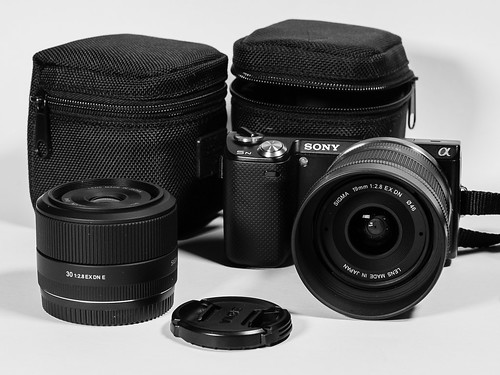
NEX-5N with Sigma 30mm and 19mm
Concept: 3 out of 5
Execution: 3 out of 5
Yeah, but: My how time flies.

The Long Version: Back in mid-February I wrote part 1 of this review with every intention of following up with part 2 in a reasonable amount of time. Sometimes life intrudes into plans, such that your idea of reasonable evolves into not what you originally intended. It's good that I'm just now getting around to writing part 2, because it's allowed me more time to work with these lenses and the NEX 5N. The singular flaw with all camera reviews is that everyone is so eager to get their review out in front of the public before anyone else that the reviews wind up reading pretty much the same and pretty thin on meaty real-world use. I don't have that excuse this time for writing a thin, meatless review.

Behind the Counter, Key West Florida, Sigma 30mm, f/2.8, ISO 2000, 1/60s

Unless a camera manufacturer is grossly incompetent (and Sigma has skirted that particular edge more than once), gear performance, and especially a lens' optical performance, is pretty much the same across contemporary lenses; that is to say, of good to excellent optical performance, even in the face of 100% pixel peeping. Personally what I want to know about a lens is more mundane, such as how well will it work in the real world under varying conditions and how well it holds up under use. I have toted the Sigmas all over a good portion of Florida since purchasing them, and under my ham-handed amateur use they have worked flawlessly and held up quite splendidly.

Conch Train, Key West Florida, Sigma 19mm, f/2.8, ISO 100, 1/800s

In part 1 of the review I talked about how, in spite of the fact the Sigma lenses lacked in-lens image stabilization, I purchased them anyway primarily because I'm so cheap and I refused to make any major (read: expensive) lens purchases for the NEX 5N. Fortunate was I to have chosen to purchases these specific lenses, simply because I didn't need in-lens image stabilization for how I use these lenses.

Under practical use the Sigma lenses shoot far above their discount cost to me. As an avowed amateur photographer I have neither a burning need nor an infinite amount of cash to purchase every top drawer lens that is offered in E-mount (such as the Zeiss Touit lenses). At $99/lens (and even double that price), the Sigma 19mm and 30mm are some of the best lenses you can purchase for your Sony NEX cameras. For photographers on a budget, a good deal of enjoyment comes from reducing the economic pressure by not tying up large sums of cash in eye-wateringly expensive camera equipment. Based on that metric the Sigma lenses are thus very, very enjoyable.

Ringer, Key West Florida, 30mm, f/3.2, ISO 100, 1/160s

An irrelevant issue that has cropped up on the various forums is the mechanical noises the lenses produce. The first noise comes from shaking the lenses, either accidentally or deliberately. Both lenses use an internal focusing element. When the NEX 5N is powered up, so is the lens, and the internal focusing elements are locked into place. Powered off the internal elements are allowed to float. I've given both a fair deliberate shake, and you can hear a soft 'thunk' as the elements hit the extremes of their travel. That noise means nothing. If all you can do is shake your camera in public to hear the lens make a noise, then perhaps you need to find another hobby.

Big Boat, Key West Florida, 30mm, f/5.6, ISO 100, 1/60s

The second irrelevant issue is the noise produced by the aperture. During focusing the aperture blades will snap open to the aperture's widest opening, the lens will focus, then the aperture blades will snap back down for proper exposure. This has been described in various fora as "lens chatter." The Sigma's aren't the only lenses to exhibit this; for example you can spend over $500 for the µ4:3rds Panasonic Leica 25mm f/1.4 and experience the exact same behavior. From a practical standpoint it means nothing to the overall operation of the lens. The noise is low enough that you have to be very close to the lens to hear it, let alone care about it.

Other than the two nit-noids just listed both lenses focus silently and very quickly, which is 99.9% of the time they're in use.

Better Than Sex, Key West Florida, 19mm, f/2.8, ISO 100, 1/3200s

The strengths of the Sigma 19mm and 30mm far out weight their perceived weaknesses. Combined with the Sony NEX 5N they create a modest but quite enjoyable compact system, especially for travel. I spent a fair amount of time just carrying and using the 5N and the two Sigma lenses. If you can find the older versions of these lenses at the discount prices then by all means pick them up. Even the more current 'Artist' versions are reasonable, given that more metal is used in their construction, even at twice the price ($199) of the first generation. The Sigma lenses really strike a nice series of compromises between image quality (very good), use of materials, construction, and overall operation. For the budget photographer who's more interested in making photographs than making a status statement, you really can't go wrong purchasing the Sigma 19mm and 30mm for your NEX camera.

Picket Fence, Key West Florida, 30mm, f/2.8, ISO 100, 1/80s
Bike Stop, Key West Florida, 30mm, f/5.6, ISO 250, 1/60s
Sunrise, Key West Florida, 30mm, f/5.6, ISO 100, 1/800
Rent Me, Key West Florida, 19mm, f/2.8, ISO 100, 1/80s
Rail Bridge, Bahia Honda, Florida, 30mm, f/6.3, ISO 100, 1/640s

Technical

All photographs taken hand-held with the Sony NEX 5N and post processed in LR 4.4 and the Nik Collection.

2013-04-20

Nikon FT-1 Mount Adapter


Concept: 2 out of 5
Execution: 2 out of 5
Yeah, but: It's the best there is.

The Long Version: I have to be fair to the FT1 lens mount adapter, since it does accomplish the task of letting F-mount lenses attach to the Nikon 1-series cameras. It provides metering and camera-based aperture control, and allows static centre-point autofocus with AF-S lenses. In Nikon's world of restricted interoperability and reduced feature sets that's really all it can be expected to do, its $270 MSRP notwithstanding. (Dealers, as usual, may sell for less.)

The main problem with the FT-1 is that even the best F-mount lenses don't really shine on the noisy CX sensors. While workable, putting a big lens on the small body is awkward, and it's made worse by the low weight limits on the 1-system lens mounts. But when used with enough compassion and forgiveness my little V1 and FT1 can produce decent results, which should be familiar territory for the fans of these little cameras.

My personal experience with the FT1 adapter has been that it doesn't really solve much of a problem. The Nikon V1 is a camera that I use for its non-photographic strengths: being small, light, and quiet, it goes to places and gets used at times when my D800 wouldn't be an option. Putting an FX or DX lens on the V1 removes its 'small and light' attributes, leaving only quietness as its main attraction, with just a limited increase in its actual photographic value.


The FT1 is a small adapter, about the size of the 10-30 or 18.5mm lenses, and it has a tripod mount that supersedes the cameras' own when a "heavy" lens is attached. And that's pretty much all of them: any lens that's over 380 grams needs to be supported when it's on the camera lest it damage the mount. This is a pretty low limit; the 85/1.8G is pushing it, and the 60/2.8G is over. But for a little perspective, my CX lens trinity – 10-30, 30-110, and 18.5/1.8 – total up to just 360 grams. It's easy to feel like Hercules when everything around you is sized for Newton.

It feels quite natural to handle the combination by the lens when there's something bigger, like the 105VR, attached. But I have to admit that I haven't always strictly followed the 'handle-by-the-lens' requirement with smaller lenses like the 60/2.8G or 50/1.4G, and have had no ill effects to date. Nikon also advises that we don't fog our lenses by breathing on them – apparently it can damage the coatings – so I suspect that their product advisories are being written by liability lawyers rather than real-world practicality experts. As always, participate in this world at your own risk.

The tripod foot on the FT1 sits flush to the camera, so any quick-release plate that projects behind the mount will need to be attached after the adapter is on the camera. Nifty.


Nikon's AF-S lenses will autofocus on the FT1 adapter, using only the central AF point and without any tracking or CAF abilities. I've been using it with the 50/1.4G, 60/2.8G, and 105/2.8VR, and the results have been pretty good. The autofocus from those three isn't quite as quick as with the native CX lenses, including in low light, which surprised me given the brighter apertures of the real Nikon lenses over the f/dark 1-series zooms.

Optical issues like distortion, corner sharpness, and vignetting are basically non-existent on the lilliputian CX sensor. I'm tempted to make a snide "only using the best part of the lens" joke, but that's just leftover bitterness from my Olympus days talking.

Nikon is working very hard to forget about the whole "AF-D" lens era, and hopes you are too, but they do make some concession to motorless lenses. Not only do they graciously permit magnified viewing on the LCD, but they even include the familiar triangle-and-dot rangefinder focusing cues on the LCD screen. This is actually much more useful on the V1 than it is on an SLR, with results that are accurate enough that I won't always use the magnified view. There's something to be said for extensive depth of field.

Manual focus and older "AF" lenses on the FT1 retain the ability to zoom in on the LCD for focus assist, but lose the rangefinder because it relies on the D-is-for-Distance chip in the lens.


One attraction of the FT1 adapter is to 'get more reach' from long lenses. To try this out I used the same lens on both the V1 and the D800, cropped the D800 frame to match the V1, and then compared the results. After a couple of rounds with the 500/4 and 105VR I will say that the D800 pulls slightly more out of a similarly cropped frame, despite putting only 4.8 megapickles on the target. (Compare crops: D800, downsampled from 1500x1000 pixels, and V1, downsampled from 2150x1500 pixels; the focus point is the left eye and bridge of his nose.)

If long-lens work was what I really wanted to do with my time – it isn't – I'd be buying a Pro DX camera like the D7100 instead of any Nikon 1. That would put almost as many pixels on the subject and provide massive usability improvements over a CX camera with the FT1 adapter.

While it's hardly a comprehensive or exhaustive comparison, I've also checked to see if there's any optical benefit in choosing an adapted F-mount lens over a native CX one. I put the Nikon 60/2.8G, which has a very good reputation, up against the 30-110 lens at 60mm. While the $600 prime macro lens did resolve a bit more detail than the $250 kit zoom, there wasn't a significant difference. This suggests that the lens isn't the limiting factor where sharpness is concerned – *cough* noisy pixel-dense sensor *cough* – so I'm not going to bother using the FT1 when there's a native lens that can do the job.


'Equivalence' sucks. That's the theory that says that the noise and depth of field from a wide-open 50/1.4 lens on a CX camera at iso100 will look about the same as a 135mm lens on an FX camera at f/4 and iso800. Looking at it that way there's no reason to use the semi-little 50/1.4+FT1+V1 setup when I could use the bigger 105VR+D800 combination, crop down for a bit more reach, and still stomp all over the V1's image quality. When I'm under-lensed my own experience tells me that using the D800 and cropping away 85% of its pixels still gives better image quality than switching the same FX lens onto the FT1-V1.

Yup, that sucks.

But that's not to say that there's no reason to use bigger lenses on the FT1. Despite their operational limitations, it does give options that the diminutive catalog of petite CX lenses lacks. Fast primes are an obvious choice, but not the only one. The small sensor is a great equalizer, so even the modest 18-55 turns in good results; this ubiquitous lens has a useful 50-150mm-ish range, and it isn't too big for the camera. Stepping up to an f/2.8 DX standard zoom keeps the great range but adds a modest ability to drop out the background, and could be an effective PJ/wedding lens. And even if the results aren't better than a heavily cropped file from a contemporary SLR, using different tools and playing with unconventional options often helps the creative process.

Anyone who uses a V1, or any CX "Nikon 1" camera, does it despite plenty of very good reasons not to. Image quality was never very high on the list of positives for the system, but the point of it is that there are times when an SLR isn't a practical, or even possible, option. Using FX or DX lenses does mostly take away its advantage of smaller size, but it remains more discreet than an SLR and keeps the advantage of silence.

I'm not about to run out and buy more lenses just to use on the adapter, but the FT1 is worth considering if there's already a CX camera and AF-S lenses in the house. I don't use it very often in either my casual day-to-day camera-carrying or my dedicated photography sessions, but it was vital in catching family photos across the winter holidays. It works no miracles, but it's not a bad thing to have just the same.


Finally, a ranting aside:

The broader problem is that Nikon's efforts to cripple the 1-system as a photographic tool extends to its attitudes toward non-Nikon lens adapters. The V1 can't magnify the viewfinder for focus confirmation, shoot in anything but manual mode, or meter the exposure. Let me repeat that last point: with a generic lens adapter the V1 is completely unwilling to meter or even preview exposure before the shot is taken. I bought an adapter for my Zeiss M-mount lenses, which match the camera perfectly, but using them is essentially unworkable in practice.

Does Nikon think that they already offer everything anyone could want, and that they can be a photographer's complete universe? Did they miss the years of Panasonic, Olympus, and even latecomer Sony selling thousands of cameras to people who want to use decades' worth of older lenses from other systems? Or have they intentionally hobbled the 1-series to drive sales of their own ill-suited lenses at the expense of their customers?

As with many of Nikon's actions, they could be motivated by hubris, incompetence or malice: it's so hard to tell.


last updated 21 apr 2013

2013-02-16

Sigma 19mm and 30mm F2.8 EX DN E-Mount Lenses, Part 1

NEX-5N with Sigma 30mm and 19mm
Concept: 3 out of 5
Execution: 3 out of 5
Yeah, but: Never look a pair of gift lenses in the aperture.

The Long Version: I've been carrying two unique mirrorless camera systems for a while now. The first is µ4:3rds consisting of my µ4:3rds cameras (E-P2, E-PL1, E-PL2, and the OM-D E-M5) as well as a fair number of µ4:3rds lenses, some of which I've reviewed on this site. The other mirrorless camera system I've been carrying since late last year has been the Sony NEX, specifically the NEX-5N, which I picked up when it dropped precipitously in price right before the NEX-5R was announced (it has risen a bit in price since then).

So why did I buy the NEX-5N with all those other Olympus Pens lying about? Curiosity mainly. When I saw the low, low price of the 5N plus kit zoom, I figured the price was low enough to give the NEX a tryout. If it turned out bad I'd resell it and go on about my business. But the 5N turned out to be pretty good actually and so I kept it around. With regards to video it's turned out something close to phenomenal (but that's a review for another time).

Unlike the µ4:3rds system, I held back purchasing any other equipment for the camera beyond the 18-55mm kit lens the 5N was sold with. I wanted to investigate what the 5N was capable of on its own merits before making any kind of equipment expansion. While I was somewhat interested in the Sigma lenses when they were released for their still photography potential on the 5N, I was growing more interested in the 5N for its video capabilities and found the kit zoom to be more than adequate for my very modest video needs.

After their announcement the Sigma lenses began an inexorable slide in price, first down to $200/lens, then $150. Sometime around late January Sigma bundled both of them together for $199 ($99.50 each), which made the lenses irresistibly attractive to a cheapskate like me, so I bought them.

The bundle price was for both the µ4:3rds as well as E-mount versions. As luck would have it, the µ4:3rds sold out fairly quickly (that's where a good majority of the mirrorless camera enthusiasts seem to be) leaving plenty of E-mount lenses for the NEX system. I wouldn't have purchased the µ4:3rds versions because I already have those focal lengths pretty well covered with other lenses I own. From my perspective the 19mm and 30mm lenses make a lot more sense on the NEX body with its APS-C sensor; the 19mm gives an equivalent focal length of 28.5mm and the 30mm an equivalent focal length of 45mm. In other words, decent wide angle and normal primes.

The Problem With These Lenses

Before you go run off and buy copies of your own, you need to know the following:
  1. These particular lenses have been discontinued, which is why they've been chopped down in price so much. Sigma has officially stated that they will be replaced with "Art" versions of these lenses in the future. And if it's an Art lens, it will cost more.
  2. These lenses do not have built-in image stabilization. That means you'll need to work on your "camera technique", another way of saying you'll have to learn how to hold your camera steady in low light when aperture and ISO won't buy you a high enough shutter speed to be indifferently held. Tripods come to mind.
And Why You'll Buy Them Anyway

None of this will bother the true budget photographer. You'll purchase your copies, appreciate their value where others might not, and learn to use them regardless. While it could be argued their introductory MSRP might have been a tad too high, they're certainly worth what they're selling for now, which is one important reason I rate them as highly as I do.

The 19mm and 30mm have features which their more costly cohorts from other manufacturers lack at this price point, such as metal bayonets and lens hoods (at least a lens hood for the 19mm).

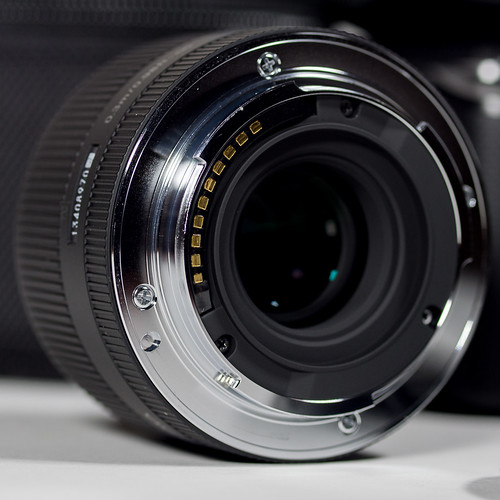
Sigma 30mm Metal Mount

Both lenses use plastics quite heavily in their makeup, and both are blessed with quality metal bayonets. When I say they use plastics quite heavily, I mean that they spare nothing in the construction of the lens, especially the lens barrel itself. Both lenses are well-built and exude a level of fit and finish above their station.

And they are wonderfully black. I am so tired of seeing and/or buying silver and silvered lenses from Olympus and Sony. I hail from the Jurassic film period of 35mm photography, where every manly lens was metal and black anodized, with etched lettering everywhere. In these modern times the black anodized and etched metal has given way to industrial plastics with silk-screened lettering. I may grouse about the use of such, but I will at least grant that Sigma's use of silk-screened plastics is better than most (I'm looking at you Olympus and Sony).

Fitting one of these primes on the 5N produces a compact and enjoyable little camera system. The matte black finish of the Sigma lenses blends beautifully with the semi-gloss black finish of the 5N. The physical handling of the combination is superb. The operational handling (focusing and picture taking) is as good as the kit zoom. And this is why I like to have one or the other prime on the 5N instead of the zoom for still photography; at f/2.8, either lens' maximum aperture is 2/3rds to two stops wider than the kit lens at equivalent focal lengths. That's great for low-light photography.

Because the Sigma primes are black and smaller than the kit zoom, the overall combination is easier to carry and more inconspicuous in use. Even if you carry both primes with you (which I do), the total space occupied with the two primes plus the 5N is no more than the 5N with the kit zoom mounted. In practice I carry one prime in one pocket and the 5N with the other prime mounted slung over my shoulder or stuck in another jacket pocket.

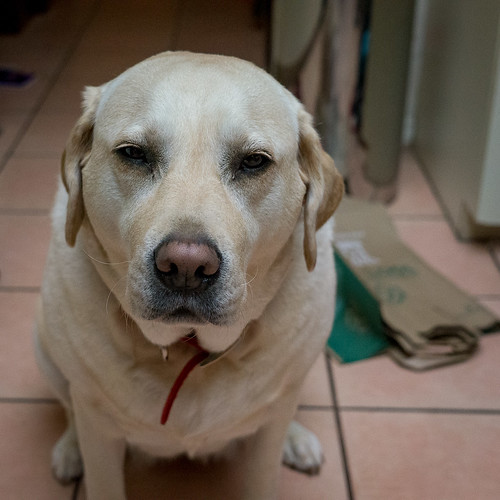
That's it for now. In part two I will speak a bit more of their operation as well as display soul-searing (or is it eye-searing?) images made with the pair and the NEX-5N. In the mean time I leave you with this haunting image I made of poor Ruby, my yellow Lab, using the Sigma 30mm and the NEX-5N.

Not Another Damn Photo Test
Oh, hell, not another test photo of me?
One day you're going to stick a camera in my face and
I'm going to grab it from you and bury it in the back yard
where you can't find it.

Technical

The hero photo at the top and the middle lens mount detail photo were taken with the Olympus E-M5 and the Zuiko Digital 50mm macro with the Olympus MMF-1 adapter. I used a pair of Fotodiox LED 312AS panels for lighting (thank you Kirk Tuck). Being lazy, I used the E-M5 instead of the E-1. And I mean lazy in that I didn't want to sit the camera on its tripod, use base ISO, and a very slow non-hand-holdable shutter speed. I hand-held the E-M5 and let it choose very high ISOs for both images (2500 for the top and 640 for the bottom). I have now put the E-1 away, and have no idea if I'll ever go back to it again.

last updated 16 feb 2013

2013-02-01

Olympus 75-300mm 1:4.8-6.7 II

M.Zuiko MSC 75-300mm 1:4.8-6.7 II zoom (photo Olympus)
Concept: 2 out of 5
Execution: 2 out of 5
Yeah, but: Here we go again...

The Long Version: You're looking at the Mark II version of Olympus' only long native µ4:3rds zoom lens of any description. You can look over at Olympus' older 4:3rds mount lenses and note Olympus has at least three to choose from; the SG 70-300mm 1:4-5.6, the HG 50-200mm 1:2.8-3.5 and the SHG 90-250mm 1:2.8. Unfortunately, not so much choice with µ4:3rds.

In the beginning all µ4:3rds Olympus zooms stopped at 150mm (14-150mm 1:4-5.6 and 40-150mm 1:4-5.6). It wasn't until the original 75-300mm was released 31 August 2010 that Olympus had a "real" zoom that gave the Pen user a long focal length that at least matched the 4:3rds reach. The problem with the original 75-300mm was the initial MSRP of $900, for what was perceived by many (including me) as small and optically slow, especially at 300mm. I for one even refused to consider buying the lens because of the cost, its slow speed (especially when compared to the 50-200mm for just $200 more) and the unforgivable lack of weather sealing, especially for a lens that cost that much.

MZD-ED75-300mm_09m_Black_XL
Original M.Zuiko MSC 75-300mm 1:4.8-6.7 zoom (photo Olympus)

At the time of the original zoom's release I was greatly unimpressed, so much that I even refused to go to a nearby camera store and even try it out.

Time passed and it would appear that the original 75-300mm languished on many a store shelf. Panasonic released it's own long zoom, the Lumix 100-300mm 1:4-5.6 zoom. The Panasonic zoom was interesting in that it was a half to two-thirds of a stop faster at both ends. Depending on who's review you read, it would appear that the Zuiko might have an edge in overall image quality, but then the Panasonic was good enough and was (and continues to be) offered for a mere $500, $400 less than the Olympus equivalent. A large majority have voted with their pocketbooks and purchased the Panasonic, while a very few, such as Torontowide, have embraced the 75-300mm and created quite good work with it. Yet here we are, 2+ years after its initial release, with the second version close to the Panasonic 100-300mm in price. Things that make you go "hmmm".

I actually need at least a 200mm native µ4:3rds lens, and the 75-300mm II is at least inexpensive enough to pull me into a camera store to try it out. Even though the optical speed is still the same slow values as before, the release of the Olympus E-M5 with excellent image quality all the way to ISO 3200 takes some of the sting out of the slowness of the zoom. Granted I would love to purchase a native µ4:3rds equivalent to the 50-200mm 1:2.8-3.5, I can live with a zoom that's one stop down from that.

Here's one for anyone who's listening in Olympus' marketing department: I would have paid $900 for the Mark I if it had been 1:4-5.6, it had come with a lens hood, and if it had been weather sealed. In fact, if they'd kept the price for the Mark II as the same for the Mark I and added weather sealing (and a lens hood) it would have drawn my credit card out of my wallet. I swear it appears form the outside that the Olympus lens engineering group and the body engineering group don't talk to one another. The E-M5 was released a year ago January 2012, which means that this new release could have been the third weather sealed lens to go with the E-M5, along with the 12-50mm and the 60mm macro. It isn't the amount of money I object to spending, it's the value for money spent. The older 75-300mm just didn't have a high enough value for the asking price, while the Mark II just barely based on the printed specifications...

I will probably try out the Mark II when it arrives on local camera store shelves, but I will not pre-order one. I'll put it on my E-M5 body and see how it performs. If its IQ is reasonable, especially at 200mm and beyond, then I'll more than likely purchase a copy. If anything, all Olympus has done is convince me to give the Mark II a try, something I never did with the Mark I.

Update 2 February

Call me fickle. I went to my local camera shop, the one that has the Mark I in black. They pulled it out and handed it to me to look at, and I have to admit it was very well built and of very high physical quality. Every seam was tight, and with the barrel fully extended to 300mm there was no play in the inner barrel. I almost broke down and and purchased it right there except someone had left a scratch (a rather noticeable divot, actually) on the front element. I guess the universe really doesn't want me to own this lens.

last updated 2 feb 2013

2012-08-24

Nikon L37c UV Filter


Concept: 1 out of 5
Execution: 2 out of 5
Yeah, but: If it makes no difference then it doesn't matter.

The Long Version: I'm generally known for only having mild and ambiguous opinions, so I should say up front that I don't agree with the premise of using "protective" clear or UV filters. But I know that some photographers swear by them, so I decided to run some tests on an old Nikon L37c filter that I had lying around. It was included with a second-hand lens, so I don't know its history, but it cleaned up nicely and was in perfect condition. I'd consider this to be a medium-to-high-quality filter, with a green reflection from its coatings.

So I broke out the gear and tested this 62mm UV filter for sharpness. The camera was on the wooden Berlebach tripod that normally holds my GX680, and I set up my target on a lighter basalt tripod. Everything was squared and levelled, with the target clamped to a right-angle Manfrotto quick release plate.


The resolution target is my usual subject: a $20 bill. These have lots of fine printing and detail, and although they may not be as definitive as an officially sanctioned resolution charts, they're a lot cheaper and I'm just comparing the results by eye. To keep it flat it's securely taped to a section of marble floor tile. Since I wanted maximum detail, I used a Nikon 60/2.8G Micro lens, kept it at about 1:2, resolution and filled the frame.

I went through a number of different variations. I used Live View to focus, I used the focusing rails with zoomed-LCD manual focus, took three exposures at each setting, used mirror lock up and a cable release, and so on.


The filter made no difference.

I couldn't tell if the filter was on the lens or not just from looking at the results. I knew from the file name and sequence, but that was all.

Now, as I said earlier, this Nikon is a decent and multicoated filter. Just the same, I was quite pleased to see no drop in sharpness in this little trial. Perhaps there's a difference that test-lab gear would be able to detect, but I'm not worrying about that too much.


The second test was for flare and ghosting. I attached an LED flashlight to the target tripod and pointed it directly at the lens. The focus is on the black bar that's in front of the light, and the lens is at f/8 – that nine-bladed circular aperture thing really works. It's also worth noting that I use the D800's cropped DX mode for the sharpness test, since I only cared about the centre, but switched back to full-frame for the flare results.

This flashlight has an inset bulb, but no lens or reflector to blur the source.

Here are the results without the filter:


And here's the same setup, with the filter:


Similar images, and both are bad, but the one with the filter is worse. (Larger: with, without.) What I notice is that the starburst around the flashlight is stronger, there's an extra reflection on the lower-right (in front of the tripod) from the additional surface, there's a halo running around the lower-left corner, and some additional flare/ghosting visible in front of the bar that's about 15cm in front of the light.

I also checked for flare with off-axis light hitting the front of the lens. I switched to a brighter flashlight and flagged it to make sure that it didn't light my test scene. Here's what the setup looked like:


And here are the results, first with the flashlight off:


Bare lens, no hood:


Lens with filter, no hood:


So here the difference matters a little more – it went from bad to worse, rather than very bad to very very bad. But I also tried a comparison with the hood on, which shaded the lens like this:


And the results, with the filter and hood both on, looked like this:


To my eye the results are indistinguishable from the photos where the light was off. I'm pretty impressed – I knew that shading the front of the lens would help immensely, but I still expected to see some additional ghosting from light hitting the inside of the hood. The 60/2.8G has pretty good coatings, but it lacks the extra crushed-velvet lining that can be found on the inside of the more deluxe hoods.

So after an interesting afternoon, I can say that this filter had no visible effect on sharpness, and while it made flare and ghosting worse, it only did it under conditions that the lens was already producing enough to be objectionable. I imagine that better filters would have less flare, and may test that with my bigger B+W MRC filter some day, but I can't see any difference mattering very much if the lens itself shows as much flare as this one has.

And no, I haven't changed my outlook on 'protective' filters, because my argument is simply that the 'protection' that they provide is illusionary and unnecessary. I'm glad that I know a little more about them for people who do want to use them, and see no harm in it if it makes people feel better. But I do know that I'll advocate for proper lens hoods more strongly than I used to.


last updated 24 august 2012

contact me...

You can click here for Matthew's e-mail address.