M.Zuiko MSC 75-300mm 1:4.8-6.7 II zoom (photo Olympus)
Concept: 2 out of 5 Execution: 2 out of 5 Yeah, but: Here we go again... The Long Version: You're looking at the Mark II version of Olympus' only long native µ4:3rds zoom lens of any description. You can look over at Olympus' older 4:3rds mount lenses and note Olympus has at least three to choose from; the SG 70-300mm 1:4-5.6, the HG 50-200mm 1:2.8-3.5 and the SHG 90-250mm 1:2.8. Unfortunately, not so much choice with µ4:3rds.
In the beginning all µ4:3rds Olympus zooms stopped at 150mm (14-150mm 1:4-5.6 and 40-150mm 1:4-5.6). It wasn't until the original 75-300mm was released 31 August 2010 that Olympus had a "real" zoom that gave the Pen user a long focal length that at least matched the 4:3rds reach. The problem with the original 75-300mm was the initial MSRP of $900, for what was perceived by many (including me) as small and optically slow, especially at 300mm. I for one even refused to consider buying the lens because of the cost, its slow speed (especially when compared to the 50-200mm for just $200 more) and the unforgivable lack of weather sealing, especially for a lens that cost that much.
Original M.Zuiko MSC 75-300mm 1:4.8-6.7 zoom (photo Olympus)
At the time of the original zoom's release I was greatly unimpressed, so much that I even refused to go to a nearby camera store and even try it out.
Time passed and it would appear that the original 75-300mm languished on many a store shelf. Panasonic released it's own long zoom, the Lumix 100-300mm 1:4-5.6 zoom. The Panasonic zoom was interesting in that it was a half to two-thirds of a stop faster at both ends. Depending on who's review you read, it would appear that the Zuiko might have an edge in overall image quality, but then the Panasonic was good enough and was (and continues to be) offered for a mere $500, $400 less than the Olympus equivalent. A large majority have voted with their pocketbooks and purchased the Panasonic, while a very few, such as Torontowide, have embraced the 75-300mm and created quite goodwork with it. Yet here we are, 2+ years after its initial release, with the second version close to the Panasonic 100-300mm in price. Things that make you go "hmmm".
I actually need at least a 200mm native µ4:3rds lens, and the 75-300mm II is at least inexpensive enough to pull me into a camera store to try it out. Even though the optical speed is still the same slow values as before, the release of the Olympus E-M5 with excellent image quality all the way to ISO 3200 takes some of the sting out of the slowness of the zoom. Granted I would love to purchase a native µ4:3rds equivalent to the 50-200mm 1:2.8-3.5, I can live with a zoom that's one stop down from that.
Here's one for anyone who's listening in Olympus' marketing department: I would have paid $900 for the Mark I if it had been 1:4-5.6, it had come with a lens hood, and if it had been weather sealed. In fact, if they'd kept the price for the Mark II as the same for the Mark I and added weather sealing (and a lens hood) it would have drawn my credit card out of my wallet. I swear it appears form the outside that the Olympus lens engineering group and the body engineering group don't talk to one another. The E-M5 was released a year ago January 2012, which means that this new release could have been the third weather sealed lens to go with the E-M5, along with the 12-50mm and the 60mm macro. It isn't the amount of money I object to spending, it's the value for money spent. The older 75-300mm just didn't have a high enough value for the asking price, while the Mark II just barely based on the printed specifications...
I will probably try out the Mark II when it arrives on local camera store shelves, but I will not pre-order one. I'll put it on my E-M5 body and see how it performs. If its IQ is reasonable, especially at 200mm and beyond, then I'll more than likely purchase a copy. If anything, all Olympus has done is convince me to give the Mark II a try, something I never did with the Mark I.
Update 2 February
Call me fickle. I went to my local camera shop, the one that has the Mark I in black. They pulled it out and handed it to me to look at, and I have to admit it was very well built and of very high physical quality. Every seam was tight, and with the barrel fully extended to 300mm there was no play in the inner barrel. I almost broke down and and purchased it right there except someone had left a scratch (a rather noticeable divot, actually) on the front element. I guess the universe really doesn't want me to own this lens.
Concept: 1 out of 5 Execution: 3 out of 5 Yeah, but: Unquestionably the best camera of 2009.
The Long Version: The Nikon 1V1 is a deeply flawed camera, and those flaws start with its name. The "Nikon 1" appellation is very difficult to search for, the "CX" format name has no traction, and the whole thing just sounds dumb. Nikon already makes three distinctly different operational tiers of SLRs, in two different sensor formats, and didn't feel the need for anything more than model names to identify them. The "1" in 'Nikon 1' is superflous and self-aggrandizing, and is probably an underlying reason why Nikon's small-sensor mirrorless format was so ruthlessly mocked by the camera intelligentsia.
Let's be clear: Nikon had it coming. From the marketing exhortation to "set your creative freedom free" to their offended "but we've been working on this for four years" stance, it's clear that they had no warning of the animosity that their 116-square-millimetre sensor and Sigma SD1-esque launch price would provoke. It was as if every camera-blogger and forum dweller had turned into Ken Rockwell, convinced of the indisputable rightness of their opinions based on something they read on the internet. I have to admit that I joined in briefly, decided that it was an evolutionarydead end, and then – like the rest of us Serious Camera People – forgot all about the system. Now, a year later, its price has dropped through the floor.
I have been mocked and derided for buying a V1, but I was shooting 4/3 sensors before they were cool. My photography has occasionally benefited from an antagonistic attitude, so the V1 suits this approach perfectly. But of course, not all of the initial scorn that the V1 faced was unwarranted. Far from it.
The V1 camera itself feels like it was designed by three different people who weren't on speaking terms. There are flashes of real brilliance here, which just makes its failings all the more frustrating.
The green 'power' light on the top of the camera is dark when the LCD is on – it's redundant, and thinking to turn it off is an elegant design touch. It's lit when the EVF is active, which is a great reminder that the camera is ready and drawing power. Yet even when the display button has been used to turn off the LCD there's no way to defeat the eye-sensor and keep the EVF active, so the EVF is always dark for a second when the camera is first brought up for use. Frustrating.
The camera's exposure compensation has a range of three stops in each direction, but there's no automatic exposure bracketing function. The camera is almost frighteningly fast to shoot, but there's no way to turn off the image review, or even to extend its duration should someone actually want to use that feature. This cripples the cameras' vaunted focusing speed and tracking. The Auto White Balance can be tuned to provide subtle colour refinement, but Active D-Lighting can only be turned on or off, with no level control. Only whole stops are available for setting a single iso sensitivity, but the auto-iso mode will use thirds of a stop increments; its ceiling can be set with three different maximum values, although it will never tell you what sensitivity it's actually using. And there aren't even any "Art" effects built in – which is a good thing, but it proves that this camera really did start its development an eon ago.
The appeal of the menu structure, which other reviewers have praised, escapes me. There's no apparent order or logic, settings that are likely to be changed frequently aren't located together, and there's no "my menu" list of recently used items to provide a shortcut. Yet the selection bar changes from yellow to red to warn the user that selecting "yes" after "format" isn't just another trifling choice. I've never seen another camera interface combining such poor execution with such thoughtful attention to detail.
It's absurd that a camera that offers pixel mapping, front and rear IR receivers for the wireless remote, and a built-in intervalometer nonetheless requires a trip into the menu to change the shooting mode. This inconsistency is my main frustration with the camera: if it was universally bad I could just write it off, but so much of it is better than this.
The V1's buttons and controls, few though they are, are still worth mentioning. Exposure compensation is one of the most useful photographic controls, and its button is the right side of the four-way pad – the three-o'clock position. It can be adjusted up or down by pressing the top or bottom of the control ring, or by rotating it like the command dial that it is. Setting a brighter exposure, which is an upwards movement of the on-screen indicator, is accomplished with a clockwise turn: that's rotating the dial "downwards" from the EV Comp button position. Completely counterintuitive.
The exposure compensation on-screen display is another of the V1's many almost-made-it design moments. It cleverly avoids clutter by only putting numbers at zero and at the ends of its range, and displays the currently selected value in white instead of black on the muted grey background. Very clear and easy to understand. But the LCD doesn't preview the effect of the change, and the V1 doesn't have a live histogram, so it's still a matter of guessing the correct setting before being able to see its results.
I'm not even going to discuss the "mode" dial – mine has been neutered by taping it in place. The only thing I really miss is having access to the better controls and options of the dedicated movie mode, and the extra few seconds to unstick the tape is a small price to pay for not accidentally using the Harry Potter or Auto-Cull modes. No, what really bothers me is that none of the three people who designed the V1 could think of a supplemental use for the dedicated "Trash" button when the camera is taking photos.
But I wouldn't take the time and effort to be this annoyed by the Nikon V1's faults if I didn't like the camera. In just a few weeks I've gone from essentially impulse-buying the deeply-discounted camera and standard zoom to owning a three-lens kit, an FT1 adapter for my full-sized lenses, and Richard Franiec's custom V1 grip. Clearly, despite its foibles and flaws, there's something very appealing about the Nikon V1 and the CX format.
After my first few weeks with the V1 I still can't decide if it's a good camera or not. It certainly has its frustrations; some of them go away when I'm using it, and others don't. There are a lot of good things going on with this camera, but I'm needing to learn how to use it in ways that I haven't faced with the many others that I own.
I have some very solid – although inevitably personal and subjective – reasons why this is exactly the right camera for what I do. I take a longer look at those, and possibly even discuss image quality, in part two.
Concept: 3 out of 5 Execution: 1 out of 5 Yeah, but: Hey, internets.
The Long Version: Here's something I don't understand: the Youtubed single-take video review. I've been shopping for a new pocketknife recently, and these things are the dominant form of experiential information about it. Let me tell you, most of them are just plain bad, and many of them are much worse than that.
Coughing, bumping the camera, um, let's see, dropping things, focus hunting or locked on the wrong thing; um, background noise, hiss and wind noise; shaky camera, um, I don't know if you guys can see this; helmet-POV, hand-on-each-side demonstrations, um, webcam, hey youtube; missed framing, drifting auto exposure, fidgeting; dumb catchphrases, um, random backgrounds; bad video and worse lighting; scantily researched, improvised, self-indulgent and rambling presentations.
Seriously, I've seen considerably higher production values – and better scripting – from some very average efforts at amateur porn.
Writing a good review is hard work: look at just how rarely I accomplish it despite my many attempts. Taking photos is also an acquired skill, and one that most casual reviewers lack. That's usually okay, since the goal is description, not art, and a still photo can be puzzled out or skipped over as the viewer prefers. But when people take a video camera out to the garage because they think that it's easier than acquiring and/or combining those two other skills, bad things happen.
Making a good video is a lot of really hard work, which is why I don't do it. I can't say that I won't ever create a video review – they have their place and can draw a lot of attention – I absolutely promise that it won't be recorded with my cellphone.
Concept: 0 out of 5 Execution: 0 out of 5 Yeah, but: I don't support link-bait; use google if you must.
The Long Version: Last week the worst individual in photography blogging, someone who has enthusiastically and unapologetically misled and misinformed for years, may have finally jumped the shark. Circa August 14th, 2012, he wrote:
'As usual, most of the people who have shifted focus-points [sic], dead-pixels [sic] or other 'widespread' problems are people who bought locally at retail. Your local dealer or chain lacks the volume of [REDACTED] and other huge online sellers, so they don't get the "A" stock that [REDACTED] does. That's another reason I buy from [REDACTED]: they don't get stuck with the samples with defects sent out to local retail stores with a lot less buying-power than the major online powerhouses.'
Obviously, I've modified the quotation somewhat, but the source is easy enough to find and specifically identifies only one retailer, whose name rhymes with 'Hadorama'. It continues:
'As a general rule, if Nikon or Canon or Sony or whoever [sic] have a few thousand cameras not quite [sic] perfect, but nowhere bad enough [sic] to scrap, they don't get sent to the top couple of dealers who sell millions and millions and millions of cameras. They customarily go to the dealers that sell only tens of thousands of cameras.'
I love conspiracy theories because they're usually unfathomably stupid, and this one is a shining example. Even setting aside all of the absurdly nefarious allegations, what he's alleging is that from the management of the quality-control division to the order pickers in warehouses and distribution centres across the globe, there is a way to identify and track units with substandard performance and choose their specific end destinations. From companies that can't meet their shipping dates in the first place.
Think about the simple logistics of this for a few minutes. This secret stock-tracking system has to be easy enough that everyone in the supply chain can use it, but precise enough to direct individual cameras in an industry that sells over a hundred and forty million units a year. That level of accuracy, let alone specificity, would be astonishing: I've never seen an inventory control system that could even keep an accurate count of the total units after a few months of shipments.
Meanwhile, this global and industry-wide deceptive business practice is enforced under a strict code of silence despite the breadth and scope of the operation. All for a mere 'few thousand units'. Does anyone really believe that 'Nikon or Canon or Sony' – or whomever – are that competent, let alone that motivated?
So with all of that out of the way, I have to admit that what I'm really fascinated by is that this link-hungry troll-whoring novice-exploiting equipmibater might have actually realized that he went too far. After all, while his opinions are frequently unfounded, they usually range only from plausible to merely wrong, and don't extend to such outrageously self-serving allegations of fraud.
While the original text remains easy to find elsewhere, the relevant passage on his personal site has been quietly changed. The entry now reads:
'As usual, most of the people who have shifted focus-points, dead-pixels or other "widespread" problems seem to have been people who tended to have bought locally at retail. I've never had any of these problems buying from [REDACTED], [REDACTED] or [REDACTED], but when people call me wondering why my phone number is in their camera, these have been people silly enough to have bought at a huge electronics chain. (Someone loaded my settings file into a camera, and then the store resold it as new, at full price.)'
All this grafted-on second idea really means is that 'huge electronics chains' aren't bright enough to properly reset a camera, and that his readers are the people dumb enough to shop at said big-box unit-shifters. (Please note that this is something he and I actually agree on.) On the other hand, my local electronics store regularly has "open box specials". I wonder what happens to the cameras that The Affiliated Three get back under their long no-risk return periods. Perhaps they're taken out back and shredded to ensure that they're never resold?
'Local dealers and retail chains lack the volume of the huge online sellers, so they probably don't get the pick of the best stock that the huge online dealers get. That's another reason I buy from [REDACTED], [REDACTED] and [REDACTED]: I doubt they get stuck with samples with defects possibly sent out to local retail stores with a lot less buying-power than the major online powerhouses. I doubt any known bad cameras ever get shipped, but if they do, who knows.'
Notice how he's shifted from alleging outright deception and conspiracy to a more bucolic 'the pick of the best stock', as if we're looking through produce at the local market instead of consumer electronics that ship by the skid. But while he no longer names names, he's not willing to back off the idea entirely – at least, not until the last sentence, where he completely folds. 'I doubt any known bad cameras ever get shipped…'
So he's engaged in blatant FUD-mongering for the sake of driving sales to the links that fund his site, all while swearing that he's unbiased because he doesn't evaluate demo units from manufacturers. (That is at least partially true: sometimes he evaluates nothing at all in the course of writing his reviews.) And when the going gets tough, when there's a stand to take, he silently edits out the worse of his lies and just leaves behind a nasty, slimy trail of insinuation.
I used to have a live-and-let-live attitude. But I work part-time in a locally owned camera store, and spent many years working in high-value warehouses before that. Not only do I know that he's wrong, I take his snide and self-serving allegations as a personal attack against my own professionalism, knowledge, and skill: it's much more than 'just' an attack that's directed at my employer, trying to drive away customers from a legitimate business that continues to exist alongside those who fund his imaginary off-shore tax-exempt empire. As far as I can see, that makes his supporters, admirers – and yes, affiliate retailers – worthy of all of the scorn and derision that used to be reserved for him alone.
Updated 21 August: Never let it be said that I'm not willing to publicly correct myself when I go too far. I've been having a conversation via Twitter with Helen Oster, a Customer Service Ambassador with Adorama. She has used phrases like 'absolutely, completely 100% not true', calls it 'pure conjecture' and puts 'his "facts"' in quotation marks. So forget that bit about subjecting his affiliates to scorn and derision – based on my small inquiries, they're not playing along with this absurd foolishness.
Concept: 0 out of 5 Execution: 0 out of 5 Yeah, but: I hope getting there isn't half the fun.
The Long Version: As a reviewer, there's a special place in my heart for companies and products that really piss me off. They have reviews that practically write themselves – and Etymotic, with their handling of Essency's "AWARENESS!® for Etymotic" iOS App, has joined this select group.
I very recently bought a pair of Etymotic's HF3 earphones, which is bundled with the downloadable "AWARENESS!® for Etymotic" iOS program by the UK developer Essency. Essentially, "AWARENESS!®" is a clever-sounding program that uses the built-in mic to monitor and optionally transmit ambient sounds. This isn't a review of the app, although that's coming up soon; a review of the earphones themselves may also eventually follow as well. For now I'm just looking at the post-purchase experience: going from the earphones' retail box to the point where the "AWARENESS!®" application is up and running.
There is also a paid "AWARENESS!®PRO" version that unlocks a few additional features. The upgrade process is straightforward, but I won't bother dealing with the anti-customer stupidity of charging $15 in the iTunes Store versus the $5 cost of upgrading through the application. I'll save that for part two.
"AWARENESS!® for Etymotic" requires an account that's created via the Etymotic website. It asks for an amazing amount of personal information, including an email address, phone number, and full mailing address. If something is omitted, don't expect it to be easy to figure out what it is – I'm hardly an idiot when it comes to this internet thing, and I lost track of the number of times I bumped into some unmarked mandatory field or missed a requirement. And incidentally, you also need to type in the UPC and the secret code that's printed on the top of the box. Awesome.
And the purpose of asking for all of this information is made perfectly clear: to create the account to register the product to be able to use the app, the lucky customer must select at least one of Ety's marketing "tell me more" checkboxes. And no, "none of the above" is not an option. Not only is that repugnantly disrespectful, I'll even bet that it's illegal in many jurisdictions.
Once you've pressed "submit" – to the invasion of privacy and blatant disregard of your wishes – you earn the ability to log in to their "free" app.
Download the app, click to log in, and it asks for a user name and password. Hold on – the password is what I laboriously created online, but there was no mention of what the user name will be. Is it my full name, which was a mandatory field? Perhaps it's the required e-mail address? Could it be something randomly generated and buried in the click-this-link verification email? I love guessing games.
I type something in and get an error message: unable to connect to network. Check your internet connection. That's not unreasonable; two bars are showing on my iPhone 4S, but I'm on the Rogers Wireless network in downtown Toronto, so failure is always an option. I move to a place with better reception and type in my first guess again. Same 'bad network' result. Now I have to consider that "AWARENESS!®" could just be an idiotic program, so I ignore the second warning and take another guess at what my user name might be. Third time lucky: now it thinks that the Internet connection is just fine and I'm in.
And no, I'm not going to spoil the surprise by saying what worked.
I'm sure someone will helpfully point out that I don't need to use the app, and that I could choose to ignore it and continue to exist in anonymity. If I did that then I would still resent Etymotic for having the audacity to ask such impertinent questions as a condition of deriving the advertised benefits of their product, but I would also feel like I'm being cheated out of some features that they promote as "included with purchase" simply because I won't accept their blatantly unreasonable terms. That's not an improvement.
What's more, the "AWARENESS!®" app is important enough to Etymotic that they heavily promote it. They market isolation as a unique product advantage for their earphones, which makes the features of the app seem useful and appealing: it's in their interest for me to want it, associate it with them, and like it. It's absolutely not in their interest for me to be so dissatisfied with the process that I investigate further and discover that Essency also markets a generic version that makes Etymotic's vaunted isolation seem much less remarkable, and come away feeling cheapened and deceived.
It takes an unconscionable amount of hubris for companies like Essency and Etymotic to demand personal information in this post-LulzSec era. Linkedin, eHarmony, and Last.fm all fell to hackers in the time that it took me to write this, but I'm supposed to trust that Essency's infrastructure and information is properly secured? Seriously? The etymotic.com/awareness/register page isn't even encrypted.
Do you follow the internet's best practices and use a unique and complex password for every little pissant product registration page? I certainly don't, and although I do try to limit the damage that can be done, it seems inevitable that these small fish are going to get fried.
I have to ask: is the risk to Etymotic and Essency of non-Etymotic-owners using the limited functions of the free app – or purchasing the $5 Etymotic version instead of the functionally identical $7 unbranded edition – so great that it's worth the liability and effort of having the registration process at all, let alone one so onerously-yet-ineffectually locked down? Is having my email address really worth what it costs?
While I'm yet to form an opinion of the application itself, I do wish that I had found the white-label version rather than following Etymotic's links. It seems to skip the registration step, and the extra couple of bucks seems like a small price to pay for avoiding all of this nonsense.
Even assuming that there is a valid reason for Etymotic and/or Essency to restrict the app via product registration, there's still no excuse for the information that they collect or the platform that they do it with. "AWARENESS!®" is already capable of accepting and confirming login information – asking instead for the UPC and box code, and skipping all of the privacy invasions and marketing hoop-jumping, would be just as (in)effective at keeping the undesirables out. Instead they choose to inflict this anti-customer bullshit on people who either already have or would otherwise like to give them money.
Etymotic, a company with a sterling reputation for sound, thinks that getting my information is so important that they're willing to make me hate them. And to what end? When I do receive their mandatory marketing material I guarantee that all it will do is remind me how much I resent them right now.
Today my earphones are shiny and new. I took the considerable effort to seek out this brand and model, and spent a big chunk of money to own them. This should be the peak of my post-purchase happiness. Instead this terrible software tie-in and registration has me writing a 1200-word rant about just how bad the experience was.
What a massive amount of hassle and effort for such a lousy reward.
Concept: 3 out of 5 Execution: 0 out of 5 Yeah, but: No review subject too small…
The Long Version: This is a review that probably could have been shortened down to under 140 characters, but I need to rant: WTF is with the D-Rings, bag designers?
I bought a cheap portfolio case the other day, and sure enough, the shoulder strap is attached to the body of the case with nylon D-rings. Within minutes of actually using the thing, the D-rings are twisted sideways and pinching the nylon webbing. I've seen this over and over again, from bags that cost enough that this kind of foolishness shouldn't be tolerated. It's not like these things are a recent innovation – why do designers and manufacturers still insist on using them so badly?
There is another question: why do people still buy anything that uses them? Frequently I forget that I'm supposed to be performing quality control on products that have made it all the way to market, and often there simply aren't any options out there. But give me a round ring to attach straps and handles, a sensible buckle, or even a D-ring that's been properly secured, and I'll buy it instead. Surely, this can't be all that difficult a problem to solve.
Concept: 1 out of 5 Execution: 1 out of 5 Yeah, but: "'Not the same thing a bit!' said the Hatter."
The Long Version: There's a lot of truly bad photographic advice out there, but I can't think of anything worse than these four simple words: Zoom With Your Feet.
The idea behind it is that moving the camera forward or backwards is equivalent to changing the focal length of a lens. It looks like it's correct; a pair of sneakers can make the subject bigger or smaller in the viewfinder. But ZWYF is an insidious oversimplification: when you move the camera, everything else changes, too.
"Zoom with your feet" fundamentally confuses perspective with proximity.
The closer something is to the camera, the bigger it looks. But moving the camera forward doesn't just enlarge the subject, it enlarges it relative to the background as well. The camera's position sets the spatial relationships within the photo, and even small movements can create huge compositional changes.
Keeping the same camera position and switching to a longer focal length doesn't change the subject's relationship to the camera or the background, it just makes it take up more of the frame. Focal length is a live-action cropping tool, a way of selecting and excluding, using the lens to create a new delineation of space. It's not just a matter of seeing farther away or squeezing more in: choosing the focal length literally defines the photograph.
Whether wide or long, different focal lengths have unique ways of seeing the world because they crop differently sized rectangles out of it. Moving closer with a wide lens doesn't make its rectangle smaller, it makes the subject bigger in it; moving back with a long lens simply does the reverse.
Subject-size and rectangle-size aren't the same things at all.
"Zoom with your feet" needs to be retired from the photographic lexicon. Every photo is a combination of the camera position and the lens's field of view, regardless of what style of lens is used. Primes and zoom lenses both have their advantages, but suggesting that changing camera position is similar to changing focal lengths does a disservice to them both.
Concept: 1 out of 5 Execution: 0 out of 5 Yeah, but: "What we've got here is (a) failure to communicate!" The Long Version: I really am glad that Photokina 2010 is finally over. I've been emotionally whip-sawed about by Olympus' announcements leading up to Photokina, first with their special E-P2 kits and two new M.Zuiko µ4/3rds zoomlenses, then with the announcement of the regular 4/3rds E-5, the follow-up to their three-year-old E-3. On the surface all those announcements sound wonderful. It's when you add the context and dig into the details that you realize it's anything but.
In happier times (15 July 2010) I wrote an opinion piece titled "Whither FourThirds?" In that editorial I wrote how I believed that Olympus knew what it was doing, that Olympus was working diligently to merge it's older 4/3rds line with its newer µ4/3rds camera line. Among other things, I wrote:
It all sounds wonderfully grim, and Olympus' critics are rubbing their hands with sadistic glee over what they see as another major Olympus failure in the making. The only problem with this delightfully grim prediction is that it's wrong. Olympus knows it can't just drop regular 4/3rds. They are painfully aware of the repercussions of another mount abandonment. If Olympus were to abandon 4/3rds then they might as well pull out of the entire camera market, because the repercussions of a second major mount abandonment would fatally taint every other camera product they would try to sell going forward...
I believe that Olympus is working hard to merge its two interchangeable lens lines into one, based exclusively around µ4/3rds. They will provide a seamless transition with existing 4/3rds-mount lenses. It's going to take time (I estimate 24 months), but we will see the road-map for this transition starting with Photokina this fall.
As I said, written in happier times, and making assumptions that have come back to haunt me.
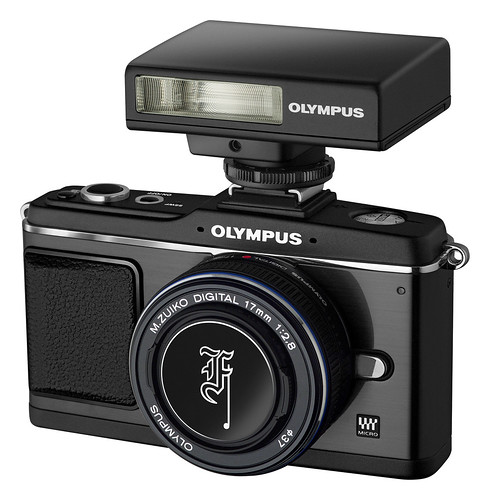
The start of my dissatisfaction came with the release of the two newest E-P2 kits. They cost more, anywhere from $200 to $350, than the original E-P2 kits released in December 2009. And for what? So that you could purchase a black version of the M.Zuiko 17mm f/2.8 with a Pen-branded lens cap, and with your choice of the VF-2 EVF or a black version of the FL-14 flash.
All new, all black E-P2 kit with fancy 17mm lens cover
and black FL-14 external flash.
What would have been far more useful to the Olympus faithful would have been an updated version of the E-P2 that included the sensor tweaks currently in the E-PL1 along with new camera firmware that allowed for faster autofocus with standard 4/3rds lenses.
Just how slow is autofocus with a regular 4/3rds lens mounted on an E-P2? Take, as an example, my ZD 12-60mm HG zoom. On my E-3, with the latest lens firmware upgrade, it snaps to focus so quickly as to be unmeasurable by anything other than fast instrumentation. Put it on my E-P2, however, and I can watch the sweep hand of my analogue watch count out two seconds before the lens finally locks onto focus. That's what I mean by slow. I'm well aware of the differences between phase detect autofocus in the E-3 and contrast detect autofocus in the E-P2 (and the other Pens as well). That's my point. Olympus could have begun to bridge between the two lines with advances in the Pens using a combination of firmware in the body and possibly a new, special adapter. Instead, we got marketing fluff.
Then came two new lenses, the M.Zuiko 40-150mm and 75-300mm. It was the later that raised my eyebrows because of its cost: a cool $900.
All new, all expensive, M.Zuiko 75-300mm f/4.8-6.3
That's a lot of cash for a mighty slow lens. I won't mention the kind of fast quality glass you can get in the regular HG 4/3rds line for that amount or a lot less. That would be pointless because of the slow autofocus performance of regular 4/3rds lenses on µ4/3rds bodies. Later in this post I'll get to why I keep harping on this point. But to continue...
Finally, on September 14th, Olympus announced to the world the new E-5. You can hit the link to read the particulars. Basically, the E-5 was pitched as an improved E-3 for $1,700, body only. Responses in the Olympus user community were almost immediate, and the majority of them weren't good. Ken Norton of Zone-10 best exemplified may reaction by writing the following:
Olympus officially introduces the new E-5. Essentially a warmed-over E-3 or an E-30 in E-3 body. Move along, people--nothing to see here.
On a personal note, I'm extremely disappointed with Olympus for two reasons:
After three years this is the best they could do?
Why didn't they do something like this with the E-1 in those four years before the E-3 came out?
Olympus, you are a creative company that has proven through the years to be the maverick in every industry you compete in. The E-5 is the opposite of what the very fabric of this company is all about.
But not all is bad. At least Olympus finally put a decent LCD on it. Way to step out!
If you are needing to buy a new pro-level Olympus DSLR, the E-5 is fine. In fact, it's probably quite good as it blends the best of the E-3 with the improved imaging capabilities seen in the E-PL1. It will definitely not be a slouch in image quality. However, it is obvious that Olympus has lost all interest in legacy FourThirds. The E-5 is a protection for existing investment in lenses and accessories, but at this point I won't be recommending any non Micro FourThirds products to anybody not already invested in the line.
Then came Simon Joinson's preview on DPReview, and these priceless pearls of witty observation:
Taking what could most politely be described as a 'considered' approach to product upgrades, Olympus has lifted the curtain on the third generation of its professional SLR, in the form of the much anticipated E-5. Olympus introduced the world to the first Four Thirds camera, the E-1, back in June 2003, and finally got round to updating it with the E-3 four years later. We got a sneak preview of the E-3's successor a couple of weeks back - we'll update this short article to a full review as soon as we get a production E-5 in the office.
It is perhaps indicative of where Olympus's priorities lie - or the way the market is headed - that whereas the E-3 took the E-1 back to the drawing board and introduced several new features, the E-5 is probably best described as a warm over of its predecessor. It's also interesting to note that it benefits from a 'trickle up' of technology from the latest developments in the company's Micro Four Thirds cameras - a situation unusual for what is, effectively, the hero product in the E-system range.
Into this swirling brew of disbelief and controversy was dumped a series of poorly translated (read: Google translated) interviews reported via other blogs where English was a second language at best. By the time the smoke had cleared on those little missives, I learned the following:
There would be no more development for new standard 4/3rd lenses. Olympus had decided, for whatever reason, that what they had was good enough, and that the E-5 would finally deliver the image quality the regular line (especially the SHG) were supposed to deliver with regards to sharpness and detail.
All regular 4/3rds DSLRs, from the E-30 on down (E-4x0, E-5x0, and E-6x0) would no longer be manufactured. The E-4x0 to E-6x0 were considered entry-level DSLRs; the Pens could easily substitute (and would be substituted) for them. The E-5 would subsume and replace the E-30 just as it was doing to the E-3.
So there you have it. Olympus showed I was wrong. They are abandoning (however slowly) regular 4/3rds. This time, unlike the OM line, they're providing a half-way transition from the 4/3rds to µ4/3rds lens mount with a mechanical adapter that pulls the electrical contacts straight through to the µ4/3rds mount. This at least gives some feedback for EXIF data as well as some control (slow autofocus, control of the aperture).
They've already started to abandon the Standard Grade lens line by reproducing many of the more popular zooms as M.Zuiko zooms (9-18mm, 40-150mm, 14-42mm, and 70-300mm (as the $900 75-300mm). None of the current Pens and M.Zuiko lenses are weather sealed. If you want weather sealed, then you're left with the lone E-5 (and remaining E-3s still in stock) with the High Grade and Super High Grade lenses.
What am I left with? A very sour taste in my mouth. I shoot primarily Olympus digital (E-3 and E-P2). I've written well of the gear I own (especially the E-P2), and it all continues to operate quite well. The problem is that this is all expensive gear that represents an investment of money and time. Quality gear costs money, and to wring the most out of that monetary investment requires a not-to-considerable personal investment of time and effort. When you make that kind of an investment in a camera brand, you expect the camera manufacturer to make a reciprocal investment in engineering, development, quality, and marketing. Especially marketing. Because, over time, I have this idea I want to add or replace what I have, based on my changing needs. And I'd like to do it with a vital brand and with it's supporting ecosystem.
I give points to Olympus engineering and quality, but their marketing is the worst I think I've ever seen. Instead of providing leadership and vision at this year's Photokina, they gave a series of scattershot interviews to a few enthusiast photography sites, then had to issue a few corrections from the Japanese mothership to tamp down the ensuing controversy. When it came to the E-5, I had to learn about its image quality via informal photographs on forums and at other enthusiast sites. The E-5 might be absolutely fabulous, the bees knees, and hold its own, IQ-wise, against the Canon 7D or the Nikon D300s at equivalent ISOs. And maybe we'll learn that when DPReview publishes its official review. But Olympus could have primed the pump with a full-court press of the E-5 including plenty of sample images and reviews ready to go at Photokina 2010. Instead they pissed away a golden opportunity.
So what about the future? As far as Olympus' future goes, I have absolutely no idea. If I had that kind of perceptive ability, I'd be super rich and this kind of a blog post would be moot. As it is I've barely enough ability to figure out my own future, much less a world-wide Japanese company's. As for myself, I have to echo Ken Norton's conclusion: I won't be recommending any regular 4/3rds equipment (body and lenses) to anyone who isn't already heavily invested. And I mean heavily invested. And I'm going to hold back my enthusiasm for µ4/3rds. Olympus' handling of regular 4/3rds and their lack of a detailed, cohesive and compelling vision regarding the evolution of regular 4/3rds to µ4/3rds has poisoned the well for all cameras for me. All I can say is, be very careful buying Olympus.
I have no idea where I might migrate to, and no desire to sit and slowly stew over all that's happened. I'd much rather go out and use the gear I've got. It still works, and works well. For me, photography is the best therapy.
Update 25 September
These are quotes from trusted sources meant to provide additional background to my rant. I wanted to document them, and then let the reader follow them and draw their own conclusions.
"Twelve megapixels is, I think, enough for covering most applications most customers need," said Akira Watanabe, manager of Olympus Imaging's SLR planning department, in an interview here at the Photo Marketing Association (PMA). "We have no intention to compete in the megapixel wars for E-System," Olympus' line of SLR cameras, he said.
Instead, Olympus will focus on other characteristics such as dynamic range, color reproduction, and a better ISO range for low-light shooting, he said...
"I personally believed, before starting the E-System, that 12 was enough," Watanabe said. "We interviewed many professional photographers, people in studios, about how many they needed in the future. Before we started, the system, we had a rough idea we'd be at a plateau at 12 megapixels. We gradually increased the pixel count," with the newer Olympus SLRs now reaching that level...
Watanabe, though, believes image sensor-based autofocus will outperform phase-detect systems in the future. That's important not just for compact cameras, but also for SLRs that today often have an awkward problem with composing a shot using the camera's LCD: when the sensor is in use to run the display, the phase-detect autofocus subsystem can't be used. That means live view on SLRs today is typically a frustratingly slow process.
"In terms of speed, phase detect is faster. But imager autofocus will exceed phase detect," Watanabe said.
And speed isn't of course the only factor. "In terms of accuracy, imager-based autofocus is much more advantageous. It directly focuses on the surface itself," the exact location where the image will eventually be recorded. "Phase detect focuses not on the real surface but on a virtual surface," the focusing subsystem reached via a moving mirror.
Imager-based autofocus doesn't require the full use of the image sensor area, so it doesn't directly increase power consumption concerns, he said. In Olympus's new midrange E-30 SLR, for example, autofocus uses only a few points on the sensor when autofocusing in live view mode.
In an interview at Photokina, reports quesabesde.com (relayed to us via 4/3 Rumors), Miguel Garcia , Marketing Managing Director of Olympus Europe, has confirmed that Olympus has stopped development of future lenses for reflex 4/3 cameras. Although the E-5 will not be the last 4/3 body, according to Garcia, Olympus will concentrate its future development on Micro 4/3. There will be a professional Micro 4/3 body in 2011, and the lower-end Micro 4/3 camera will be updated as well.
He mentioned that in Japan, mirrorless cameras have already captured 40% of the market, and he emphasized that Olympus has a big lead over some of its competitors in the development of these systems.
About Micro 4/3 lenses for the future, he said Olympus has lenses in development that will be "spectacular for all levels [of photographers], not just consumers."
Olympus will next month launch the Olympus E-5, a DSLR the firm admits may be the last of its traditional Four Thirds cameras as it signals a future without optical viewfinders.
The news appears to support controversial comments made by US DSLR manager Richard Pelkowski earlier this year.
Pelkowski had speculated that the Four Thirds system will be using a mirrorless viewfinder system within the next 24 months, as the quality of electronic viewfinders had improved so much. Speaking at the PMA trade show in the US, Pelkowski had explained that switching from a traditional mirror SLR system would save space and weight in Four Thirds cameras, and would make the incorporation of HD video functions much easier.
However, days later, Toshiyuki Terada, manager of the SLR planning for Olympus Tokyo, refuted Pelkowski's comments, telling AP that the Olympus Four Thirds camera range will continue to use mirror-type viewfinders.
Six months later, the Olympus E-5 is born, boasting the 'reliability' of the E-3 with the 'evolution' of a Pen, according to Olympus – but it could be the last E-series Four Thirds camera.
I would like to point out Olympus' past history with regards to releasing new cameras in a consistent and timely fashion; they don't. Consider the four year span between the E-1 and E-3, and the three year span between the E-3 and E-5. Or the vaporware 100mm Macro that stayed on the regular 4/3rds lens map for so long; it'll never be produced now.
So it's anybody's guess as to what Olympus may introduce in the "professional µ4/3rds" category. We may have to wait as long as PMA 2011 to find out, if ever. PMA 2011 starts in early September.
Update 26 September
On 21 September Focus Numérique posted an interview (Google translated) with Michiharu Uematsu of Panasonic. Keeping in mind this is a Google translation, the translation was clear enough to be interesting in its own right:
Digital Focus: You have to present a contrast detection autofocus very quickly. You announce that GH2 is even in some circumstances faster than some professional SLRs. Do you think these developments agree to end the autofocus system by phase correlation [system and Sony Alpha DSLR 55/33, Ed]?
Michiharu Uematsu: With our new sensor, and a new processor that analyzes 120 images per second instead of 60, we managed to make the autofocus GH2 two times faster than the previous model. In addition, the phase correlation is not very efficient with faint targets, leading to a shallow depth of field if you want a continuous autofocus, video for example. It also poses constraints of aircraft design (?) and precise adjustment of the detection system of phase with respect to the sensor is sensitive. However, on moving subjects and burst, the phase correlation is much higher...
Digital Focus: There are less than 6 months (see previous interview with Mr. Uematsu), you explain that a 12 megapixel sensor was more than enough for a camera public. Yet the GH2 now offers 16 megapixel ...
Michiharu Uematsu: Yes ... For my part, I still think that 12 MP are quite sufficient for our photographic use. In the case of GH2, it is primarily a marketing decision, not a technical choice. We must follow the market trends that impose even now augment the definition of our sensors.
In spite of the mangled translation, some of the points in the interview are clear enough. First is the doubling of autofocus performance in a contrast detect autofocus (CDAF) system. I've read several informal forum postings that the GH2's focus performance matches or exceeds that of the Canon 5D Mk2 and the E-5, which would be astounding if true. What's more interesting is the technical explanation: they have a new processor evaluating 120 frames/sec in order to achieve this. All things considered, I would expect a boost in overall power consumption, with a consequent drop in the number of exposures/battery.
What's more intriguing is the comment that Uematsu still considers 12 MP "quite sufficient", echoing Olympus' sentiments as well. I found it refreshingly honest that a representative of Panasonic admitted that the increase to 16MP was "primarily a marketing decision, not a technical choice."
Finally, there are some key statements with regards to mechanical shutters vs electronic shutters, and optical viewfinders vs electronic viewfinders. In both instances Uematsu noted they ran out of engineering resources to do a good job on both. With regards to the electronic viewfinders, Uematsu noted that "much work remains to achieve the quality of an optical viewfinder."
The problems that Panasonic ran into with the GH2 sensor and EVF probably played a critical part in Olympus' decision to remain conservative with the final design of the E-5.
Bottom line is that it appears that Olympus and Panasonic, at an engineering level, are in mutual agreement. Furthermore, pushing the envelope takes time and resources, where for practical reasons you have to choose which important problems you work on first. Finally, all these advances will take time and will cost when they are released. That means first adopters will pay a premium (as they always do), but reap the rewards earlier than more conservative users.
Video interview with Toshiyuki Terada, SLR Product Planning Manager, Photokina 2010.
Update 2 October
A second video interview with Toshiyuki Terada, SLR Product Planning Manager, Photokina 2010.
There are two new reviews that have caught my eye recently, and both are from Malaysia. The are:
The "On The Streets" review is interesting in that the reviewer finds the autofocus "extremely fast and reliable", the image quality to be "drastically" improved, and "awesome" out-of-camera JPEGs. He also expresses great appreciation for the new Dramatic art filter, which is Olympus' pseudo HDR ability. In particular, the reviewer stated
Another separate note for existing PEN users, now the E-5 can apply the Art-Filters directly with any other camera shooting modes, such as Programme Exposure, Aperture Priority and Shutter Priority. The processing speed for ALL the filters have been improved dramatically, and there was almost no lag at all shooting with Art-Filters. This is one improvement making the photographers’ life much easier, and enjoyable I must say.
The "Zuiko and E-5: Day 1" review, while less effusive, provides a series of test shots, two of which show the capability of the Dramatic art filter.
Standard image without Dramatic art filter.
Same image with Dramatic art filter applied.
Personally, I'm beginning to like what I see and hear about the camera. Some people still complain about the high initial price and the apparent abandonment of the regular 4/3rds line. I have only one comment to counter that; Leica.
I may very well wind up with an E-5 body. Or something very close to it. More to come, I'm sure.
Concept: 2 out of 5 Execution: 1 out of 5 Yeah, but: A lot can change in a year.
The Long Version: I reviewed the SX20 almost exactly a year ago, and there are a few differences this time around. For one thing, I don't own the SX30, and I never will. I also don't own the SX20 any more, having sold it after getting the GH1 which is a superzoom done right. Of course, the SX30IS has the spiffy new 35x 24-840mm-e lens with an image-stabilization system that really does work, which will be the reason why people buy it. Maybe the rest won't matter.
The other big change from the SX20 is the battery. Gone are the four AA batteries, replaced by the same proprietary rechargeable batteries that are used in the G11/G12. The lens is also lighter, making for a camera with very different handling than the previous models. For most people this will be a good thing, good enough that they'll overlook the memory card moving back into the battery compartment. That's the way most compact cameras work, and even a bad design can benefit from the comfort of familiarity.
But man, is this camera ever ugly.
The hand grip is awkward, being simultaneously angular and hard to hold. The SX20 had a substantial grip, partly thanks to the jumbo battery compartment, but the SX30 is too small for my hands without the benefit of it being a diminutive camera. While Canon's SLR's have all been borrowing from the swoopy-slabby stealth-fighter aesthetic recently, this long-zoom plastic case looks like an F22 that's crashed into the ocean, been eaten by a shark, and pooped out the far end. The mode dial is dished out in a way that's unique to the SX30, and there's a red detailing to it that adds to its disco points. And just in case you forget what camera you own, the SX30 has added another branding location on top of the flash, facing backwards, so that there's no escaping this camera at all.
Someone once said that the best the best thing about driving a Pontiac Aztek is that you can't see the cars' exterior. That gives the automotive horror a real advantage over the Canon, because looking through the SX30IS is actually worse than looking at it. It has a mediocre-average 230K 2.8" LCD screen, and the worst electronic viewfinder I've seen in years.
Bad.
Really, really bad.
The rise of mirrorless cameras has created a renaissance for electronic viewfinders. People who swore they'd never use an EVF are coming around, and many cameras have genuinely good ones. This one is nowhere near the Panasonic m4/3 options, and is years behind what Sony has on their upcoming "SLT" A55 camera. In the SX30's own long-zoom class, the arch-rival Panasonic's viewfinder is considerably better than the SX30, and even the Nikon Coolpix P100, which is otherwise an uninspiring little machine, does better. Considering how important the EVF is for controlling and aiming long telephoto lenses, this is a huge problem. Adding additional humiliation, 2003-vintage Sony F828 has a visually larger viewfinder, and it even has 30,000 dots - 15% - more resolution than the 2010 Canon camera. It's appalling. I've never said this about anything before, but from an aesthetic and ergonomic point of view, I'd rather have a Sony Alpha A330. Even people who love Sony don't like that camera - the SX30's viewfinder really is that bad.
As far as the performance goes, there's not much to say. It's a Canon superzoom, so the image quality averages out to a decent but not outstanding result. The big deal is the lens, which is longer than anything else on the market (at the moment). This is something like having a talking dog - it really doesn't matter what it says, its mere existence is remarkable. I can also say that its image stabilization works very well, holding the picture very steady even when at the monstrously long zoom extension. The photo above, of the man with his hand in his pocket as he enters an 'adult entertainment' venue, was taken from the far side of the street and hasn't been cropped at all. The camera handles its primary task as well as anyone could ask, given its intended purpose and market. Those who are able to withstand their first encounter will probably be quite happy with it, or at least grudgingly accept its compromises. But whatever you do, don't even think about buying it without trying it first.
In the immortal words of Opus the Penguin: "Okay, maybe it wasn't that bad, but Lord, it wasn't good." Time could prove me wrong. Style is personal, and some say that taste can't be taught. But man, that viewfinder stinks.
Concept: 2 out of 5 Execution: 3 out of 5 Yeah, but: You've gotta know this is going to be about photography.
The Long Version: Hats and I have a difficult relationship. I frequently like the concept, but rarely wear them; I own five already, but I'm always looking for something better. I want them for rain and sun, neither of which are common in Toronto, and they're likely to be left at home when I need them. I bought a new one for my trip to Chicago, but it got swiped in Detroit. I miss it, and have been looking for a replacement for a week now.
Shopping for a hats and I have a difficult relationship. I don't care for - about - any of the mainstream professional sports, and think it's a little weird to wear these totemic emblems of monopolistic businesses whose marketing strategy is to falsely align themselves to home-town loyalties. (Put another way: seriously, dude, you're five foot six - nobody thinks you're a basketball star.) I'm actually not a huge fan of logos in general, and it continues to amaze me when people confuse the concept of multi-billion dollar companies with "friend". While I'm both a photographer and Apple computer user, two famously brand-loyal demographics, I care about Apple or Nikon about as much as they care about me. I'm also not interested in the current fad of hats with brims that could double as a shovel or serving platter, or those fancy foil stickers that prove that the hat has never been washed. So right off the bat, almost everything is disqualified.
Ultimately, what I wanted was something simple. I already have organic cotton caps in colours that match my Domke F6 (sand) and F1X (olive) camera bags, so I was looking for something a little more upscale in black to go with my Billingham bag. And since I'm most likely to be wearing hats while using a camera, it can't make me look like a complete tool when I have it reversed.
The result is this golf-style cap with two of Oakley's logos on it. They're subtle, and I'm okay with Oakley, since they were once a pretty serious optics company. (One of its founders has used his play-money to build the camera company Red, which is one of the more interesting developments of the past decade.) I was initially worried about being too matchy-matchy, since I use Oakley frames with both my eyeglasses and sunglasses, but have since gotten over it. The hat's constructed from six panels, with the sides and rear being a mesh fabric for ventilation, but not so loose a weave that it looks like a cheap ballcap. I have worn a meshback once, but it was a fluorescent orange one from Walmart that I wore in the northern woods during deer season. I figure that makes it okay.
While the hat is predominantly light black, the trim is grey, including the underside of the brim. That gave me an idea.
I pulled out all of my grey references, and compared the results of the Lightroom eyedropper tool. I would take a white balance reading from each target, and knew that I'd gotten it right when the colour didn't change when I switched it to greyscale. The Xrite Passport and old-skool Macbeth target gave me essentially identical results, at 6650+9 and 6550+9, respectively. The Ezybalance came in at 6900k and +15 magenta, while the exposure-target-only Delta grey card was 7200+13. The camera thought the correct white balance was 6900+7; Lightroom's auto setting wanted 7500+10. The hat came in at 7750+3. So it's not exactly perfect, being too blue, but it's certainly better than nothing. Not much better, but maybe a little bit, and I'll take it if it's all I've got.
So it's a hat. I like it, and it will be something I use occasionally. Maybe I'll have it for years, and maybe it too will be gone in a couple of weeks. It's not the best I've seen, but it's pretty good. What else can I say? I needed a hat.
Concept: 2 out of 5 Execution: 1 out of 5 Yeah, but: Is it the thought that counts?
The Long Version:Coca-Cola, the American brand that dominates the soft-drink market of almost the entire world, loves to support the home team no matter where it is. To celebrate the 2010 Olympics, they issued a small number of gold cans. There wasn't much promotion that I saw, no ads or special markings on the cases, and I haven't seen them in the stores. The distinctive gold colour of these cans surprised everyone who saw them: "How old is that thing?" being the overwhelming response. They look like they've faded from been left in the sun too long.
The fine print on the cans reads "Congratulations Canadian Olympic Ice Hockey Team on Winning Gold!" It's a nice sentiment, so I know this will sound churlish, but my question is: Which one? As usually happens, both the Canadian hockey teams - Men's and Women's - won gold medals. So either they've missed the pluralization, or they missed an entire event. I hope it's just a grammatical issue, because otherwise someone's been snubbed, and I doubt it's the NHL players.
For what it's worth, 'Team Canada' also took twelve non-hockey gold medals, and I really don't think that team sports like hockey should be part of the Olympics in the first place. So perhaps I'm just snippy at a multi-billion-dollar corporation congratulating a select group of millionaires while neglecting the rest. Call it youngest-child syndrome. Even though these cans are listed on eBay for almost two dollars each, mine are gone and I have no regrets.
Concept: 1 out of 5 Execution: 1 out of 5 Yeah, but: What do we have without anticipation?
The Long Version: We live in an electronic world, and one that's constantly changing. The first day of January's 2010 International Consumer Electronics Show saw forty-five new cameras introduced - and before winter ends there's still PMA in February and CIPA's show in Yokohama in March. The only real news to come out of the 45 new me-too buzzword-compliant press releases is the tidbit that both Sony and Olympus are finally moving to SD cards in their point-and-shoots. Otherwise it's just a collection of new numbers to remember, whether they're meaningless product names or meaningless product specifications.
Press releases that do nothing but announce upcoming announcements are a continuing source of annoyance for me. I have a hard enough time keeping up with the real cameras that actually exist to bother with the constant swirls of rumour and expectations. In November (of 2009) someone told me that they weren't going to buy a Nikon D700 because Nikon had announced that there would be a product announcement in early December. The purpose of this meta-announcement wasn't clear, but the rumour mill went into overdrive. Naturally, people were expecting a replacement for the D700 - with Nikon risking decimating their sales if ample replacement product wasn't ready - just weeks before christmas. It would be either the D700x, with 24 megapickles, or the D700s, with video. The D700x has been anticipated for longer, as people would like a high-resolution camera to undercut the sales of the top Nikon in the same way that they undercut the D3 with the original - and still only - D700. But then the video-recording D3s came out, with the same resolution as the D3, so now a smaller video-capable camera is needed. Exciting times, except that 720P video just isn't good enough any more, and anything less than 1080p will make people wait for the next one.
As the eighteen-month-old D700 remains Nikon's only small-bodied pro camera, I've read one web pundit saying that it's now too late for a simple x/s model bump, and a full-fledged model number increase is in order. No doubt people will continue to not buy a great camera that would do everything that they want simply because there might be another one some day. Personally, I don't understand the willingness to not take pictures between now and then: I know that there will be another strawberry crop in July, but I'll still eat while I wait for it. Naturally, if the tools available won't do the job, or aren't affordable, then find another solution or reframe the problem. People have been taking photos, and even making videos, for years now. They must have been doing it with something.
My biggest consolation is that for everyone who's refusing to buy the right tool now because there will eventually be a new one, there's someone else who's looking for the old model because they heard that it's better. I hear requests for the 40D, D40, and/or G10 on a weekly basis. Oh, and remember that December 2009 Nikon product announcement that was supposed to be an eagerly-but-prematurely expected camera? They were taking the $5000 AF-S 300mm f/2.8VR to version 2, and their 2.0x teleconverter from version 2 to version 3. Exciting stuff.
The champions of product anticipation, and home of the RDF since 1981, is the company formerly known as Apple Computer. They have an Apple Media Event - a term which currently generates 1.23 million hits on Google - scheduled for the end of January (of 2010). There's rampant speculation and eager anticipation, among other cliches, for an Apple Tablet. Apparently that's a new form of computer whose mere possibility makes stocks hit record highs. Regardless, an Apple Tablet is something that was anticipated all the way back to early 2006, when the crowd was wowed by the iPod Hi-Fi. It was even eagerly anticipated back in 2001 when we were calling them Personal Digital Assistants. I still remember the crushing angst of the rumour sites when Apple announced a going-nowhere knockoff of Creative Labs' Nomad instead of reviving the Newton. Who knew?
If only to finally make the experts predict something else, I hope that Apple does produce a tablet computer. But if they update the Apple TV, iPod Hi-Fi, or announce a revival of the LaserWriter, I'll enjoy that too. There's always going to be another Next Big Thing to look forward to, so it's no loss either way. I'll just keep on doing what I'm doing.
Concept: 3 out of 5 Execution: 1 out of 5 Yeah, but: It's not the getting, it's the having.
The Long Version: I still remember when having a monochrome monitor that was green and yellow was the height of cool, and I still enjoy the computer games that I played on my Commodore 64 and Mac Classic. I'm hardly cutting edge; in fact, I'm of the "never too late to have a happy childhood" school. And in this case, I have a long-held envy of a friend's wicked-fast Mac IIfx that was running dual monitors. Yes, I know that my mid-2007 iMac with its 24" screen completely stomps that historical footnote, with power and pixels that are straight out of science fiction. I've still wanted a second monitor for many years.
I'd find myself standing in front of the displays in the happiest place on earth, trying to decide if I had enough room on my desk for a new toy. Invariably, I'd decide that I didn't know enough to make a good monitor choice, and would wander back to the flash drives and paper shredders. (Look for reviews of those soon as well.) The final straw was when I found some really good 'boxing day' deals on a local store's website. I started researching a few models, and that's where the trouble really started.
I'm a reasonably technical person. I know what Linux is, worked for a couple of IT companies, and enjoy finding highly complex solutions to simple problems. Within photography, I'm swimming in a sea of technical information, and even though much of it is meaningless and/or hype - Samsung calls the processor in its newest cameras "DRI Me II Pro", I kid you not - an abundance of information is out there. DPReview takes 27 pages to discuss the merits and shortcomings of the model bump of the model bump of the entry-level Nikon D40 - one of the most straightforward cameras on the market. People who think a lot about buying cameras truly did wring their hands over the Canon 50D dropping to 6.3 frames per second from the 6.6 of the 40D, and the image-quality ramifications of more megapixels. Photographic technophiles could even make the overclocking quake-benchmark-addicted slashdotter shout: "17'5 1RR3L3\/4|\|7, dUD35!". Eris knows I've come close to losing it a time or two myself.
Shopping for an LCD monitor was like hitting a wall, except that the wall is solid, impenetrable NOTHING.
Forget about trying to learn the differences between TN, IPS, and PVA technologies. The manufacturers websites wouldn't even tell me if the panels were glossy or matte. I abandoned one possible purchase after fifteen minutes of hunting for information because of a minor aside in a user review. It mentioned that not only was the height not adjustable, the panel didn't even tilt. Isn't that worth mentioning on the products' web page? It should probably be right under the note: "May Not Be Suitable For Normal Use". Perhaps my frustration is because I was mostly looking at Samsung, as I have found more useful manufacturers, but it should never have been this difficult. The best source of information, virtually by default, were the single-paragraph "I bought it and it's the most awesome / it broke and sucks in every possible way" tragicomedy of aggregated user reviews. Trying to find a decent screen was the most frustrating thing I've done since choosing a cell phone plan.
I did eventually find an affordable matte-screen PVA monitor that tilts and swivels. (Model "F2380".) Its image quality, in terms of sharpness, contrast, and nuance, isn't a match my iMac; and I've yet to be able to calibrate it to get rid of a cool shift to its mid-tones. I actually expected that last part because of something I read somewhere, and partially expected the other attributes because of my price range. The aesthetic of the display is greatly improved by some black electrical tape to get rid of a cosmetic light that flashes obnoxiously when there's no input signal. And maybe it's just me, but for some reason it doesn't use a half-inch of its screen when it's horizontal, but uses it all when it's vertical. Such is life. At least it tilts.
Since it's not good enough to be my reference screen, I've discovered that I prefer it set vertically. It takes up less room on my desk, which is no small mercy, but it's also a useful way to work. For Lightroom, I typically keep the second screen in Grid view, which speeds my sorting and ranking immeasurably. In Survey mode (top photo) it gives jumbo previews of two horizontal images, and in Loupe mode it lets me see a vertical image in all its glory. For Final Cut, it lets me mix ten stereo audio tracks in the timeline viewer without reducing the other windows to nothing (second photo), and the custom configurations can be quickly flipped to put the Viewer in the main window and still have lots of room to work. Even Spaceward Ho!, which I first played on a 9" screen, benefits from the tall arrangement. After only a week, I know I'd suffer if I had to give it up.
Concept: How good the underlying idea is. Originality counts.
Execution: How well the idea has been realized. Bad ideas can be done perfectly, and vice-versa.
Unless explicitly and prominently noted, any products or services discussed here have been bought with our own money from normal retail channels, and the opinions offered are not sponsored, endorsed, paid for, or compensated in any way.
However, there's no such thing as a truly unbiased opinion. All thoughts here are simply those of the people who write them, and should be given the appropriate consideration and viewed in the context of the individuals' experience.






 Posts
Posts



