Showing posts with label micro 4/3. Show all posts

2014-01-09

A year of LensRentals

For 364 days this year, I didn’t buy a new camera.

It’s not that I didn’t want to. I misplaced my Canon S100, which I enjoyed using. And my other digital system is a Panasonic G1 with a small collection of Micro Four-Third lenses. I like the G1, but it’s over five years old, which may as well be fifty in digital sensor years. It’s time to move on.

However, for a variety of reasons, I’m having trouble deciding what should take its place. And because you can only learn so much from reading reviews online, I’ve been leaning on Lensrentals all year to get more hands-on experience with a wide variety of gear.

What follows are some brief impressions of all the toys I played with in 2013.

Before starting, I’ll fully own up to dilettantism here. A week or two is not nearly long enough to truly judge any camera or lens, particularly with how I was flitting about between brands and formats. And the smarter use of my time would be to just use the stuff I already own. But it can also be quite a bit of fun—even inspiring—to try something new or uncomfortable every now and then. And it (usually!) doesn’t hurt to know what else is out there.

This is also something of a fool’s errand as exciting new cameras are being released faster than I can try them all out without quitting my job or selling my dog.

Finally, Google overlords be damned, I’m not putting any hyphens in product names. I’ve had to look up where they go in “OM-D E-M5” or “X-Pro1” for more often than I'd prefer to admit. It’s gone too far. I’m tired of it. I’m fighting back.

Zeiss ZM C Sonnar 1.5/50

What Matthew said.

I’m having a bit of a love affair with 50mm at the moment, and this may be the most romantic 50mm lens you can buy.

I didn’t spend nearly enough time with this one.

(Although, in my heart of hearts, I think I might be more of a 2/50 Planar type of person.)

Panasonic G5

I went long about the G5 on this very site and concluded:

The G5 checks a lot of boxes but it does so without a lot of pizazz, like an above-average PowerPoint from the accounting department.

Michael Johnston recently called it “very capable but quite bland but very capable”, which is exactly right.

The newer G6 appears to address some of my nits with the G5: the EVF got an update, you can finally (I’m told) disable the toggle button on the command dial, and the camera’s updated look is snazzier – like a mini Leica S2 instead of Frankenstein’s camera. It doesn’t look so much like the bargain that it is.

If you want an EVF and the cost of an EM5, EM1, GH3, GX7 or EP5+VF4 is a bit dear, the G6 looks like a screaming deal.

Fujifilm X100S

The adulation this camera receives is mostly justified. It looks great, feels great, and the autofocus, menu system, and control layout are light years ahead of the original X100.

Image quality is astonishing. I spent a lot of time in Lightroom gobsmacked at the detail and lack of noise at ISO 6400. The 35mm equivalent f/2 lens is well matched to the sensor. It’s also more or less my ideal walk-around setup, but that’s maybe because I’ve been walking about with a Zeiss Ikon and the 2/35 Biogon for a few years.

The aperture ring has firm whole-stop clicks that feel much nicer than the mushy third-stop clicks on the 35mm XF lens I used.

As with the XPro1, fumbling between viewfinders is still a point of friction for me. I had more fun if I forced myself to use only one and lived with its limitations. I’m also certain that with more experience I’d better be able to predict when I’m about to brush up against those limitations.

I lusted after this camera so badly … right up until I tried a Ricoh GR.

Fujifilm XPro1 & Fujinon XF 35mm f/1.4

I wrote a longer review of this pair. I'd call it tough but fair.

I would like to give the XE line a try; with only an electronic viewfinder my suspicion is that the XE will be slightly easier to use—if slightly less fun without the optical viewfinder, also.

Olympus OMD EM5

I understand why people adore this camera.

It’s a lot of camera packed into a tiny space. The pictures online can mislead you into thinking it’s the same size as any other DSLR, but hold one for yourself and you’ll probably be as astonished as I was.

The specs are great. The pictures are wonderful. The new stabilization system is a miracle worker. You can customize nearly every aspect of its operation. Everything is super responsive, with a “yessir!anythingyouwantsir!” zippiness. It’s built like a fine precision instrument: quality and choice of materials is top-notch everywhere.

Again, I totally understand why people love the little thing.

But …

(here come the emails)

… together with our oversize brains, our hands have kept us humans on top of the food chain for two million years. So it is with some alarm that I report that our hands have a new enemy: the OMD EM5.

I could not get comfortable holding it. I don’t mean it like “well the corner pokes a little” (it does) but rather much worse: it outright hurts to hold it for longer than a minute. I didn’t find the textured area on the front sufficiently grippy, the thumb rest forces your hand into a cramped position, and it’s an awkward reach to both command dials, especially the rear one. The angles are just all wrong for my hands.

(Your mileage on this will vary, but I was relieved to find out that I’m not the only one that feels this way.)

The HLD6 add-on grip helps some. But if you determine that you’ll need the grip, you might as well buy an EM1. You’ll even get a bigger, more awesome viewfinder as a bonus.

All this to say: definitely spend a decent chunk of time holding an EM5 (or any camera!) before you drop a grand on one.

Panasonic GX7

My initial impression is that this is the current Micro4/3 sweet spot in balancing handling, advanced features, customizability, performance, image quality, size, and price.

I still want to take the GH3, EM1, and maybe a G6 for a spin, but unless they really impress me I think the GX7 will be the next system camera I buy.

Pentax K5 & 35mm f/2.8 Macro Limited

I wasn’t sure such a camera existed: the K5 has all the physical controls I want in exactly the place I want them.

This includes the Pentax-specific “Green”/“*” button, which powers the ridiculously named but seriously powerful Hyper-Program and Hyper-Manual modes. Lemme tell ya: every semi-serious photographer should take those modes for a spin. Hyper-Program is your basic Program mode but with instant access to Aperture Priority or Shutter Priority, no mode dial required; Hyper-Manual gives you the stability and predictability of full Manual mode but with vastly less needle-chasing. Either might totally change how you shoot. I can’t believe other brands haven’t copied these.

The camera is solid, heavy, and reassuring for those times when you need a bigger dick to swing around. But it’s still a soft touch: the shutter and mirror are shockingly quiet for a DSLR.

As for the 35mm Macro, no one makes DSLR lenses like the Pentax Limiteds anymore. It backs up the forged good looks with excellent image quality and almost no flaws. It even has a built-in hood, which is handy. Shame it’s not weather-sealed to match the camera.

This mostly confirms my suspicion that Pentax makes the only APS-C DSLRs worth looking at.

Ricoh GV2 28mm viewfinder

It’s tiny! But I had difficulty seeing the entire frame with glasses on. So it’s not very fun.

Also you’re missing out on the toy-camera good looks of the larger GV1 viewfinder.

Pass.

Ricoh GR

Matthew’s recent ongoing praise is not even a little out of line: The GR is the smartest, best thought-out digital camera I’ve ever used. It treats an advanced photographer with respect instead of ambivalence or (too often!) hostility. Because I haven't used any of the GR's predecessors, I'm so astonished at the design and usability that the huge image quality packed into a tiny box is almost the least impressive thing about it.

A major flaw is that I don’t think I see well with a 28mm-equivalent lens. I could learn.

In fact, I better: I ordered one for keeps on New Years Eve and it showed up yesterday.

2013-02-04

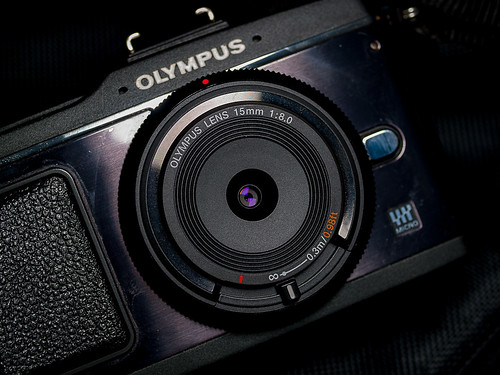
Olympus BCL-1580 15mm 1:8 Body Cap Lens

Olympus BCL-1580 Body Cap Lens
Concept: 5 out of 5
Execution: 5 out of 5
Yeah, but: So what if it's ranked 2,872nd by DxOMark.

The Long Version: There's really not a lot to say about an all-plastic µ4:3rds prime that has just three lens elements, two focusing stops, and costs a mere US$49. You can read all the more flowery prose about this optical wonder on the web by those who've purchased their copy and then written about the experience. This lens was priced so low that even I, Mr. Penny Pincher Photographer (P3), was able to buy a copy without giving it a second thought. And I can honestly say it's worth every pinched penny I spent.

In a world where Holga and Instagram seemingly reign supreme, the BCL-1580 15mm prime is a down-to-earth non-pretentious alternative that will make quite reasonable photos (given enough daylight) if you concentrate on composition and story telling instead of the affectations of ultra-sharpness, shallow depth of field, and damnable bokeh (for which there is a special place in the ninth circle of Hell for the man who coined that term).

The BCL-1580 has no autofocus. You select either the infinity hyperfocal point or the close focus point at around 1 foot from the camera. 99% of the time it'll stay on infinity. It has only two glass elements, a small outward facing lens and a slighter larger inner lens facing the sensor. The aperture is a simple hole in a piece of plastic that sits centered between the two lens elements.

Even though it's not a Zuiko branded lens, somebody at Olympus still had the good sense to at least put some simple lens coating on at least the front glass element. It doesn't need much more than that, considering its one and only aperture setting is f/8. Because it has no focus motor it absolutely has no focus noise, and with its simple hole-drilled-in-a-plastic sheet aperture it has no aperture chatter (like the far more expensive Panasonic Leica 25mm 1:1.4). When it's mounted on a Pen there is no delay in turning the entire camera on or off, thus saving battery power because you don't have to wait to turn the camera back on. And if you break the BCL-1580 or it gets stolen, so what? It's cheap enough that you can go buy a new one.

The Photographer
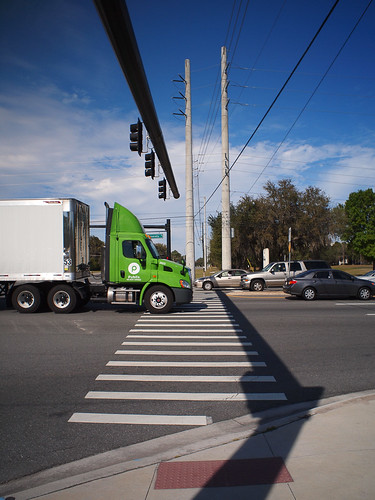
The Cross Walk
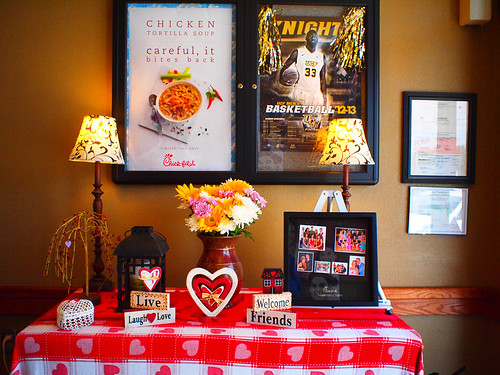
Local Chick-fil-a
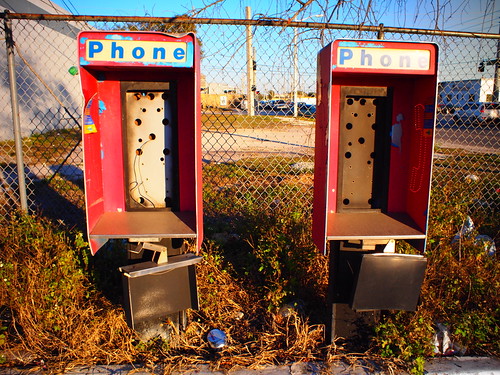
Fifteen Experiments Group 1
Streaking Home

It's a lens that will work with any Pen, from the original E-P1 to the latest Pens and OM-D. It can breath new life into a µ4:3rds body that's taken to sitting unwanted on the back shelf or unloved in the bottom of your bag. The lens, combined with any of the Pen's art filters, can produce any number of charming, interesting, Holga- and Instagram-beating photographs, with any subjects ranging from the urban core to what's left of the not-so-great out doors.

Some are want to call it the ultimate street photography lens. I use a less grandiose description; to me it's just about the best documentary lens I reach for when I want to go out and not have to worry about anything. The only other µ4:3rd lens I own that comes anywhere close is the Panasonic Lumix 14mm 1:2.5. Using the BCL-1580 strips away all vanity and pretense. It makes photographs, not a statement.

This little $49 gem is the ultimate µ4:3rds lens worth owning. If you can't use this lens and take simple enjoyment in using it, then you don't deserve to own or use any other. This is camera optics stripped down to its bare essentials. All other lenses are just more expensive and gilded versions of this little 15mm.

Technical

Top hero photo taken with an Olympus E-1 and Zuiko Digital 50mm 1:2 macro, lit by a single LED light panel. The next three photographs were taken with the 15mm mounted on my E-P2, the next four with the 15mm mounted on my E-PL1, and the last with the E-P2 + 15mm.

last updated 5 feb 2013

2012-03-05

Olympus M.Zuiko MSC Digital ED 9-18mm µFourThirds Zoom Lens


Concept: 3 out of 5
Execution: 2* out of 5
Yeah, but: A conflicted lens and a conflicted review.

The Long Version: Over a three week period, from mid-May to early June of 2011, I was given the opportunity by B&H Camera to test the Olympus M.Zuiko (MZ) 9-18mm µFourThirds lens on my Olympus E-P2 body. I used the lens to photograph my corner of the world in Orlando, Florida. All of my testing was done under available light, most of it out-of-doors. It was an opportunity to not only experience the MZ 9-18mm, but to compare it to the original Zuiko Digital (ZD) 9-18mm for regular Four Thirds which I own. So be warned that this is an “experiential” review, devoid of any technical testing what-so-ever.

Overview
Released in the first quarter of 2010, the M.Zuiko version is the second 9-18mm 1:4-5.6 zoom that Olympus has released, and the third µFour-Thirds lens after the 14-42mm and 17mm kit lenses. The first was the ZD regular Four Thirds lens a full year before that. To appreciate the difference a year can make, let’s perform a brief comparison of the two designs.

Design comparison between the two versions

While it appears at first glance there’s little to differentiate the two, a closer inspection reveals important differences. The ZD 9-18mm is built with 13 elements in 9 groups, of which three are of special glass. The MZ 9-18 is built with 12 elements in 8 groups, of which five are of special glass. Note that the diagram of the µFour Thirds shows the lens in its collapsed, or stowed, position. When extended to its operational length, the µFour Thirds version is a long as the original version, although noticeably smaller in diameter. Of greater significance is how the lenses operate.

The ZD 9-18mm is a ‘fixed’ non-expanding lens in which the front element moves in concert with the other lens groups for focusing. If you look directly at the front of the ZD you’ll notice a narrow gap between the section where the front element is mounted and the outer edge of the lens barrel where you would attach a screw-on filter. This allows the front element to freely move while focusing. In contrast the MZ version’s front element is a solid part of the outer barrel; only the central element moves for focusing. It’s this design that contributes to the MZ’s ability to focus quickly and silently (more on that later).

What the diagrams can’t convey are the major differences in the two lenses overall size and weight. The original 9-18mm has an 80mm diameter (requiring 72mm filters) and weighs 280g. The µFour Thirds version has a 57mm diameter (requiring 55mm filters) and weighs 155g. Those differences in size and weight are profound when mounted on a µFour Thirds body such as the E-P2. Whether retracted or extended for use, the µFour Thirds MZ lens truly belongs on a µFour Thirds body such as the E-P2. The original 9-18mm lens, with its required adapter, does not.

Operations
My first exposure to the Olympus collapsing lens design was with the MZ 14-42mm Mk 1 kit lens. It came as part of the E-P2 bundle. The purpose of the collapsible design was to create a package that was easily transportable. I won’t say pocketable, because unless you’re wearing a large coat with large pockets, the E-P2 with kit lens won’t fit into any kind of regular pocket I’m aware of.

The µFour Thirds 9-18mm is a collapsible design like the M.Zuiko 14-42mm Mk 1 kit lens. What is interesting is that the M.Zuiko 9-18mm lens, both collapsed and extended for use, has the same lengths as the M.Zuiko 14-42mm Mk 1 kit lens in its collapsed and extended modes. If you’re comfortable with the kit zoom you’ll have no issue with the MZ 9-18mm.

A less-pleasant aspect of the MZ Mk 1 kit lens is its inexpensive construction. You know when you’re opening and closing that lens; you hear it clicking and can feel it as it moves from stowed to operational position. And once deployed, various elements of the 14-42 are, shall we say, not quite mechanically tight.

Not so with the MZ 9-18mm. It extends and collapses with silent smoothness. I could barely feel the lens barrel as it moved across the mechanical switch. Unlike the kit zoom, there was no flexure of the zoom ring whatsoever. From the time I put the lens on the E-P2 until I took it off to send it back to B&H, the operation of the zoom mechanism was smooth as silk and for all practical purposes totally silent.

Focusing
There are two aspects to focusing with this lens; speed and silence. Among the alphabet soup of letters on the MZ barrel there are three new letters to designate new capabilities for this lens compared with all other Olympus lenses: MSC. MSC, or Movie and Still Compatible, is the latest µFour Thirds lens designed specifically for both video and still photography.

As I mentioned earlier the MZ 9-18mm has a different internal focusing design from it’s regular Four Thirds ancestor. That design allows for quick and silent focusing operation. While it was mounted on my E-P2 it was the fastest focusing lens, faster than any of the µFour Thirds lenses I’ve used to date.

It was also the absolute quietest. For testing purposes I used am EMA-1 external microphone adapter with the ME51S dual electret condenser stereo microphone plugged directly into the adapter. The microphone sat directly above the lens. I put the E-P2 into video with autofocus, and swung the camera back and forth a number of times from a near object to infinity. On playback of the recorded video I could not hear the lens focusing at all. My copy was totally silent. All my other lenses make a mess of the sound being recorded with the video.

General Photography
You can find all sorts of charts and learned opinions about the optical quality of the lens all over the web. The question is, does it really matter? How does the lens behave under standard operating conditions, especially when compared to the first version?

One of my first acts with the purchase of my E-P2 was to purchase the Olympus Four Thirds to µFour Thirds adapter, the MMF-1. I used the adapter to test my regular lenses on the E-P2 body, specifically the 9-18mm. While the autofocus operation of the lens wasn’t ideal, I couldn’t fault its image quality. With the MMF-1, the ZD 9-18mm was as well behaved optically on the E-P2 as it was on my E-3.

I can’t say that about the M.Zuiko version. Both lenses are slow, with a maximum aperture of f/4 at 9mm. As a consequence I tend to shoot the regular Four Thirds lens wide open as much as possible. If I do stop down it’s usually to f/5.6, at which point the lens become a constant aperture zoom for all practical purposes.

When I tried to use the M.Zuiko version in the same fashion as the regular version, I found center sharpness of the MZ version was indistinguishable from the original, but  I was disappointed in the noticeable corner softness of the MZ lens, especially when close focusing. My original version was much sharper. Stopping down to f/5.6 helped, but I didn’t achieve the same level of sharpness with the MZ version until I'd stopped down about a stop and two-thirds to f/7.1. Those differences tended to minimize as the lens was used for regular distance photography (outside architecture and landscapes). The corner issues began to show up when shooting interiors wide open, such as small to medium sized rooms, or something down close like flowers. Then I could see the difference.

With either lens wide open there is some vignetting, more so with the MZ than the ZD versions. But considering you can add vignetting to your photos during post processing with applications such as Adobe’s Lightroom, I find concerns about lens vignetting somewhat amusing. It might be there but for all practical purposes it’s irrelevant.

Barrel and pincushioning are complex on this lens. While I can certainly find situations to point them out, I don’t find it particularly noticeable. When I do there’s Lightroom to fall back on to clean it up.

Chromatic aberration, if it does show up, only shows up around the edges under extreme light contrast. Once again, if it is noticeable it can be cleaned up in post.

All of these comments presume you shoot raw and post process. For those who want SOOC images, just realize your mileage will vary, and you should probably borrow a copy and see if you can live with its JPEG output.

Recommendation
This lens is best suited for videographers who want to use this lens for creating movies with the Pens and who feel they need a zoom lens that zooms to 9mm. Its totally silent operation is a boon to those particular videographers.

For still photographers, the best group this lens would serve are those who again need 9mm in a zoom lens and place a premium on light weight for travel and/or outdoor hiking, or for those photographers in settings where they wish to be as discrete as reasonable. This lens’ small size and silent operation are a great help in those areas.

For my own personal use I’m not so sure. The question you’re probably thinking is “Bill, would you buy this lens?” And my answer is “No.” I won’t buy it due to its higher than expected cost, especially for a lens that is heavily composed of plastic. Its overall quality is certainly head and shoulders above the 14-42mm kit lens, but it didn't have far to stretch. I’m not interested in paying more for the M.Zuiko version than I did for the Zuiko Digital, especially when the M.Zuiko is considerably smaller and lighter (using less materials in manufacture). Add to that my dissatisfaction with the M.Zuiko’s image quality under certain conditions, conditions in which the original is a stellar performer, and I find I’m not inclined to spend the money. You can argue my sample copy might have had mechanical issues with regards to image quality in the corners under those peculiar circumstances, but that doesn’t answer my criticism with regards to size-vs-price.

What would be the "ideal" price be for this lens? Probably around $400, not the $600 or more I’ve seen it advertised for. For what you can spend on the MZ 9-18mm you can pick up two faster Panasonic pancakes, or Olympus’ lovely 45mm with plenty of change to spare. If you’re intent on spending that much on the 9-18mm you should at least consider two alternatives, the Olympus 12mm 1:2 or the Panasonic 7-14mm 1:4. They both cost more, but these are lenses that are worth the investment. In my opinion, the M.Zuiko 9-18mm at its current price point, not so much.

Apologia
This review has been a long time coming. It was originally destined for another µFourThirds enthusiast site. That site owner set up a sweet deal where I would get equipment on loan from B&H for 30 days, enough time to use it and then review it. The MZ 9-18mm was to be the first of many µFourThirds lenses. I thought I'd hit the big time.

But as I got to know the lens I realized I couldn't give it a sweeping recommendation like I originally thought I would. Just as I've written, I had the original FourThirds 9-18mm lens and found it to be a sweet little performer. I expected no less from the µFourThirds version. But for me it didn't turn out that way.

That left me in a real ethical quandary. How could I pan an expensive piece of kit that was given to me? I'm sure a lot of other reviewers don't have this problem, but being very new to this I had no idea what to do. As a consequence it took quite a while for me to write it before sending it to the site owner who'd originally commissioned it. In the end the site owner allowed me to publish the review here. And before you ask, it's an excellent site, and they're not pushing for rosy reviews on gear. It's just me with the hangups.

This is the first and last piece of free kit I'll ever review. Every other review of gear on this blog (or my own) has been and will be bought and paid for by me. Normally I pepper my reviews with sample photographs taken with the item under review. This time, if you want to see the results of what I shot, you can follow the link to my Flickr set and judge for yourself: http://www.flickr.com/photos/wbeebe/sets/72157626668272915/

* It is now a qualified 2 (think of baseball). I relented somewhat based on the conversation in the comments and thinking about it for a while. Even though it's been raised from a 1, I still won't rush right out and buy a copy.

last updated 8 march 2012

2012-01-29

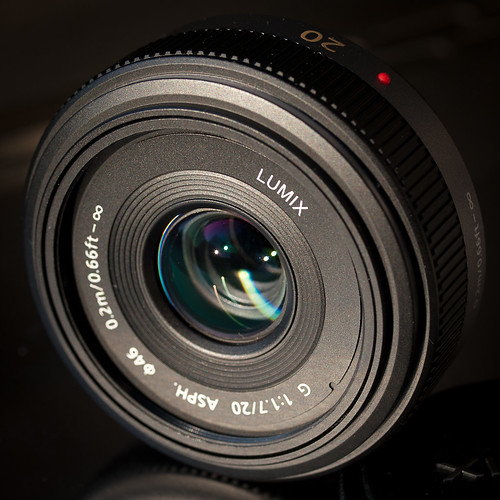
Panasonic Lumix G 20mm F1.7 ASPH.

Panasonic 20mm Side

Concept: 4 out of 5
Execution: 3 out of 5
Yeah, but: So what took me so long?

The Long Version:

This is the second review of this lens. Matthew wrote the first, an excellent review when he purchased his copy over a year and a half ago. Rather than repeat what he wrote, I'll refer you to his review. I'll wait here while you go and read it.

I first considered the 20mm when Matthew wrote his review. Unfortunately the price at that time for the 20mm was its MSRP of $400, or $150 more than the Olympus 17mm. So being the cheap guy that I am I purchased the 17mm and went off happily using it for all sorts of subjects, none the wiser.

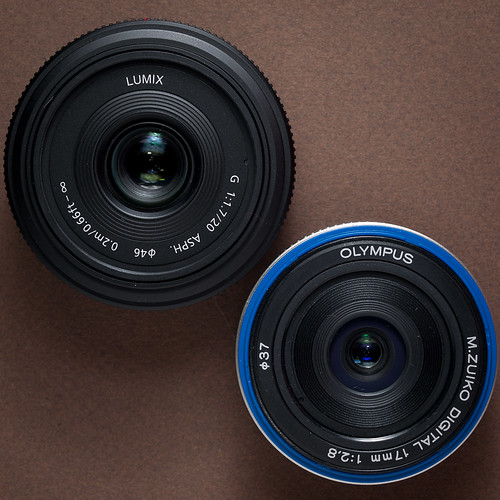
Panasonic 20mm and M.Zuiko 17mm
Panasonic 20mm on the left, Olympus 17mm on the right,
minus its front cosmetic outer ring.

I even wrote a review about the 17mm not long after Matthew wrote his 20mm review, extolling the 17mm's virtues. Over the period I've owned the 17mm I've certainly taken my fair share of photographs with it. Yet, in spite of its lower price and slightly smaller size, there's one key feature that the Panasonic has that's superior to the 17mm; the 20mm is one-and-a-half stops faster than the 17mm. This feature alone makes it superior to the 17mm in very low light situations or situations where excellent separation of foreground subject from background is needed. When the price of the 20mm dropped to near $300 this past December, I finally purchased a copy for myself.

Self Portrait - First Light 20mm
Self portrait - First Light 20mm

As I mentioned one of the two key features I found attractive about this lens is its separation of foreground and background in a very tiny package. When the 20mm arrived the first thing I did was slap in on my E-P2, set it to f/1.7, turn the camera back around to face me and fire off this lovely portrait. Look at the larger version (if you can stand to) and you'll note that elements in focus in the center part of the image are quite sharp and clear, such as my glasses frame, the dirt on my face, and the strands of my thinning hair straggling down over my furrowed brow. I also like the way that focus quite rapidly drops off, which you can see on the shoulders of my t-shirt. I've quickly come to appreciate the quality of this lens wide open, and make it a habit to shoot with it wide open as much as possible.

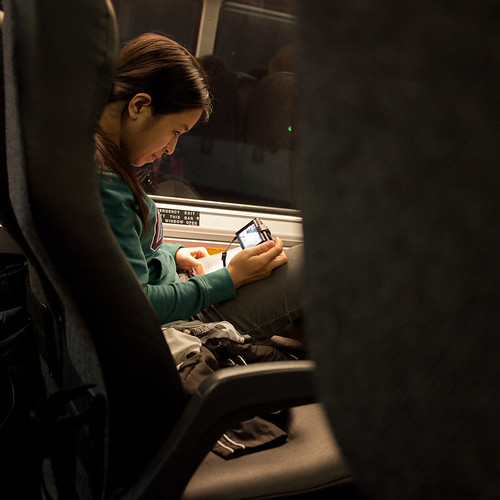
Chimping Her Camera

The lens' wide aperture of f/1.7 comes in handy in low-light situations. In this photo I was able to keep the ISO down to 400, which is only one stop faster than the E-P2's base ISO of 200. If I'd had the 17mm I would have had to move it up to ISO 1,000, where noise begins to show up. I know what's been written elsewhere about the E-P2's high ISO performance and how it's acceptable up to ISO 1,600, but it's been my experience to keep ISO as close to base as possible. So I juggle shutter speed, f-stop, and ISO in these situations, giving priority to keeping the ISO as low as practical. It's a shooting methodology I've had since my first days of 35mm film. After over 40 years of photography I much prefer to shoot no higher than ASAISO 400.

Welcome to Lake City Florida

Another feature I've come to appreciate with this lens is its apparent lack of barrel distortion or pin cushioning regardless of the aperture setting. The 17mm has noticeable pin cushioning wide open (f/2.8), which begins to clean up one stop down and is almost completely gone by f/5.6. But the 20mm doesn't have any to speak of, which makes shooting architecture a real joy, particularly when you don't have to clean up any distortion in post. And if you think you see distortion above, let me assure you that the concrete sidewalk in front of that Greyhound station is actually warped.

Tifton

The 20mm also has a different color character from the 17mm. I can't quantify what is different about the 20mm, but I like the colors that come out of the 20mm mounted on the E-P2. While the 17mm is quite capable of producing great color under the same lighting, I have to give the nod to the 20mm.

Ride 'em Cowboy

The 20mm makes for a superb all-around travel lens, capable of rendering exquisite detail between f/5.6 to f/8 in broad daylight. The photo above was taken with the E-P2's ISO set to 200. The 20mm coupled with the dynamic range of the sensor at this ISO can produce some pretty remarkable results.

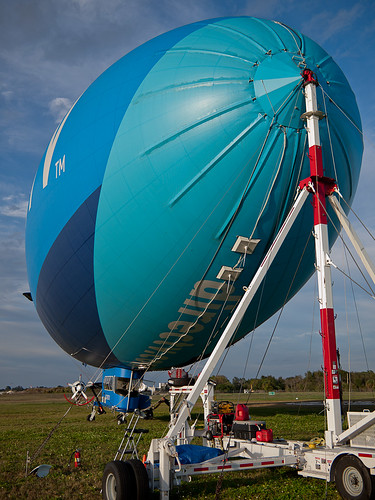
Blimp Starboard Mooring

Although the field of view of the 20mm is definately less than the 17mm (57° vs 65° respectively), it's still wide enough that with careful composition you can dramatically photograph large objects such as the DirecTV blimp. In the photo above the 20mm was stopped down to f/2.8 and ISO once again set to 100. The lighting, the dynamic range, and the depth of field, coupled with the focal point gives the appearance of sharp focus from the mooring tower to the airship's tail. Yet the background is out of focus enough to help hold the viewer's attention on the airship. I can honestly say I could not have achieved this level of image quality with the 17mm at its widest, f/2.8.

Conclusions

As good as the Olympus 17mm is, especially stopped down, the Panasonic 20mm is better, especially when you realize that the 20mm is already closed down 1 1/2 stops at f/2.8. While the 17mm is physically smaller, it's only barely so.

The 20mm actually gives exposure "breathing room" to the E-P2, allowing it to be used at lower ISOs more consistently than with any other µ4/3rds lens except the M.Zuiko 45mm 1:1.8 (which I also now own) and the M.Zuiko 12mm 1:2. And with the drop in price of the 20mm bringing the price differential between the 17mm and the 20mm to less than $100, there's no real reason to purchase the 17mm independent of the 20mm any more.

There's also the issue of build quality. I've groused about this already, but I'll say it again; ever since the early 1980s starting with Olympus OM equipment I've never had bits fall off of any Olympus lens, except for the 17mm. While I was on a trip to Boston last March the front outer ring over the blue plastic you see on the 17mm above simply fell off and onto the ground. I heard it hit but never found it in the street. The 17mm still functions, but the idea of something just falling off bothers me and gives the lens a bad mark in my book. The 20mm looks and feels better built than the 17mm. Hopefully nothing will fall off the 20mm during normal use.

I'm glad I have the 17mm, and I'm glad I had it for as long as I did. It served yeoman duty and was the most used lens of all my regular and micro 4/3rds lenses. But I've got the 20mm now, and it's going to cut into the use of the 17mm considerably, and that seems a bit sad. I wish that Olympus had released an f/2 version of the 17mm, and beefed it up a bit, but Olympus was apparently working on the M.Zuiko 12mm 1:2. At its current price of around $700, I don't think I'll be picking up a copy any time soon, so the 17mm will take the spot the 12 would have if my budget would allow it.

When Matthew wrote his review back in 2010 he called the Panasonic 20mm "the single best lens available for micro four-thirds cameras." While it now has to contend with the Olympus M.Zuiko 45mm and 12mm lenses, it still holds its own quite well with those two lenses. It isn't that the Panasonic 20mm is any worse for the Olympus lenses, it's that Olympus has finally stepped up its game to at least match the 20mm. The 20mm is still well worth the purchase, especially as part of a trifecta composed of the 12 and 45mm lenses.

last updated 29 january 2012

2012-01-27

M.Zuiko Digital ED 40-150mm f4.0-5.6 R

M.Zuiko 40-150mm R on E-P2

Concept: 3 out of 5
Execution: 3 out of 5
Yeah, but: It's just dandy for what it sells for.

Background:
Olympus has a habit of re-introducing two zoom lenses repeatedly. One lens is the 14-42mm 1:4-5.6 kit lens. The other zoom lens that Olympus has released repeatedly is the 40-150mm zoom. It first appeared along with the 14-45mm when the Olympus E-300 was introduced. It was a rather large lens with an aperture range of f/3.5 to f/4.5.  As large as it was I used mine on my E-300 quite a bit and with good effect.

While it was an excellent performing lens for the price, the biggest complaint heard from all over the 'net was how big and heavy it was. When Olympus introduced the E-5x0 series of 4/3rd cameras, it cut the size of the Mark 1 down considerably and gave it a slower maximum aperture range of f/4.0-5.6, producing the Mark 2.

The Mark 2 lens remained a staple of the Olympus stock lens kits for the remainder of the E-4x0/5x0/6x0 manufacturing run. I wouldn't call it popular, but it was certainly ubiquitous, so much so that Olympus sold a combination of the Olympus MMF-2 4/3rds to µ4/3rds and the Mark 2 lens for use with the E-P2. That's the combination I purchased, direct from Olympus, for a modest $199.

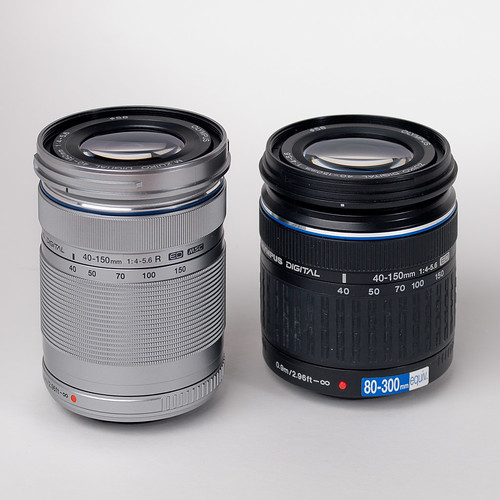
Zooms at 40mm
"R" version on the left (4th version), Mark 2 on the right

I used the Mark 2 quite a bit, both with the E-P2 as well as with my E-3. It was slow to focus on the E-P2, but it was decent enough and helped me to grab good shots when I needed to with the E-P2. And for $200, I got an affordable and adaptable short telephoto zoom. But it wasn't a native µ4/3rds lens. I wanted a native version of the lens if for no other reason than to get a lens with better autofocus speed on the E-P2.

So I waited a bit and sure enough Olympus released a Mark 3 version of the lens that was native µ4/3rds mount. It was engineered to focus quietly and given the MSC (Movie & Still Compatible) moniker. As a consequence the price moved up to $300. Olympus released it with a plastic bayonet mount (like they'd done with the Mark 2). I didn't feel inclined to spend $300 on a lens that didn't have a metal bayonet mount. The M.Zuiko 17mm, which sold for less, had one, and my M.Zuiko 14-42mm Mark 2 kit lens had one as well.

Eventually Olympus released a Mark 4 version when they released the E-P3, this time with the 'R' designation. The 'R' differences from the Mark 3 were a faster focus motor and different lens coatings. And the price went up slightly yet again. This past December, when Adorama surprisingly offered the silver 'R' version for $160, the clamp around my credit card loosened and I purchased a copy for myself.

Build and Performance

Physically the 'R' version is slightly narrower in diameter, but slightly longer, than the Mark 2. It's also lighter. In the hand the 'R' version feels better built than the Mark 2 version, but I wouldn't categorize the Mark 2 version as poorly built. The bayonet is plastic (as it was with the Mark 2 and Mark 3 versions), but it mounts snugly and tightly on the E-P2. How long it will continue to do this I have no idea.

The 'R' version, compared to the Mark 2 with adapter mounted on the E-P2, is blazing fast when it comes to autofocus speed on the E-P2.  Because of its very light weight it balances quite well in the hand, even when zoomed out to 150mm.

M.Zuiko 40-150mm 'R' at 150mm


You'll note that I have the VF-2 mounted on the E-P2. If you intend to use the 40-150mm at 100mm or longer, then you're going to want to use the EVF to help focus and compose. Using the LCD on the back at the longer focal lengths only makes sense if you have the E-P2 on a stable platform, such as a tripod. Otherwise you're going to see the image jump and dance all over the place. The EVF gives you a third point, your head, to help stabilize the whole assemblage (the other two points being your left and right hands).

With my copy I noted that the zoom ring was tight, almost too tight. With its light weight you won't have zoom creep if the lens is pointing down. Focus is focus-by-wire, which isn't all that good or bad. I've yet to have to manually focus this lens, as the 40-150mm and E-P2 always seem to pick the point I want to focus on.

I can't get over how silently this zoom focuses. It's fast and silent focusing performance is a spoiler. The only other lens that focuses this way is the M.Zuiko 45mm, which is also an MSC lens. In bright outdoor light it's a joy to use when it's needed.

Examples

I've taken enough photos with the 'R' version to come to the conclusion that it's as good a performer, IQ wise, as every other version I've owned and used. In bright light and stopped down around a stop the lens will produce nice, clean, crisp, well-colored photos with plenty of detail.

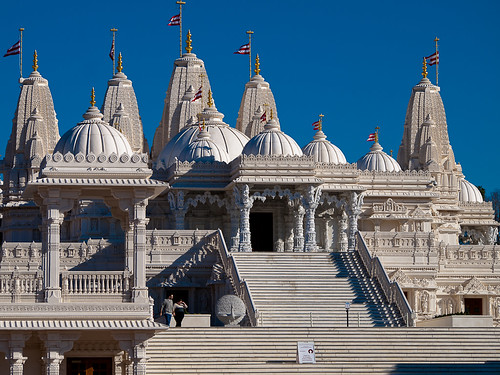
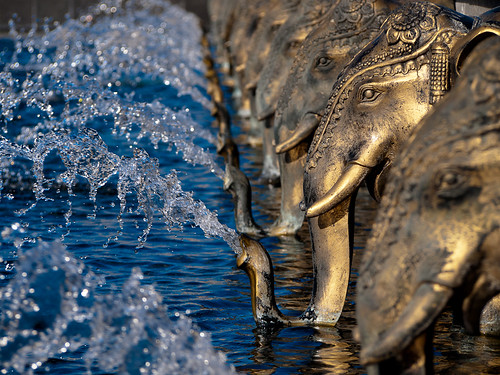
BAPS Shri Swaminarayan Mandir
BAPS Shri Swaminarayan Mandir, Atlanta, Georgia, USA
BAPS Shri Swaminarayan Mandir
BAPS Shri Swaminarayan Mandir, Atlanta, Georgia, USA
Link-up
MetLife Blimp docking, Orlando, Florida, USA

While the lens can produce good detail, it's not going to give you the same level of performance of a zoom that's five times its cost (or higher). The image of the tender getting ready to latch the airship to its mooring tower shows the limit of its resolution. This photo was taken late afternoon. If you look closely you'll see the line that connects the tip of the airship, through the tip of the mooring tower, and then back off to the right. It doesn't look quite sharp enough, not enough separation from the background sky. It would have looked better with the 50-200mm but then again, if I had the 50-200mm mounted on the E-P2 it would have handled very awkwardly, and you can rest assured it wouldn't have focus locked nearly as quickly as the 'R' version on the E-P2.

Conclusion

Remember that this is a $200 zoom lens, not the equivalent of the Zuiko Digital 50-200mm SWD (or any of the SHG zooms). But then, it's roughly 1/5 the cost of the 50-200mm and quite a bit smaller and lighter. This is the kind of lens you want in your kit to make your kit as small and light weight as possible.

The Travel Kit
Clockwise from top: M.Zuiko 40-150mm R, M.Zuiko 45mm,
M.Zuiko 17mm. E-P2 in center with Panasonic 20mm.

Look at my modest E-P2 kit, and you'll see my copy of the 40-150mm peeking out from behind the E-P2. It's a great little lens for the money, the kind you carry with you on impulse without having to worry about the consequence of it being too heavy or too expensive if something happens. In the right light it works quite well. It is, in my opinion, the best utility zoom for the money, especially if you can purchase it for $200 or less. Especially less.

Technical

I use Olympus, and all different kinds of Olympus. The two photos of the 40-150mm mounted on the E-P2 were taken with the E-1 and Sigma 30mm 1:1.4. The first image was a JPEG taken out of the E-1 and cropped in post 1:1. The photo of the two 40-150mm lenses as well as the kit photo were taken with the E-3, the ZD 50mm, and a pair of FL-50Rs, one in an Apollo 42" reflector and the other using a Rogue FlashBender.

last updated 27 January 2012

2010-09-24

The Future and Olympus

The all-new, all-wet Olympus E-5 DSLR

Concept: 1 out of 5
Execution: 0 out of 5
Yeah, but: "What we've got here is (a) failure to communicate!"
The Long Version: I really am glad that Photokina 2010 is finally over. I've been emotionally whip-sawed about by Olympus' announcements leading up to Photokina, first with their special E-P2 kits and two new M.Zuiko µ4/3rds zoom lenses, then with the announcement of the regular 4/3rds E-5, the follow-up to their three-year-old E-3. On the surface all those announcements sound wonderful. It's when you add the context and dig into the details that you realize it's anything but.

In happier times (15 July 2010) I wrote an opinion piece titled "Whither FourThirds?" In that editorial I wrote how I believed that Olympus knew what it was doing, that Olympus was working diligently to merge it's older 4/3rds line with its newer µ4/3rds camera line. Among other things, I wrote:
It all sounds wonderfully grim, and Olympus' critics are rubbing their hands with sadistic glee over what they see as another major Olympus failure in the making. The only problem with this delightfully grim prediction is that it's wrong. Olympus knows it can't just drop regular 4/3rds. They are painfully aware of the repercussions of another mount abandonment. If Olympus were to abandon 4/3rds then they might as well pull out of the entire camera market, because the repercussions of a second major mount abandonment would fatally taint every other camera product they would try to sell going forward...

I believe that Olympus is working hard to merge its two interchangeable lens lines into one, based exclusively around µ4/3rds. They will provide a seamless transition with existing 4/3rds-mount lenses. It's going to take time (I estimate 24 months), but we will see the road-map for this transition starting with Photokina this fall.
As I said, written in happier times, and making assumptions that have come back to haunt me.

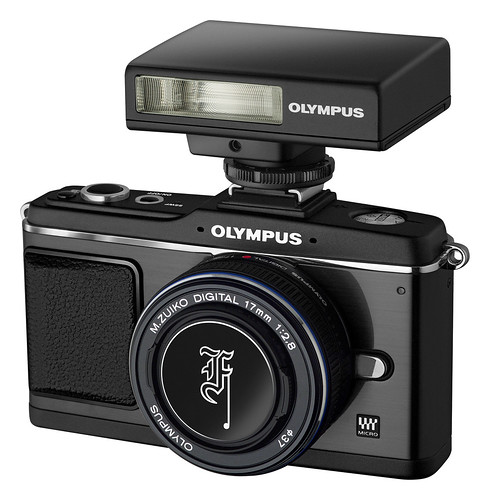
The start of my dissatisfaction came with the release of the two newest E-P2 kits. They cost more, anywhere from $200 to $350, than the original E-P2 kits released in December 2009. And for what? So that you could purchase a black version of the M.Zuiko 17mm f/2.8 with a Pen-branded lens cap, and with your choice of the VF-2 EVF or a black version of the FL-14 flash.

E-P2_rightside_black_closed_kit_XL
All new, all black E-P2 kit with fancy 17mm lens cover
and black FL-14 external flash.
What would have been far more useful to the Olympus faithful would have been an updated version of the E-P2 that included the sensor tweaks currently in the E-PL1 along with new camera firmware that allowed for faster autofocus with standard 4/3rds lenses.

Just how slow is autofocus with a regular 4/3rds lens mounted on an E-P2? Take, as an example, my ZD 12-60mm HG zoom. On my E-3, with the latest lens firmware upgrade, it snaps to focus so quickly as to be unmeasurable by anything other than fast instrumentation. Put it on my E-P2, however, and I can watch the sweep hand of my analogue watch count out two seconds before the lens finally locks onto focus. That's what I mean by slow. I'm well aware of the differences between phase detect autofocus in the E-3 and contrast detect autofocus in the E-P2 (and the other Pens as well). That's my point. Olympus could have begun to bridge between the two lines with advances in the Pens using a combination of firmware in the body and possibly a new, special adapter. Instead, we got marketing fluff.

Then came two new lenses, the M.Zuiko 40-150mm and 75-300mm. It was the later that raised my eyebrows because of its cost: a cool $900.

MZD-ED75-300mm_09m_Black_XL
All new, all expensive, M.Zuiko 75-300mm f/4.8-6.3
That's a lot of cash for a mighty slow lens. I won't mention the kind of fast quality glass you can get in the regular HG 4/3rds line for that amount or a lot less. That would be pointless because of the slow autofocus performance of regular 4/3rds lenses on µ4/3rds bodies. Later in this post I'll get to why I keep harping on this point. But to continue...

Finally, on September 14th, Olympus announced to the world the new E-5. You can hit the link to read the particulars. Basically, the E-5 was pitched as an improved E-3 for $1,700, body only. Responses in the Olympus user community were almost immediate, and the majority of them weren't good. Ken Norton of Zone-10 best exemplified may reaction by writing the following:
Olympus officially introduces the new E-5. Essentially a warmed-over E-3 or an E-30 in E-3 body. Move along, people--nothing to see here.

On a personal note, I'm extremely disappointed with Olympus for two reasons:
  1. After three years this is the best they could do?
  2. Why didn't they do something like this with the E-1 in those four years before the E-3 came out?
Olympus, you are a creative company that has proven through the years to be the maverick in every industry you compete in. The E-5 is the opposite of what the very fabric of this company is all about.

But not all is bad. At least Olympus finally put a decent LCD on it. Way to step out!

If you are needing to buy a new pro-level Olympus DSLR, the E-5 is fine. In fact, it's probably quite good as it blends the best of the E-3 with the improved imaging capabilities seen in the E-PL1. It will definitely not be a slouch in image quality. However, it is obvious that Olympus has lost all interest in legacy FourThirds. The E-5 is a protection for existing investment in lenses and accessories, but at this point I won't be recommending any non Micro FourThirds products to anybody not already invested in the line.
Then came Simon Joinson's preview on DPReview, and these priceless pearls of witty observation:
Taking what could most politely be described as a 'considered' approach to product upgrades, Olympus has lifted the curtain on the third generation of its professional SLR, in the form of the much anticipated E-5. Olympus introduced the world to the first Four Thirds camera, the E-1, back in June 2003, and finally got round to updating it with the E-3 four years later. We got a sneak preview of the E-3's successor a couple of weeks back - we'll update this short article to a full review as soon as we get a production E-5 in the office.

It is perhaps indicative of where Olympus's priorities lie - or the way the market is headed - that whereas the E-3 took the E-1 back to the drawing board and introduced several new features, the E-5 is probably best described as a warm over of its predecessor. It's also interesting to note that it benefits from a 'trickle up' of technology from the latest developments in the company's Micro Four Thirds cameras - a situation unusual for what is, effectively, the hero product in the E-system range.
Into this swirling brew of disbelief and controversy was dumped a series of poorly translated (read: Google translated) interviews reported via other blogs where English was a second language at best. By the time the smoke had cleared on those little missives, I learned the following:
  1. There would be no more development for new standard 4/3rd lenses. Olympus had decided, for whatever reason, that what they had was good enough, and that the E-5 would finally deliver the image quality the regular line (especially the SHG) were supposed to deliver with regards to sharpness and detail.

  2. All regular 4/3rds DSLRs, from the E-30 on down (E-4x0, E-5x0, and E-6x0) would no longer be manufactured. The E-4x0 to E-6x0 were considered entry-level DSLRs; the Pens could easily substitute (and would be substituted) for them. The E-5 would subsume and replace the E-30 just as it was doing to the E-3.
So there you have it. Olympus showed I was wrong. They are abandoning (however slowly) regular 4/3rds. This time, unlike the OM line, they're providing a half-way transition from the 4/3rds to µ4/3rds lens mount with a mechanical adapter that pulls the electrical contacts straight through to the µ4/3rds mount. This at least gives some feedback for EXIF data as well as some control (slow autofocus, control of the aperture).

They've already started to abandon the Standard Grade lens line by reproducing many of the more popular zooms as M.Zuiko zooms (9-18mm, 40-150mm, 14-42mm, and 70-300mm (as the $900 75-300mm). None of the current Pens and M.Zuiko lenses are weather sealed. If you want weather sealed, then you're left with the lone E-5 (and remaining E-3s still in stock) with the High Grade and Super High Grade lenses.

What am I left with? A very sour taste in my mouth. I shoot primarily Olympus digital (E-3 and E-P2). I've written well of the gear I own (especially the E-P2), and it all continues to operate quite well. The problem is that this is all expensive gear that represents an investment of money and time. Quality gear costs money, and to wring the most out of that monetary investment requires a not-to-considerable personal investment of time and effort. When you make that kind of an investment in a camera brand, you expect the camera manufacturer to make a reciprocal investment in engineering, development, quality, and marketing. Especially marketing. Because, over time, I have this idea I want to add or replace what I have, based on my changing needs. And I'd like to do it with a vital brand and with it's supporting ecosystem.

I give points to Olympus engineering and quality, but their marketing is the worst I think I've ever seen. Instead of providing leadership and vision at this year's Photokina, they gave a series of scattershot interviews to a few enthusiast photography sites, then had to issue a few corrections from the Japanese mothership to tamp down the ensuing controversy. When it came to the E-5, I had to learn about its image quality via informal photographs on forums and at other enthusiast sites. The E-5 might be absolutely fabulous, the bees knees, and hold its own, IQ-wise, against the Canon 7D or the Nikon D300s at equivalent ISOs. And maybe we'll learn that when DPReview publishes  its official review. But Olympus could have primed the pump with a full-court press of the E-5 including plenty of sample images and reviews ready to go at Photokina 2010. Instead they pissed away a golden opportunity.

So what about the future? As far as Olympus' future goes, I have absolutely no idea. If I had that kind of perceptive ability, I'd be super rich and this kind of a blog post would be moot. As it is I've barely enough ability to figure out my own future, much less a world-wide Japanese company's. As for myself, I have to echo Ken Norton's conclusion: I won't be recommending any regular 4/3rds equipment (body and lenses) to anyone who isn't already heavily invested. And I mean heavily invested. And I'm going to hold back my enthusiasm for µ4/3rds. Olympus' handling of regular 4/3rds and their lack of a detailed, cohesive and compelling vision regarding the evolution of regular 4/3rds to µ4/3rds has poisoned the well for all cameras for me. All I can say is, be very careful buying Olympus.

I have no idea where I might migrate to, and no desire to sit and slowly stew over all that's happened. I'd much rather go out and use the gear I've got. It still works, and works well. For me, photography is the best therapy.

Update 25 September

These are quotes from trusted sources meant to provide additional background to my rant. I wanted to document them, and then let the reader follow them and draw their own conclusions.

c|net News, 5 March 2009, "Olympus: 12 megapixels is enough for most folks":
"Twelve megapixels is, I think, enough for covering most applications most customers need," said Akira Watanabe, manager of Olympus Imaging's SLR planning department, in an interview here at the Photo Marketing Association (PMA). "We have no intention to compete in the megapixel wars for E-System," Olympus' line of SLR cameras, he said.

Instead, Olympus will focus on other characteristics such as dynamic range, color reproduction, and a better ISO range for low-light shooting, he said...

"I personally believed, before starting the E-System, that 12 was enough," Watanabe said. "We interviewed many professional photographers, people in studios, about how many they needed in the future. Before we started, the system, we had a rough idea we'd be at a plateau at 12 megapixels. We gradually increased the pixel count," with the newer Olympus SLRs now reaching that level...

Watanabe, though, believes image sensor-based autofocus will outperform phase-detect systems in the future. That's important not just for compact cameras, but also for SLRs that today often have an awkward problem with composing a shot using the camera's LCD: when the sensor is in use to run the display, the phase-detect autofocus subsystem can't be used. That means live view on SLRs today is typically a frustratingly slow process.

"In terms of speed, phase detect is faster. But imager autofocus will exceed phase detect," Watanabe said.

And speed isn't of course the only factor. "In terms of accuracy, imager-based autofocus is much more advantageous. It directly focuses on the surface itself," the exact location where the image will eventually be recorded. "Phase detect focuses not on the real surface but on a virtual surface," the focusing subsystem reached via a moving mirror.

Imager-based autofocus doesn't require the full use of the image sensor area, so it doesn't directly increase power consumption concerns, he said. In Olympus's new midrange E-30 SLR, for example, autofocus uses only a few points on the sensor when autofocusing in live view mode.
The Online Photographer, 20 September 2010, "Olympus to End Development of 4/3rds Lenses":
In an interview at Photokina, reports quesabesde.com (relayed to us via 4/3 Rumors), Miguel Garcia , Marketing Managing Director of Olympus Europe, has confirmed that Olympus has stopped development of future lenses for reflex 4/3 cameras. Although the E-5 will not be the last 4/3 body, according to Garcia, Olympus will concentrate its future development on Micro 4/3. There will be a professional Micro 4/3 body in 2011, and the lower-end Micro 4/3 camera will be updated as well.

He mentioned that in Japan, mirrorless cameras have already captured 40% of the market, and he emphasized that Olympus has a big lead over some of its competitors in the development of these systems.

About Micro 4/3 lenses for the future, he said Olympus has lenses in development that will be "spectacular for all levels [of photographers], not just consumers."
The Amateur Photographer, 14 September 2010, "OLYMPUS E-5: THE LAST FOUR THIRDS DSLR CAMERA?":
Olympus will next month launch the Olympus E-5, a DSLR the firm admits may be the last of its traditional Four Thirds cameras as it signals a future without optical viewfinders.

The news appears to support controversial comments made by US DSLR manager Richard Pelkowski earlier this year.

Pelkowski had speculated that the Four Thirds system will be using a mirrorless viewfinder system within the next 24 months, as the quality of electronic viewfinders had improved so much. Speaking at the PMA trade show in the US, Pelkowski had explained that switching from a traditional mirror SLR system would save space and weight in Four Thirds cameras, and would make the incorporation of HD video functions much easier.

However, days later, Toshiyuki Terada, manager of the SLR planning for Olympus Tokyo, refuted Pelkowski's comments, telling AP that the Olympus Four Thirds camera range will continue to use mirror-type viewfinders.

Six months later, the Olympus E-5 is born, boasting the 'reliability' of the E-3 with the 'evolution' of a Pen, according to Olympus – but it could be the last E-series Four Thirds camera.
I would like to point out Olympus' past history with regards to releasing new cameras in a consistent and timely fashion; they don't. Consider the four year span between the E-1 and E-3, and the three year span between the E-3 and E-5. Or the vaporware 100mm Macro that stayed on the regular 4/3rds lens map for so long; it'll never be produced now.

So it's anybody's guess as to what Olympus may introduce in the "professional µ4/3rds" category. We may have to wait as long as PMA 2011 to find out, if ever. PMA 2011 starts in early September.

Update 26 September

On 21 September Focus Numérique posted an interview (Google translated) with Michiharu Uematsu of Panasonic. Keeping in mind this is a Google translation, the translation was clear enough to be interesting in its own right:
Digital Focus: You have to present a contrast detection autofocus very quickly. You announce that GH2 is even in some circumstances faster than some professional SLRs. Do you think these developments agree to end the autofocus system by phase correlation [system and Sony Alpha DSLR 55/33, Ed]?

Michiharu Uematsu: With our new sensor, and a new processor that analyzes 120 images per second instead of 60, we managed to make the autofocus GH2 two times faster than the previous model. In addition, the phase correlation is not very efficient with faint targets, leading to a shallow depth of field if you want a continuous autofocus, video for example. It also poses constraints of aircraft design (?) and precise adjustment of the detection system of phase with respect to the sensor is sensitive. However, on moving subjects and burst, the phase correlation is much higher...

Digital Focus: There are less than 6 months (see previous interview with Mr. Uematsu), you explain that a 12 megapixel sensor was more than enough for a camera public. Yet the GH2 now offers 16 megapixel ...

Michiharu Uematsu: Yes ... For my part, I still think that 12 MP are quite sufficient for our photographic use. In the case of GH2, it is primarily a marketing decision, not a technical choice. We must follow the market trends that impose even now augment the definition of our sensors.
In spite of the mangled translation, some of the points in the interview are clear enough. First is the doubling of autofocus performance in a contrast detect autofocus (CDAF) system. I've read several informal forum postings that the GH2's focus performance matches or exceeds that of the Canon 5D Mk2 and the E-5, which would be astounding if true. What's more interesting is the technical explanation: they have a new processor evaluating 120 frames/sec in order to achieve this. All things considered, I would expect a boost in overall power consumption, with a consequent drop in the number of exposures/battery.

What's more intriguing is the comment that Uematsu still considers 12 MP "quite sufficient", echoing Olympus' sentiments as well. I found it refreshingly honest that a representative of Panasonic admitted that the increase to 16MP was "primarily a marketing decision, not a technical choice."

Finally, there are some key statements with regards to mechanical shutters vs electronic shutters, and optical viewfinders vs electronic viewfinders. In both instances Uematsu noted they ran out of engineering resources to do a good job on both. With regards to the electronic viewfinders, Uematsu noted that "much work remains to achieve the quality of an optical viewfinder."

The problems that Panasonic ran into with the GH2 sensor and EVF probably played a critical part in Olympus' decision to remain conservative with the final design of the E-5.

Bottom line is that it appears that Olympus and Panasonic, at an engineering level, are in mutual agreement. Furthermore, pushing the envelope takes time and resources, where for practical reasons you have to choose which important problems you work on first. Finally, all these advances will take time and will cost when they are released. That means first adopters will pay a premium (as they always do), but reap the rewards earlier than more conservative users.

Video interview with Toshiyuki Terada, SLR Product Planning Manager, Photokina 2010.


Update 2 October

A second video interview with Toshiyuki Terada, SLR Product Planning Manager, Photokina 2010.


There are two new reviews that have caught my eye recently, and both are from Malaysia. The are:

The "On The Streets" review is interesting in that the reviewer finds the autofocus "extremely fast and reliable", the image quality to be "drastically" improved, and "awesome" out-of-camera JPEGs. He also expresses great appreciation for the new Dramatic art filter, which is Olympus' pseudo HDR ability. In particular, the reviewer stated
Another separate note for existing PEN users, now the E-5 can apply the Art-Filters directly with any other camera shooting modes, such as Programme Exposure, Aperture Priority and Shutter Priority. The processing speed for ALL the filters have been improved dramatically, and there was almost no lag at all shooting with Art-Filters. This is one improvement making the photographers’ life much easier, and enjoyable I must say.

The "Zuiko and E-5: Day 1" review, while less effusive, provides a series of test shots, two of which show the capability of the Dramatic art filter.

Standard image without Dramatic art filter.

Same image with Dramatic art filter applied.

Personally, I'm beginning to like what I see and hear about the camera. Some people still complain about the high initial price and the apparent abandonment of the regular 4/3rds line. I have only one comment to counter that; Leica.

I may very well wind up with an E-5 body. Or something very close to it. More to come, I'm sure.

2010-05-01

Quick Thoughts on Lenses for Micro Four Thirds Cameras


The Long Version: This is a quick look at the various lenses that can be put on a Micro Four Thirds camera. It's inherently incomplete, since they are able to wear just about anything, but it will be quietly updated from time to time. While I've had the opportunity to use all of these lenses on at least one m4/3 camera, my experience generally isn't much deeper than what anyone could get in a helpful camera store. I just happen to spend a lot of time in one, and I have a blog.

For a more general guide to lens selection, don't miss the exceptional article "The Uses and Application of 35mm Lenses", written by Mike Johnston.


GF-1 and 14-140, photo by GH1 with Olympus 17/2.8

Panasonic 7-14mm: An amazing lens, the equal of the D.Zuiko Olympus 7-14 but half the size. Highly recommended if you have a dusting cloth. (compared and reviewed)

Panasonic 8mm Fisheye: A pancake fisheye - it's a fishcake! Just as useful as a regular fisheye, but it takes up much less room when left in the camera bag.

Olympus 9-18mm: While the focal length isn't as stunning as the 7-14mm, it's more practical. The box it comes in is smaller than the Panasonic ultrawide, but in use they're similar lengths; the collapsing design means that the zoom and focus rings are a bit crowded.

Olympus 14-42mm: Compact when it's carried, large when it needs to be - what's not to like? Perhaps it's not as sharp as the Panasonic equivalent, but that's not really its point.


Blue and Red, GH1 with Panasonic 20/1.7

Panasonic 14-45mm: Longer but not as wide - physically - as the M.Zuiko 14-42, the G Vario is still deceptively small and very good. It has quick and quiet AF, but it also extends a lot through its zoom range.

Panasonic 14-140mm: A heavy lens that takes a bit of torque to get moving, it's the best of all of the superzooms for any format, for what that's worth.

Olympus 14-150mm: The difference in build and weight is enough to tell this apart from the 14-140 while blindfolded, but the biggest difference is that it isn't stabilized. Buy it to match an Olympus body, but try to save for the 14-140 for a Panasonic body.

Olympus 17mm f/2.8: I'd be really afraid of losing this lens in the padding of most camera bags. It's tiny, which is even more exaggerated by the ultra-slim tail cap and front cap that Olympus uses. Optically, compared to the Panasonic 20/1.7, at least it's much smaller. (reviewed)

Panasonic 20mm f/1.7: Sharper, faster, with less distortion and less chromatic aberration than the M.Zuiko 17/2.8, that lens would have been much more popular if this one hadn't come along. Perhaps a little over-hyped, but still the better of the pair. (reviewed)


GF1 and 45-200, photo by GH1 with 20/1.7

Panasonic 45mm f/2.8: This is an interesting idea: a macro lens with internal focus and no distance or magnification scale. It's not a good idea, but it is interesting. There's absolutely no way to tell where it is in its long focusing range. Otherwise, it's a great lens that shows its Leica influence by being twice as expensive as it should be.

Panasonic 45-200mm: A generous minimum focusing distance makes this a surprisingly practical lens; someone much smarter that I am hasn't been impressed by the effectiveness of its image stabilization.


Yonge Street Rain, GH1 with Nikon 50/1.8

Via adapters:

Olympus 12-60mm: An interesting alternative standard zoom, but since it's bigger than the 14-140 and won't autofocus on a Panasonic body, it's a solid second choice.

Nikon 35mm f/2.8 PC-Shift: An older lens that's designed for manual focus and stop-down metering, it's perfect for the smaller format. The 'sweet spot' crop and live-view focus and exposure solves almost all of the traditional problems of perspective control lenses. A great option, if a 70mm-e field of view shift lens is your kind of thing.


GH1 and 35/2.8, photo by Olympus E-1 with 50/2

Nikon 50mm f/1.8: The Voigtländer adapter is about the same size as the lens, and costs more, too. As an f/2.8 lens with an emergency low-light setting, its performance is good; definitely worth getting if you already have the adapter. (reviewed)

Leica 50mm f/0.95 Noctilux: If you can afford this lens, you might as well buy a m4/3 camera just to give your M9 a rest. Nothing's in focus anyway, so have fun.

Zeiss ZM 50mm f/1.5 C-Sonnar: A quirky lens, its size and manual focus design is a perfect match for the m4/3 cameras. Stop it down to at least f/5.6 for sharp results, or leave it wide open for more fun.

Olympus 50mm f/2: Definitely worth getting the adapter if you already have this lens - it's the best macro option by price. The fly-by-wire electronic focus works well for fine macro adjustments, and the auto-stop-down and auto-focus-magnification of the electronically coupled lens is much simpler than the manual options. (reviewed)

Olympus 50-200mm (mk I): A nice, bright telephoto with auto-aperture and auto-MF-assist on the GH1, but no autofocus, and I miss the image stabilization of my E-3. If I really needed this lens, I'd buy the 45-200 instead. I could happily live with the slower lens in exchange for the modern conveniences.


Lensbaby box, photo by GH1 with Lensbaby Composer

Lensbaby Composer: Yes, but why?

Lensbaby 3G: As above, but harder to use. (reviewed)

Nikon 85mm f/1.8: A wonderful lens, fast and sharp, and not too big for the GH and G series Panasonic bodies. A $450 170mm-e fast telephoto with a five-year warranty - if it wasn't manual focus, we'd happily spend twice as much for it. (reviewed)


G1 and Nikon 85/1.8, photo by GH1 with 14-140

Nikon 80-200mm: A very tempting idea, but verges on the ridiculous in actual use. With a tripod it becomes useable, but it's still ridiculous.

Tamron 70-300mm: This seems like a joke. In Nikon mount, the lack of an AF motor keeps it off of the cheap bodies, and the lack of image stabilization makes it a bad choice for anyone who can afford better. A highly undesirable lens, even though it sells for about what the 50/1.8 costs. But for us, it turns into a 600mm-equivalent f/5.6 ultra-telephoto. Sure, it needs to be stopped down and put on a tripod, but set up next to someone with a 600/5.6 on a full-frame body some time. Surprisingly good for the price.


Nikon 50/1.8 on Voigtländer adapter, photo by GH1 with 20/1.7

Nikon 80-400mm: Not nearly as bad as I expected from the reviews that I've read, either on a D700 or m4/3 camera. For the micro bodies, though, its VR is an unnecessary expense and the lens only makes sense if there's also a Nikon AFD-compatible camera in the family. However, it is one of the very few lenses this long with an aperture ring.

Nikon 105mm & 135mm f/2 DC: The Defocus Control lenses are interesting ideas that are a little tricky to use, but the counterpoint is that the added complexity of fully-manual operation doesn't make it that much more difficult. Big for the camera, but sharp, fast, long lenses that will really suit some specialized photography.


Steel Building, GH1 with 35mm PC-Nikkor

Nikon 135mm f/2.8: An older non-AF lens, it has a tremendously long focusing throw and is surprisingly compact. Not as sharp and contrasty as modern lenses, older designs give a different look to the photos that can be quite appealing. But if pure optical performance is your thing, then this isn't it.

Nikon 180mm f/2.8: This is a very tempting lens - a 360mm-e f/2.8 telephoto that can still slip into a small-to-medium bag. Optically it's very nice, with good sharpness and low chromatic aberrations; the built-in hood is a nice touch. Its manual focus throw is extremely long (almost 180 degrees around a large barrel) and surprisingly refined.

Sigma 180mm f/3.5: A macro lens with a lot of working distance, this one is great for stacking with extension tubes and getting 2:1 magnification, or even more. It's a very different animal than the D.Zuiko 50mm f/2, and don't expect to use it as a 360mm-e lens for hand-held photography, but once it's on a tripod it's very powerful. Too bad about the chromatic aberration, though. (reviewed)


Last Updated: 19 August 2010. 

2010-03-05

Panasonic GH1 and 14-140 Lens


Concept: 3 out of 5
Execution: 3 out of 5
Yeah, but: It's even more fun than it looks.


The Long Version: It all started with the Olympus E-330. That ugly duckling was the first SLR that could be used, awkwardly, like a cheap point-and-shoot. But even though it was lightly mocked at the time, 'Live View' has since been integrated - more or less - into most SLRs. And for years Panasonic has been supplying these revolutionary sensors to their Four Thirds 'partner' without getting any respect for their own 4/3 cameras, which always came off as poor copies of older Olympus models. But now the format has literally been redefined, and Micro Four Thirds is Panasonic's chance for revenge.


The Pansonic GH1 is the Mark II of the m4/3 world - an obvious feature bump of the first groundbreaking camera that added a movie mode. It still represents the 'high end' of these little cameras, being the only one on the market with a hand grip. Panasonic's GF1 and all Olympus models have fallen for an old-school rangefinder aesthetic, making them perfect for thin lenses but ungainly with anything larger. That's a really promising direction that appeals to a lot of people, but after significant flirting with the smaller form-factor, I picked the GH1. I know myself, and I love having accessories.


panasonic GH1, nikon 60/2.8 AF-D micro


While review sites and manufacturers try to work out an appealing acronym for the new technology, I prefer one that's been used for years. I was reading web musings about SLR-like cameras using electronic viewfinders way back when an eight megapixel sensor was a big deal. With the prescience of the people who pontificate, this new breed of reflex-mirrorless cameras were an established concept long before anyone actually made them. Electronic Viewfinder, Interchangeable Lens - they were called EVIL then, and it's still good enough for me.


While EVIL may not be the most marketable acronym, it's an accurate way to differentiate this new type of viewing system from cameras with optical viewfinders and interchangeable lenses, or OIL for short. Naturally, EVIL and OIL have a lot in common, and seem to be irretrievably linked - Olympus currently insists that it won't be moving its 4/3 cameras away from optical viewing, meaning that it will be splitting its resources to developing and marketing two different platforms. To quote Milton's horrible elderly mother in Cordelia Strube's great novel, "You say that now." It was her stock answer every time someone denied that they would let her fall into neglect and abandonment, and for some reason I can't stop thinking about it now... but I digress.


panasonic GH1, nikon 50/1.8 AF-D


There's two different ways to look at the GH1 - it's the largest micro-4/3 camera, but it's small for an SLR (excuse me, OIL), especially when equivalent lenses are added on. Physically, it's just a little taller than the GF1, but with the larger right-hand grip that makes it look like a Canon Rebel or SX20. With the 14-140 lens attached but not extended, the GH1 has almost exactly the same footprint as an entry-level OIL with an 18-55 lens. One of the cute little pancake lenses on a GH1 will still project beyond its grip and flash, letting it fit in almost the same box as a GF1 or Olympus Pen. The GH1's personality, and how people will approach it, can completely change depending on the lens attached to it. So there you are: it's stark raving sane.


If you're on the fence about an Olympus Pen or Panasonic GF1, try it in a camera store that will let you switch the pancake lens for the 45-200 or another longer zoom. Rack it in and out a couple of times, and the appeal of the GH1's grip becomes apparent. While it's not as sexy as the washboard cameras, the extra leverage is great in the hand. It won't pass for a compact camera, but as soon as anything bigger than a pancake lens goes on, nobody is likely to mistake any micro-4/3 for a happysnap. Of course, if you're unlikely to use a larger lens, then the little cameras are justifiably popular.


The 'prism' hump houses the electronic eye-level finder, which has very high resolution and is a blessing in sunlight. Even though the LCD is very good, I only use it when I don't want a composition that's 5'5" from the ground. That in itself is fairly frequent, and has been enough to make me turn off the auto-sensing switch to activate the EVF when it's brought near an object. Closing the LCD face-in activates the EVF, and opening it turns on the LCD. While it's a hindrance for chimping, it's easier to use a camera that isn't trying to be overly helpful.


panasonic GH1, 14-140 @ 73mm, f/5.8


When I start to look at specifics, not everything is rosy. I did a rare thing, and ventured into the forums on Amazon's camera website, and discovered that I'm not the only one with loose lugs. The attachment points for the shoulder strap wiggle slightly on mine, and apparently some have failed outright. Even accounting for the echo-chamber amplification of web forums, it seems to be a common issue with earlier camera bodies, although newer ones have been fixed. A trip to the spa is needed for a retrofit, so I know mine will go in for service this summer. Not a happy time, to be sure, and if I actually used the shoulder strap to carry the camera it would be a much higher priority.


The strap attachment is also a design failure for a completely different reason. It's exactly the same as on the G1, a metal stud with a metal split-ring triangle to attach the strap to. Apparently nobody influential at Panasonic thought about the self-noise from metal-on-metal links during video recording. Considering that its movie mode is the big step-up feature of the GH1 over the G1, and the cost of its video-optimized 14-140 lens with its continuously-variable aperture, that's a huge little oversight. Fortunately, there are plenty of aftermarket straps that can fix the problem, like the one that I found at a local shoe-repair place, 2 for $3.


I haven't quite come to terms with Panasonic's controls, and there are some odd decisions built into them. I'm not sure why the AF mode selection merits its own dial, while AF points, position, and tracking mode are accessed through a separate button. 'Film Mode', which is irrelevant for raw capture but effective for movies, has its own button, but changing the aspect ratio of the sensor is buried in the 'quick' menu. The quick menu itself is reached by a button that's awkwardly behind the shutter, while the multi-page full menu is accessed easily though the centre button on the four-way controller. Canon got their cameras right years ago, and they reverse these positions.


Another annoyance that I have is with the control dial on the front of the camera. It's very clever, and can be pressed like a button to toggle its function. But cameras, like art, shouldn't depend on being clever to work. It's impossible to know what variable the wheel will be controlling without looking at the camera and thinking about what's in yellow instead of green; even if it's always used for controlling the same thing, it can be bumped in the bag or just in general handling. It also means that the dial needs to be turned with a minimum of pressure, otherwise the function can be switched even while the wheel is turning. I get tired of writing this: the fastest way to annoy me is to make a control behave differently based on conditions that aren't immediately obvious. A simple two-position toggle switch to change the wheel's function - perhaps in place of the quick record button - would be an immense usability improvement.


On the positive side, I love the way the drive-mode selection works. It's a lever around the front-right of the mode dial, and is easy to flip from position to position. Single shot and self-timer are at the two ends, right where they should be, and bracketing is on there as well. Have I mentioned recently that I needed to set the bracketing on a custom function button on my D700? Way to go, Panasonic. And while I'm at it, I like having the Chimp button back near my right thumb, where it should be. The GH1 is a camera that can be used with a single hand when needed, leaving the other free to control the lens or adjust the LCD. Very nice.


panasonic GH1, 14-140 @ 140mm, f/5.8


Micro Four Thirds cameras are being defined by their lenses, and in this case, the 14-140 has a lot to answer for. It's big, heavy, expensive, and doesn't test nearly as well as the 20/1.7 that has seen the GF1 flying off the shelves. There's no getting away from the fact that it's an inherently dark lens that needs its image stabilization just to get out of bed some days. Still, it's smaller and better than any 18-200mm lens, and the m4/3's in-built correction further helps it out. All you APS-C users, just try to imagine a 10x zoom lens with essentially no chromatic aberration or optical distortions. Even without a test bench, I can see that it's a little softer at its full telephoto reach, but that's true of almost every long zoom. On the other hand, take another look at the photo of that nasty-looking pigeon. I got lucky with the distances, but look at how the foreground and background concrete just melt into each other. This is at f/5.8 on a sensor that people irrationally claim has 'too much' depth-of-field. Not too shabby, even though the photo is otherwise worth deleting on sight.


A defining point for the m4/3 lens mount is that it can be made to wear almost anything. Using a Voigtländer F adapter, I've tried the GH1 with just about every current Nikon AF-D lens, as well as every Panasonic G-series lens on the market. (Group write-up to come.) My overall impression with manual focus is that it's good to have the option, but without the camcorder-feature of 'peaking' for focus confirmation, even the magnified live view isn't the most reliable. I've come to use the changing colours of chromatic aberration to tell me if I'm in front or behind my target, because 'in focus' doesn't always mean 'sharp' on a sensor with double the pixel density of a D3x or D300s. Cheap legacy glass isn't going to produce results as good as the modern stuff, even though it's frequently good enough, and gives a huge increase in the m4/3 options.


panasonic GH1, 7-14 @ 14mm, f/5.6, iso1600


The other common-knowledge fault of the 4/3 size sensor, aside from having things in focus, is that they're weak at high sensitivities. This is a case of 'time heals all wounds'. DxO says that it matches or beats the Canon 7D on a per-pixel level, which is not a bad boast to make. It's still not going to win in a toe-to-toe fight with a D700, but for its size it's a brilliant little performer. The tonal range and detail from the GH1 is at least as good as my Olympus E-3, and its raw files can withstand more exposure adjustments. That's a very good thing, since I often find that I want to boost the exposure by as much as 1EV when I'm working with its photos in Lightroom, even though I'm watching the histogram when I shoot. I haven't yet decided if that's because the metering is inherently conservative, or if my D700 has completely removed my ability to evaluate a scene for myself. I have been trying to adjust the jpeg profile ('film mode') to better reflect the actual sensor levels, but without much success. Why, in 2010, are we still saddled with a histogram that displays information based on an arbitrary tone curve and 8-bit clipping levels?


Something very special about the GH1 sensor is that it's only the second camera on the market - its cousin, the LX3, is the other - that has a sensor that can capture different aspect ratios. (Updated: just a few days after this was written, a few more Panasonic P&S cameras have gained this feature.) Four Thirds User has a great page on the subject, but here's the short version: with just those two exceptions, every other camera simply crops down from the same rectangle to produce other shapes. A camera that produces a 4:3 image that's 4032 pixels wide will capture 3:2 or 16:9 images that aren't as tall, but they'll still be 4032 pixels wide. Panny don't play that.


For the GH1, 3:2 images actually gain 128 pixels across - 3.2% - while 16:9 images are 8.8% wider. This conserves more pixels in the narrower formats and preserves the angle of view, so that a 16:9 'panoramic' photo actually includes parts of the scene that are outside of the 4:3 image. For people who are used to shooting with 3:2 ratio OIL cameras, this EVIL machine will still provide 11.4 megapickles in their legacy ratio, and the equivalent focal lengths will be composed the same way. If you're an architectural tourist, the GH1 will give the cathedral-friendly squarer format; if you're hiking for hours before sunrise to capture that vast badlands landscape, you can exchange that huge rectangle of blank sky for a wider print.


Coupled with the 7-14mm lens, the variable aspect sensor might make the GH1 the best practical wide-angle camera of the last decade. It lets the GH1 blend seamlessly with whatever ratio your project needs, whether producing work for the web, print, or are shooting stills that will be incorporated into a video or movie. The only part that has stumped me is the 1:1 aspect ratio option. I know some photographers see this as a great feature with their E-P2's, and I can respect that. I've used it to shoot photos for upcoming reviews, and it was more convenient than cropping. But that's the source of my confusion - all the GH1 does is crop the image, and it actually captures less height than the 4:3 aspect ratio. Okay, so it's only eight pixels shorter, but it's still weird.


panasonic GH1, 20mm f/1.7


For personal and professional reasons, I read a lot of camera reviews. (Okay, I read the conclusions page of a lot of camera reviews. Who has that kind of time?) When I first started toying with the idea of a micro four thirds camera for myself, I was blown away by the raves that the Panasonic GF1 was getting. There are a lot of good cameras out there, and there are plenty that produce better images, but the GF1 was being credited with making the reviewers enjoy photography again, even to the point where they've bought their own after sending their free sample back. (Here at thewsreviews.com, we buy the product and then review it.) The Olympus E-P2 is also generating a huge amount of enthusiasm, and people who would never have considered getting a Four Thirds OIL are picking up their EVIL cameras. Manufacturers who once me-too'ed their way into the market with legacy lens mounts are hurrying to create entirely new systems based on the EVIL idea. While it's still too early to distinguish a revolt from a revolution, there's no question that the combination of small size, great sensors, and interchangeable lenses has started a fire.


So with the distinct impression that the GF1 is a great camera and riding the wave of the future, I didn't buy one. Call me stubborn.


For people who are just looking for a compact package with great image quality, the smaller cameras are perfect. I knew from the beginning that I'd be happier with a 'system' camera and additional lenses. The Panasonic GH1 combines the best of the GF1's autofocus and high-resolution LCD with the better eye-level viewfinder of the E-P2, and adds a lot of great features of its own. The tradeoff is a larger size, but it's not really any bigger than the other cameras with their optional viewfinders and the same lenses. It's more expensive than the stock Pens or GF1, but adding viewfinders or equivalent lenses quickly equalizes that as well. The one thing that the GH1 won't ever have is the sex appeal of the smaller cameras, but it's finally time for me to embrace getting older.


I like to have different tasks for all of my different cameras. I have far too many of them, so if a camera doesn't offer something compelling, then it won't get used. That was the situation that my E-3 found itself in last year: my D700 gives better image quality, metering, and autofocus, while my E-1 is tougher and quieter. It hung on because of my superb Olympus SHG lenses, but even they weren't getting much use. They were just too big and too valuable for casual carry-anywhere photography.


Which brings me to my GH1. It's a camera that's perfect for carrying, and creates great images. I can slip an entire kit in my little Billingham bag without it getting a second glance, and I rarely wish that I was carrying anything else. While I can't boast that I ran out and bought my own Panasonic after reviewing it, I did give up my Olympus 35-100 to pay for the GH1, and I've replaced my Olympus 7-14 with its Panasonic equivalent. That was a huge decision, but as Miss Piggy once said, 'never eat more than you can lift'. The GH1 is a very good little camera, it's different, and it really does make photography fun again.


You may also be interested in the thewsreviews' illustrated collection of observations on a wide assortment of lenses: "Quick Thoughts on Lenses for Micro Four Thirds Cameras".


contact me...
You can click here for Matthew's e-mail address.