Showing posts with label sigma. Show all posts

2014-09-14

Sigma DP3 Merrill


Concept: 4 out of 5
Execution: 2 out of 5
Yeah, but: Okay, but seriously…

The Long Version: The Sigma DP3 Merrill is a camera that puts the decimal point in the wrong place. My comfortable high-iso limit is iso640, it takes about 50 photos per battery, writing a burst of one raw file to a fast memory card takes 13 seconds. Even its memory cards hold just a fraction of the images its pixel count should suggest, and it needs clunky raw-processing software that predates the invention of 'workflow'. The DP3M could be from the dawn of consumer digital cameras.

The Merrill lacks basic abilities that are included in any half-decent point and shoot these days. No image stabilization, no flash, poor LCD quality, and no concessions to shapes that the human hand can hold. Forget about modern conveniences like viewfinders, tilting LCD screens, or remote shutter releases. Every nitpicking review and every negative word ever written about this camera has at least some truth to it, and often quite a lot.

And yet it doesn't matter. The Sigma DP3 Merrill is a magic camera.


Some equipment creates uncommonly compelling images in a way that has nothing to do with the users' skills. Of course this undefinable ability won't perform for every owner, or even consistently for the fortunate ones, but when it's right it's unmistakable. The DP3M has this magic.

The DP3 Merrill creates my favourite photos. It's neither my favourite nor my best camera, but I can lose track of time looking at images that should have been nothing but snapshots. I want to use it out of all proportion to its operational merits, and despite all of its shortcomings. It's capricious, but give it its due and it can be benevolent and gracious; treat it carelessly and suffer its anger and wrath.

Would you choose a flawed and frustrating camera if the results have the potential to be exceptional? That question can only have a personal answer. Most people, quite sensibly, will say no outright. There are plenty of really excellent cameras out there that don't carry the Sigma-Foveon baggage. A few will say “yes, sometimes” – this is the group that I find myself in. Some people, I suppose, will give an unqualified yes. There are certainly more difficult ways to make art, and creating art is the only purpose for a machine like this.


last updated 14 sept 2014

2014-09-12

Sigma DP3 Merrill


Concept: 5 out of 5
Execution: 3 out of 5
Yeah, but: They say to think of it as a film camera…

The Long Version: There's something really incredible about the Sigma DP3 Merrill. It's small, it's light, and it produces great photos. Normally we need to trade off quality in exchange for smaller size or more convenience, and accept smaller formats with lower resolving power and coarser tonalities. The Merrill upends all of our expectations.

The DP3 Merrill looks strikingly different from traditional compact cameras. From the front it's a slab-sided box dominated by a large off-centre lens, and most strikingly it doesn't have a viewfinder. This hints at the camera's true nature, because where the film door should be instead we find a large electronic viewing screen. Yes, this is a digital camera – but don't be intimidated, because the Merrill still fits in with film cameras and the new hybrid 'digital darkroom' perfectly.

Instead of taking film – whether in sheets, rolls, or cassettes – the Sigma DP3 Merrill takes batteries. While film rarely holds more than a few dozen photos, and typically only a third of that, the Merrill can manage as many as fifty exposures per battery. And changing batteries is far simpler than film – no more catching sprockets or switching rollers! It's even faster than swapping cassettes in Advanced Photo System cameras, because there's no time needed to rewind or advance the film. And best of all, each battery can be replenished and reused over and over again.


The Sigma DP3 Merrill fits perfectly into the new 'digital darkroom' that is increasingly popular with amateur and medium-format photographers alike. Typically we feed our developed film into scanners to digitize our captured photographs for electronic editing, but the Sigma DP Merrill has this ability built-in. This saves hours of work and the ongoing expense of chemicals or a professional lab. It's an amazing ability and one that will likely be incorporated into all cameras in the future.

Sigma provides the dedicated software that is needed to see the images as they are loaded into the computer. This is called "Sigma Photo Processor" and works very similarly to other scanning programs. Images are visible in an on-screen array that looks like a contact sheet, and then each selected image can be individually developed for best quality. You can even choose whether you want colour or black and white photographs after they're taken – or you can do both. Remarkable.

From a quality standpoint the Sigma DP3 Merrill easily matches a good 645 negative, and can rival larger film formats as well. The only major drawback is that the DP3 Merrill has the 3:2 aspect ratio of the 35mm format, not the paper-friendly 4:3 or 5:4 of larger professional cameras, so take that into consideration when planning your crops for printing.

The lens of the DP3 Merrill is a bright short telephoto with exceptional quality despite its small size. There's pleasant falloff and slight edge softness at f/2.8, giving the photographs a rich, painterly feel. Stopped down to f/4 the lens becomes much more incisive instrument with uniform sharpness and excellent descriptive power. Aperture can be set in thirds-stops, giving plenty of flexibility, and its leaf shutter is capable of astounding top shutter speeds of 1/1250-2000 depending on the aperture selected.


The Merrill is also exceedingly good throughout the standard sensitivity range, with minimal grain as high as ASA400. If you're printing black and white the camera can be pushed up to ASA1600 with reasonable tones and substantial, but not objectionable, grain. A tripod is always recommended, as benefits any high-quality camera, but if you're seduced into hand-holding the DP3 its lack of a reflex mirror and quiet leaf shutter will keep shutter shock to a minimum.

The Sigma Merrill DP3 is a rare and cutting-edge camera. Despite its occasionally awkward implementation of electronic capture technology the entire thing comes together very well. Don't abandon the habits that you have tuned through years of large and medium-format photography, and don't be tricked by its small size into thinking that it will work like some fixed-focus pocket camera. Remember to treat it exactly like your better film cameras, and you'll be rewarded with excellent images and surprising ease-of-use.


last updated 12 sept 2014

2014-08-15

Generic 52mm Telephoto Screw-In Hood


Concept: 3 out of 5
Execution: 2 out of 5
Yeah, but: So, about that thing I said earlier…

The Long Version: Sometimes, as I'm writing a review, I'll think of something that completely undermines it. I did it again, this time with my Sigma LH3-01 lens hood.

The problem of almost any hood is that it conflicts with filters that need to rotate, such as a polarizer. So in my Sigma Hood review I idly mused that I could just solve that problem by spending $4 on a screw-in hood via ebay. The idea just kept making sense, so I did. And it does.

For less than one-tenth the price of the original plastic hood the generic metal one only gives up the ability to be reversed for storage. It also weighs a bit more, and has an obnoxious painted-on generic name. I keep that covered with black tape, and have added two more strips of tape so that I can feel how much I've rotated the attached polarizing filter.


I was really impressed with the Sigma LH3-01's ability to accept a 62mm filter on its end. I had never seen a hood do that – but it turns out that the open end of this generic 52mm hood is threaded for 58mm filters. So much for innovation. With metal there's none of the worries of stripping the threads, and with the screw-in I don't worry about over-stressing the bayonet mount. Putting a filter on the end of the hood still pretty much defeats the benefit of having the hood in the first place, but having the option at no extra cost is better than not having it.

This is my second metal screw-in hood from eBay – this one was bought from 'jiakgong' – and I'm completely happy with it with the single exception of its painted-on sizing name. That wasn't shown in the photos. The amazing thing is that this one was bought and shipped half-way around the world for half of what it would cost me to mail it within my own city. Say what you will about generic manufacturing, how does the shipping make any economic sense at all?

Perhaps in the future I may not automatically buy the original hood, and try waiting a month or so for shipping instead. Not that I plan on buying any lenses that don't come with hoods, but still.


last updated 15 aug 2014

2014-07-05

Sigma LH3-01 Lens Hood


Concept: 3 out of 5
Execution: 2 out of 5
Yeah, but: Lens hoods are cool.

The Long Version: The Sigma LH3-01 for the DP3 Merrill might be the most obscure camera accessory I've ever reviewed, given that it's a sold-separately $48 add-on for a cult camera that's at the end of its sales career. Lens hoods are not the most exciting accessory, it's true, but this is one of the more interesting ones that I've seen.

Cosmetically the hood is an appropriate match for the camera; it's smooth plastic instead of metal, but the lines match. It attaches with a bayonet mount, and when reversed extends almost all the way to the camera body. It really couldn't offer any better coverage without being dramatically harder to stow. That's great, but not particularly remarkable.


So here's the clever bit: the front of the lens hood is threaded for filters. The lens is a 52mm thread, and the hood has a 62mm thread on its front. It's a nice touch. The funny thing is, though, that putting a filter on the front of the hood actually negates a lot of the ant-glare benefits of having the hood in the first place. So who not just take the hood off? Why not, indeed.

Any filter that needs to be rotated – polarizer, variable or graduated neutral density – will benefit from the improved access of being on the front of the hood, and that slight increase in shading might still be worth the effort. Might. But any filters that don't need interaction, like the two- or three-stop ND filter that the DP3 should have had built-in, should still go on the lens.


There are some more exotic uses for the lens hood threads. A rubber lens hood pressed up against a window avoids most reflections, and attaching it to the end of the LH3 would be less restrictive than putting a really tiny one on the end of the lens itself. If the Sigma DP3M wasn't terrible in low light that might be useful for the local aquarium.

I suppose there's nothing stopping me from getting a 62-77 step-up ring so that I can use my big filters, and then buying a cheap screw-in hood to protect the filter from glare. That way the hood that's on the filter would still be able to rotate the filter that's on the hood, giving the best of both worlds. Or I could just buy a 52mm screw-on hood for $4.16 with free shipping – that would work, too.

I do appreciate that Sigma thought to add an extra feature to something mundane. But at some point, no matter how clever the idea is, there comes a point where workarounds and contraptionizing become more effort than they're worth. And if that isn't the motto for the entire Sigma DP series, well, maybe it should be.


Updated Forty Days Later: The idea of spending just a small amount of money on a screw-in lens hood that would let me rotate a polarizer just kept making sense, so I did it. It turns out that the metal screw-in hood that I bought from ebay extends farther from the lens and has a narrower opening, both of which give better coverage than the original. The photo above shows it screwed onto my polarizing filter inside of the sigma hood – and yes, I did risk never being able to disassemble that contraption for the sake of this review. Live and learn, right?


last updated 15 august 2014

2014-05-02

Sigma DP3 Merrill First Impressions


Concept: 5 out of 5
Execution: 2 out of 5
Yeah, but: Pixel = Picture Element. Sensel = Sensor Element.

The Long Version: This is not a review of the Sigma DP3 Merrill. It has already been scrutinized by some of the best and there's really not much to add; these cameras are not creatures of nuance and subtlety. The DP series, and the 75mm-e DP3 in particular, is so unambiguous that anyone who has looked into it should have no doubts about whether or not it's a suitable camera for them. Anyone who hasn't looked into them already should probably stop reading now, because nothing good will come of it.

As I said, there are already some great reviews out there. But I'd like to single out their essence, which comes from Lensrentals: "if you want some amazing images, but not a lot of them and never very close together, this camera is a blast."

But there is a question I can address: Why not hold out for the recently-announced Quattro?


There is value, both financial and personal, in being a late adopter. This is something that I learned from Bill, although naturally it has taken me time to appreciate his wisdom.

Sigma's Merrill generation is a known known – none of its many flaws or strengths should surprise any purchaser with an internet connection. (Any purchaser without an internet connection is in for a nasty shock when they learn that the necessary raw-processing software is download-only.) But despite being superseded by the Quattro the DP3M can still have its age measured in months. So why hurry to pay the highest price for an early production unit of an unproven design? Cameras are invariably rushed to market with insufficient testing, and problems can strike anyone. Canon, Fuji, and Sony have all had light leaks, Nikon had the D800 autofocus misalignment, Sigma had the SD1 Merrill pricing, and so on.

Yes, I'm sure the Quattro will be a better device with less mid-iso noise and slowness, but it doesn't add what I miss most with the Merrill. There's still no EVF or tilting LCD screen, and there's still no cable release or even WiFi triggering option. And some of the dpQ's improvements don't help me: the bigger batteries will let it record more rolls of film per charge to its memory card, but the Merrill takes the battery that I already use in my pair of Ricoh GRs. Synergy matters.

Besides, the dpQ doesn't have that old Foveon three-sensels-per-colour nostalgia – I've wanted a Foveon camera since I first tried an SD9 a decade ago, so the Quattro sensor design feels like a very very small betrayal. And in another generation or two the technology pioneered in the dpQ will be even better, making the upgrade more significant when a cable release or EVF finally make an appearance.


For what it's worth, the DP3M reviews are absolutely right, but it still takes some experience with the camera to really appreciate them. The battery life is dreadful; I exhausted one by taking six photos and going through the initial setup process. Autofocus is at least as slow as any compact camera made in the past few years. Shadow noise at iso500 in indoor lighting requires countermeasures. And yet when it all works the files really are amazing.

The Sigma DP3 Merrill is a best-case camera. What's wrong with that? When I have worst-case needs I'll pick up my D800 and its suite of excellent prime lenses. If I want a more normal pocket camera I have the ultra-sharp wide-angle GR. And when I need versatility over image quality I have my Nikon V1, which is perfectly capable of producing mediocre results across an expansive range of focal lengths. The DP3M is a city-friendly camera that can produce exceptional results when used appropriately, and it just so happens that its comfort zone and mine are almost identical.

I just need to buy more batteries.


last updated 2 may 2014

2013-07-09

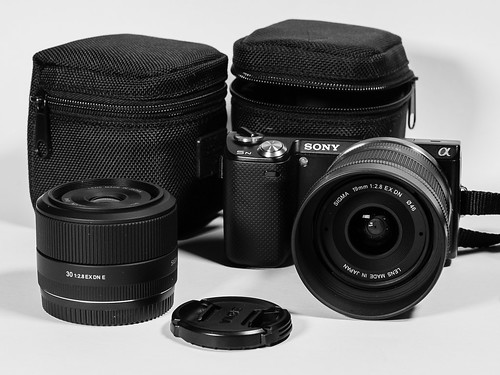
Sigma 19mm and 30mm F2.8 EX DN E-Mount Lenses, Part 2

NEX-5N with Sigma 30mm and 19mm
Concept: 3 out of 5
Execution: 3 out of 5
Yeah, but: My how time flies.

The Long Version: Back in mid-February I wrote part 1 of this review with every intention of following up with part 2 in a reasonable amount of time. Sometimes life intrudes into plans, such that your idea of reasonable evolves into not what you originally intended. It's good that I'm just now getting around to writing part 2, because it's allowed me more time to work with these lenses and the NEX 5N. The singular flaw with all camera reviews is that everyone is so eager to get their review out in front of the public before anyone else that the reviews wind up reading pretty much the same and pretty thin on meaty real-world use. I don't have that excuse this time for writing a thin, meatless review.

Behind the Counter, Key West Florida, Sigma 30mm, f/2.8, ISO 2000, 1/60s

Unless a camera manufacturer is grossly incompetent (and Sigma has skirted that particular edge more than once), gear performance, and especially a lens' optical performance, is pretty much the same across contemporary lenses; that is to say, of good to excellent optical performance, even in the face of 100% pixel peeping. Personally what I want to know about a lens is more mundane, such as how well will it work in the real world under varying conditions and how well it holds up under use. I have toted the Sigmas all over a good portion of Florida since purchasing them, and under my ham-handed amateur use they have worked flawlessly and held up quite splendidly.

Conch Train, Key West Florida, Sigma 19mm, f/2.8, ISO 100, 1/800s

In part 1 of the review I talked about how, in spite of the fact the Sigma lenses lacked in-lens image stabilization, I purchased them anyway primarily because I'm so cheap and I refused to make any major (read: expensive) lens purchases for the NEX 5N. Fortunate was I to have chosen to purchases these specific lenses, simply because I didn't need in-lens image stabilization for how I use these lenses.

Under practical use the Sigma lenses shoot far above their discount cost to me. As an avowed amateur photographer I have neither a burning need nor an infinite amount of cash to purchase every top drawer lens that is offered in E-mount (such as the Zeiss Touit lenses). At $99/lens (and even double that price), the Sigma 19mm and 30mm are some of the best lenses you can purchase for your Sony NEX cameras. For photographers on a budget, a good deal of enjoyment comes from reducing the economic pressure by not tying up large sums of cash in eye-wateringly expensive camera equipment. Based on that metric the Sigma lenses are thus very, very enjoyable.

Ringer, Key West Florida, 30mm, f/3.2, ISO 100, 1/160s

An irrelevant issue that has cropped up on the various forums is the mechanical noises the lenses produce. The first noise comes from shaking the lenses, either accidentally or deliberately. Both lenses use an internal focusing element. When the NEX 5N is powered up, so is the lens, and the internal focusing elements are locked into place. Powered off the internal elements are allowed to float. I've given both a fair deliberate shake, and you can hear a soft 'thunk' as the elements hit the extremes of their travel. That noise means nothing. If all you can do is shake your camera in public to hear the lens make a noise, then perhaps you need to find another hobby.

Big Boat, Key West Florida, 30mm, f/5.6, ISO 100, 1/60s

The second irrelevant issue is the noise produced by the aperture. During focusing the aperture blades will snap open to the aperture's widest opening, the lens will focus, then the aperture blades will snap back down for proper exposure. This has been described in various fora as "lens chatter." The Sigma's aren't the only lenses to exhibit this; for example you can spend over $500 for the ยต4:3rds Panasonic Leica 25mm f/1.4 and experience the exact same behavior. From a practical standpoint it means nothing to the overall operation of the lens. The noise is low enough that you have to be very close to the lens to hear it, let alone care about it.

Other than the two nit-noids just listed both lenses focus silently and very quickly, which is 99.9% of the time they're in use.

Better Than Sex, Key West Florida, 19mm, f/2.8, ISO 100, 1/3200s

The strengths of the Sigma 19mm and 30mm far out weight their perceived weaknesses. Combined with the Sony NEX 5N they create a modest but quite enjoyable compact system, especially for travel. I spent a fair amount of time just carrying and using the 5N and the two Sigma lenses. If you can find the older versions of these lenses at the discount prices then by all means pick them up. Even the more current 'Artist' versions are reasonable, given that more metal is used in their construction, even at twice the price ($199) of the first generation. The Sigma lenses really strike a nice series of compromises between image quality (very good), use of materials, construction, and overall operation. For the budget photographer who's more interested in making photographs than making a status statement, you really can't go wrong purchasing the Sigma 19mm and 30mm for your NEX camera.

Picket Fence, Key West Florida, 30mm, f/2.8, ISO 100, 1/80s
Bike Stop, Key West Florida, 30mm, f/5.6, ISO 250, 1/60s
Sunrise, Key West Florida, 30mm, f/5.6, ISO 100, 1/800
Rent Me, Key West Florida, 19mm, f/2.8, ISO 100, 1/80s
Rail Bridge, Bahia Honda, Florida, 30mm, f/6.3, ISO 100, 1/640s

Technical

All photographs taken hand-held with the Sony NEX 5N and post processed in LR 4.4 and the Nik Collection.

2013-02-16

Sigma 19mm and 30mm F2.8 EX DN E-Mount Lenses, Part 1

NEX-5N with Sigma 30mm and 19mm
Concept: 3 out of 5
Execution: 3 out of 5
Yeah, but: Never look a pair of gift lenses in the aperture.

The Long Version: I've been carrying two unique mirrorless camera systems for a while now. The first is ยต4:3rds consisting of my ยต4:3rds cameras (E-P2, E-PL1, E-PL2, and the OM-D E-M5) as well as a fair number of ยต4:3rds lenses, some of which I've reviewed on this site. The other mirrorless camera system I've been carrying since late last year has been the Sony NEX, specifically the NEX-5N, which I picked up when it dropped precipitously in price right before the NEX-5R was announced (it has risen a bit in price since then).

So why did I buy the NEX-5N with all those other Olympus Pens lying about? Curiosity mainly. When I saw the low, low price of the 5N plus kit zoom, I figured the price was low enough to give the NEX a tryout. If it turned out bad I'd resell it and go on about my business. But the 5N turned out to be pretty good actually and so I kept it around. With regards to video it's turned out something close to phenomenal (but that's a review for another time).

Unlike the ยต4:3rds system, I held back purchasing any other equipment for the camera beyond the 18-55mm kit lens the 5N was sold with. I wanted to investigate what the 5N was capable of on its own merits before making any kind of equipment expansion. While I was somewhat interested in the Sigma lenses when they were released for their still photography potential on the 5N, I was growing more interested in the 5N for its video capabilities and found the kit zoom to be more than adequate for my very modest video needs.

After their announcement the Sigma lenses began an inexorable slide in price, first down to $200/lens, then $150. Sometime around late January Sigma bundled both of them together for $199 ($99.50 each), which made the lenses irresistibly attractive to a cheapskate like me, so I bought them.

The bundle price was for both the ยต4:3rds as well as E-mount versions. As luck would have it, the ยต4:3rds sold out fairly quickly (that's where a good majority of the mirrorless camera enthusiasts seem to be) leaving plenty of E-mount lenses for the NEX system. I wouldn't have purchased the ยต4:3rds versions because I already have those focal lengths pretty well covered with other lenses I own. From my perspective the 19mm and 30mm lenses make a lot more sense on the NEX body with its APS-C sensor; the 19mm gives an equivalent focal length of 28.5mm and the 30mm an equivalent focal length of 45mm. In other words, decent wide angle and normal primes.

The Problem With These Lenses

Before you go run off and buy copies of your own, you need to know the following:
  1. These particular lenses have been discontinued, which is why they've been chopped down in price so much. Sigma has officially stated that they will be replaced with "Art" versions of these lenses in the future. And if it's an Art lens, it will cost more.
  2. These lenses do not have built-in image stabilization. That means you'll need to work on your "camera technique", another way of saying you'll have to learn how to hold your camera steady in low light when aperture and ISO won't buy you a high enough shutter speed to be indifferently held. Tripods come to mind.
And Why You'll Buy Them Anyway

None of this will bother the true budget photographer. You'll purchase your copies, appreciate their value where others might not, and learn to use them regardless. While it could be argued their introductory MSRP might have been a tad too high, they're certainly worth what they're selling for now, which is one important reason I rate them as highly as I do.

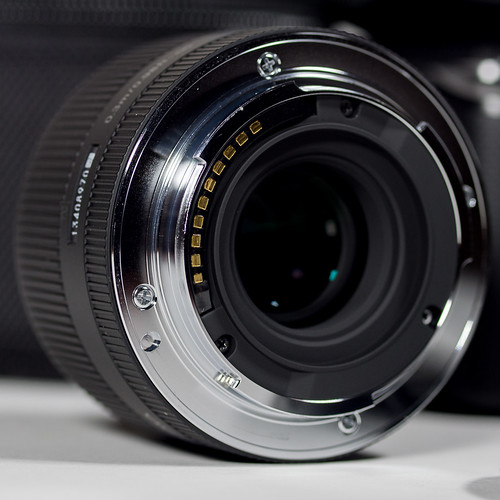
The 19mm and 30mm have features which their more costly cohorts from other manufacturers lack at this price point, such as metal bayonets and lens hoods (at least a lens hood for the 19mm).

Sigma 30mm Metal Mount

Both lenses use plastics quite heavily in their makeup, and both are blessed with quality metal bayonets. When I say they use plastics quite heavily, I mean that they spare nothing in the construction of the lens, especially the lens barrel itself. Both lenses are well-built and exude a level of fit and finish above their station.

And they are wonderfully black. I am so tired of seeing and/or buying silver and silvered lenses from Olympus and Sony. I hail from the Jurassic film period of 35mm photography, where every manly lens was metal and black anodized, with etched lettering everywhere. In these modern times the black anodized and etched metal has given way to industrial plastics with silk-screened lettering. I may grouse about the use of such, but I will at least grant that Sigma's use of silk-screened plastics is better than most (I'm looking at you Olympus and Sony).

Fitting one of these primes on the 5N produces a compact and enjoyable little camera system. The matte black finish of the Sigma lenses blends beautifully with the semi-gloss black finish of the 5N. The physical handling of the combination is superb. The operational handling (focusing and picture taking) is as good as the kit zoom. And this is why I like to have one or the other prime on the 5N instead of the zoom for still photography; at f/2.8, either lens' maximum aperture is 2/3rds to two stops wider than the kit lens at equivalent focal lengths. That's great for low-light photography.

Because the Sigma primes are black and smaller than the kit zoom, the overall combination is easier to carry and more inconspicuous in use. Even if you carry both primes with you (which I do), the total space occupied with the two primes plus the 5N is no more than the 5N with the kit zoom mounted. In practice I carry one prime in one pocket and the 5N with the other prime mounted slung over my shoulder or stuck in another jacket pocket.

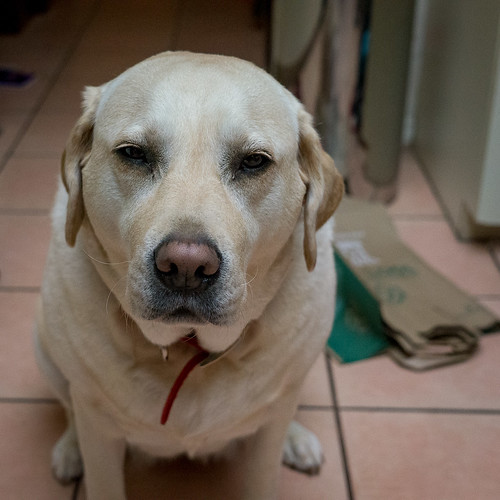
That's it for now. In part two I will speak a bit more of their operation as well as display soul-searing (or is it eye-searing?) images made with the pair and the NEX-5N. In the mean time I leave you with this haunting image I made of poor Ruby, my yellow Lab, using the Sigma 30mm and the NEX-5N.

Not Another Damn Photo Test
Oh, hell, not another test photo of me?
One day you're going to stick a camera in my face and
I'm going to grab it from you and bury it in the back yard
where you can't find it.

Technical

The hero photo at the top and the middle lens mount detail photo were taken with the Olympus E-M5 and the Zuiko Digital 50mm macro with the Olympus MMF-1 adapter. I used a pair of Fotodiox LED 312AS panels for lighting (thank you Kirk Tuck). Being lazy, I used the E-M5 instead of the E-1. And I mean lazy in that I didn't want to sit the camera on its tripod, use base ISO, and a very slow non-hand-holdable shutter speed. I hand-held the E-M5 and let it choose very high ISOs for both images (2500 for the top and 640 for the bottom). I have now put the E-1 away, and have no idea if I'll ever go back to it again.

last updated 16 feb 2013

2012-07-24

Sigma 70mm f/2.8 EX DG Macro (Nikon Mount)


Concept: 2 out of 5
Execution: 4 out of 5
Yeah, but: Solid but unsexy.

Counter Opinion: I'm looking for a sharp short telephoto, and the Sigma 70mm f/2.8 Macro is one that I've heard good things about. While I'm predisposed to the Nikon 60/2.8G – despite, not because of, having previously owned both the 150mm and 180mm Sigma macros – I decided to try the 70mm out in order to know more about my options.

Physically the 70/2.8 is substantial and well-built, justifying why Sigma EX lenses come with a decade-long warranty in Canada. The lens is all metal with the dark grey crinkle finish that looks great on its own, but always seems a little out of place when it's on a smooth black camera. The screw-on hood is metal, and works as the worlds' longest step-up ring by being threaded for 77mm filters on the front. Very clever.

The design of the 70/2.8EX Macro is something of a throwback; it feels older than the 2006 vintage that it is. It lacks Sigma's HSM motor, which means that the narrow focusing ring rotates during AF operation, and the Nikon model depends on the camera's screw-drive. I prefer this to the motor that Sigma puts in the Canon version, but it's a real problem for the little Nikon cameras, which are limited to manual focus. But what a manual focus it is – the ring has about a 270 degree throw, which is a vastly different experience from the measly 90 degrees of most quick-action AF lenses.

While focusing still isn't speedy, the powerful motors in top-end Nikons don't leave much to apologize for. Subjectively, I'd say that it's a bit faster on my D800 than my 50/1.4G in the normal range – not much to boast about – and about the same as my 105/2.8VR for macro focus. The Sigma also has an excellent limiter that keeps the lens in whichever half of the range it's already in when it's enabled. This is much easier to use that the fiddly three-position switch on the 105VR, and infinitely better than the 60/2.8G's complete absence of one.


Like three of the eight Micro lenses in Nikon's current catalog, the Sigma 70mm macro doesn't use internal focusing. The inner barrel extends quite substantially toward the minimum focusing distance, and there's a reproduction scale marked on its top. The second lens I ever owned also did that – the Olympus 35mm Macro, which is a 70mm equivalent – but it still takes a mental adjustment and feels like a negative. The upside is that there's no bellows effect: the 70/2.8EX keeps its f/2.8 aperture all the way down to its maximum 1:1 reproduction ratio.

But despite having so many other classic attributes – being polite – the Siggy 70/2.8 lacks an aperture ring. This lens could have been perfect for mirrorless cameras, and with a Nikkor "G"-compatible adapter it can still work, but naturally my Voigtlander F-to-M4/3 mount doesn't have an aperture control. Ah, well.

But the best part of the 70/2.8EX is the optics: it's subtly but distinctly sharper than the Nikon 60mm f/2.8G lens that I've put it up against, which is frequently called one of the sharpest lenses that Nikon makes. With proper technique and processing, the Nikon 60/2.8G is sharp enough to make my quickly-handled 50/1.4G look broken; when a Sigma lens can beat that, I have to sit up and take notice. While I'm not completely convinced that it will find a place on my D800, don't be surprised if I write a long-form review of it in the future.


Counter Opinions are quick "sales counter" product reviews.
As always, viewer discretion is advised.
Last updated 24 july 2012

2009-10-16

Sigma 180mm f/3.5 Macro in Nikon Mount


Concept: 3 out of 5
Execution: 3 out of 5
Yeah, but: If at first you don't succeed...


The Long Version: Sigma makes five macro lenses, and they all have the "EX" rating marking them as the best they make. In Canada, that means a 10-year warranty and a 48-hour service commitment - if they have parts in stock. I ran into that qualifier with their 150mm Macro lens in 4/3 mount, which I started reviewing over a year ago. (Parts one and two). But despite my mixed experience with the 150 macro, I was still impressed enough with its optics to buy its big brother for my Nikon D700.


Compared to the 150mm 2.8 Macro, the 180/3.5 is longer and heavier, but has fewer lens elements. The 180 does have a slightly more impressive MTF chart, and a working distance that's 8cm/3" longer, but aside from that there really doesn't seem to be much difference between them. While I own both lenses, they're in different mounts and feeding very different sensors, so there's no point in a head-to-head comparison. That isn't going to stop me from wondering why Sigma has both lenses in its lineup, but until I get a chance to play stump-the-sales-rep, I don't think I'm going to have an answer for that question.


For what it's worth, and for the three people to whom this will matter, the 180 macro has an aperture ring while the 150 does not. Otherwise I'd say that you should pick the lens you need based on their size and working distance, since any difference in sharpness or brightness is going to be inconsequential in actual use. (amended three months later: now that I'm starting to understand just what a big deal micro-4/3 cameras are, the aperture ring may be the 180's unique selling point. Putting one of these lenses on a G1 or GH1, with their dense sensors and articulating screens - via an F-to-m4/3 adapter - would make an especially awesome macro setup. I'd suggest that Nikon users should look at the 180 instead of the 150mm simply for this potential, even if they don't yet think that a m4/3 camera is in their future.)


Complaints about poor sharpness are rarely heard about any macro lens, and the Sigma 180 is at the top of this particular category. I'm not going to dwell on it too heavily; I've used the lens on a solid tripod and have absolutely no complaints. The photo above is a reduced section - not 100%, but larger than I'd use - of the area that I magnified for manual focus, and was shot at f/16 with my D700. I find it completely acceptable. Naturally, depth of field is extremely shallow, which makes a single photo just a starting place for jewellery photography. After processing many photos shot at subtly different distances, the finished result looks something like this:


The image above is very nearly the entire frame, so it shows both the amount of magnification that the D700 gets at 1:1, and gives some sense of the size of the previous sample. If you're planning a macro kit from the ground up, don't assume that a bigger sensor is a better idea. A 1:1 ratio is reality:sensor, so a bigger sensor means capturing a bigger part of the world. A reduced-frame camera's smaller sensor with denser pixels makes for a powerful combination.


But just because a lens can focus on small things doesn't mean that it shouldn't get to photograph large things. At 180mm and f/3.5, the Sigma is a useful medium-to-long telephoto. Canon and Nikon both make 180mm and 200mm prime lenses, and they alternate between f/2.8 non-macro and slightly slower macro lenses. So there is a strong precedent for macro lenses and prime lenses in this focal range, and of course the plentiful 70-200mm lenses for both major manufacturers also speak to the focal length's suitability for all kinds of photography. Telephotos are easy to shoot with, flatter most subjects, and can give the subject/background separation that Serious Photographers want to prove that they weren't shooting with a Coolpix. While the Sigma 180mm Macro isn't a small lens, I do find it very useful for general photography.


Looking at my images taken with the 180/3.5, there's a fun little game that I play called "guess the aperture". I've gotten good enough that I can usually spot the difference in vignetting between f/4 and f/5.6, which are my two favourite apertures for hand-holding this lens. A crop-sensor camera will avoid most of this - which is why they were invented - but since I'm using a camera that uses the entire image circle, I'll be building some Lightroom presets to take care of the problem. For what it's worth, the image above is shot at f/4.0, and the photo below was taken at f/5.6.


The 150mm and 180mm macro lenses both use the same tripod collar. It was one of the highlights of my experience with the shorter lens, and it's just as good on the 180. Instead of being a solid collar that slips over the back of the lens, it's split with a hinge and secured by a cam-lock. This lets it unclip from the lens without taking it off of the camera, which is great for on-again, off-again monopod sessions. A lens this long without image stabilization really does benefit from the extra support, but it's also bright enough to get away with shooting hand-held when perfection is overkill. It's nice to have the choice.


People who have read my reviews of the Sigma 150mm in 4/3 (aka "Olympus") mount might be surprised that I haven't mentioned the autofocus on the Nikon-fit 180/3.5. That's because it's simply not an issue with this lens - it's certainly not the fastest, but it is very quiet and reliable. The photo above shows a bit of camera-shake blur and a bit more Jack Russel blur, but is the only time I was able to catch the dog in motion (as if there's another state for a JRT) with anything approaching presentable sharpness. This isn't an action-photography lens, but it would be fine for normal movement, which is far more than I can say for the Olympus-mount version that inspired me to buy this one.


The Sigma 180mm f/3.5 macro lens leaves me with no complaints, except for its vignetting, which is apparently something that's not unusual for full-frame sensors and the lenses that are designed for them. I'd prefer not to see it, but it can be fixed fairly easily. But I keep coming back to my earlier question about why Sigma has both a 180mm and a 150mm macro lens in its lineup. The longer working distance of the 180mm is nice, but for my product photography it isn't as important as it would be for nature and critters. Essentially, I bought the 180 size only because I already had the 150 in 4/3 mount, and even I can't bring myself to that level of techno-redundancy.


From what I know about the 150, and after using the 180, I'm left without any strong reason to recommend one over the other, but can endorse them both. Just try them out and see which one you like best.


2009-02-07

Sigma 150mm f/2.8 Macro & Olympus E-3


Concept: 3 out of 5
Execution: 2 out of 5
Yeah, but: Whose throat is it, anyway?


The Long Version: I've now been using the Sigma 150mm f/2.8 DG EX Macro for four months - out of the six that I've owned it. My initial review dealt with the unpleasantness of learning that no shipping Sigma 150mm Macro lens will autofocus on an Olympus E-3 without a trip to the Sigma service center of your choice, so I won't dwell on that any more here except to say that you should make certain that the warranty covers your location, because you are going to need it. This review is just looking at the performance of the post-update lens.


Imagine an autofocus system is trying to catch a bus. Some lenses can sprint so quickly that they're never late for work, like the Olympus 12-60mm. Some get up a brisk run, holding their pockets so that nothing flies out. This would be the 11-22 or the 50-200. Some walk with dignity, thinking that if the bus leaves then it wasn't worth catching. The Oly 50mm f/2 macro comes to mind. The Sigma 150 Macro is the lens that stumbles and breaks its ankle.


To be fair, the Sigma is a macro lens, with an extremely long focus range that needs to be adjusted with great precision. It's not designed for speed, a goal that it achieves admirably. When it only needs to make minor adjustments, everything is fine and it works just like a normal lens. It does have focus-limiter switches, so it's possible to reduce the amount of hunting when it misses. These also serve another purpose: they can force the lens to shift its focus to the desired range. When the lens is at infinity when I want to take close-ups, or vice-versa, the boke(h) is so smooth that there's no contrast for the AF system to pick up, and the lens won't move at all. So cycling the power on the camera or flipping the focusing range is about the only way out. Sigma doesn't advise using the AF+MF mode on a 4/3 body, or adjusting the manual focus on the lens unless the body and lens are both in MF mode.


But the problem is that it's not all bad. When this lens is snicking into focus properly it really does some beautiful work. Optically there's absolutely nothing wrong with it, and there's a reason why a 300mm-e lens is a popular focal length. It's fantastic for portraits and stand-off photography of all kinds, and as a macro lens it gives plenty of working distance. If you're working with insects, models who will be patient, or anyone else who won't be discouraged by your frequent bouts of self-referential swearing, this is a fantastic lens. But it's worth noting here that I've tried the Sigma 150 Macro in other mounts - on a Canon 5D, 50D, Nikon D80, and D700 - and while the focus travel speed is the same, the lens gets into focus in fewer steps. With the EF and F mounts, it's 'almost - done', with Olympus it's 'almost, nearly, a little more, okay, that's it.' I'd hate to anthropomorphize, but the Sigma-Olympus combination just seems to need more guesses to get to the right answer.


Of course macro photography is often done with manual focus, in which the Sigma excels. It's capable of a 'life size' reproduction, which translates to really, really big. Working distance at full magnification is about 8" from the front element, or 5.5-ish from the front of the hood. That's enough room to comfortably fit the Olympus 50/2 macro - with its hood extended -between the Sigma's hood and the subject. Not too shabby. Using the E-3's flippy screen and magnified live view makes manual focus a wonderful way to work. Add the Sigma's solid tripod mount and this becomes an exceptional combination for photographing really small things.


Sigma's tripod mount is awesome. It was one of the highlights of my first look at this lens, and it deserves a special mention again here. The collar is split with a hinge, and tripod lock knob is sprung and clips over a peg on the other half of the mount. The lock knob has a cam design that locks securely with half a rotation, which is much more elegant than the thumbscrews that other manufacturers use. The collar can be opened and removed quickly and without needing to disassemble the camera. There's a best-of-both-worlds aspect to this, because the Sigma 150 is quite small for its (effective) focal length and is comfortable to hold without the tripod mount, but it's long enough that using proper support makes composition much easier. When I'm hand-holding the camera I'll lock the collar around the strap on one of my Domkes, which is a quick and easy way to stow my monopod. The collar is even faster than a quick-release plate, so there's no reason not to use the lens in the best way for each particular moment. The Sigma 150 Macro goes from party to business faster than a speeding mullet.


I bought the Sigma because I wanted the Olympus 150mm f/2.0. I love the working distance for macros, and have a tendency for tight telephoto shots in my personal work, so it's a good fit for me. The problem is that I still want to buy the 150/2.0 - the Sigma has proven for me how suitable this focal length is without really giving me what I want from a lens. But I like the Sigma as well, and I still need its macro performance. So if I win the lottery, maybe I'll be able to have a head-to-head comparison, and can actually see myself keeping both of them.


One thing that I've found with the Sigma that cuts down on its utility is that every photo that I've taken at infinity with the 1.4 teleconverter has been soft - this isn't something that I've tested rigorously, as the results were bad enough from my one afternoon out that I haven't tried it again. (Despite ample evidence to the contrary, I don't actually make an effort to take bad photographs.) Shorter focal distances seem unaffected, but don't buy this lens thinking that it can be painlessly turned into a 210/4.0. I've also had occasions where the lens/camera combination won't respond to anything, and I need to switch the camera off and on again. And one afternoon my E-3 lost connection and displayed F-- twice. There's no pattern that I've been able to find, but these are just little things that I've never noticed with my menagerie of Olympus glass.


I've had a hard time coming to terms with the Sigarette. Using it reminds me of a computer industry expression about the value of having "one throat to choke". This is supposed to illustrate the value of having only one place to put the blame when something goes wrong; ironically it's a perfect reason to buy Apple computers, but it's almost invariably used by PC-Windows integrators. I suppose they have more things go wrong, but I digress.


What we have here is a failure to communicate, or at least a failure to optimize. And because there's two companies involved, it's impossible to say who's at fault. (Sigma.) The 150 Macro focuses more quickly on bodies from Canon and Nikon, so is Olympus autofocus inherently bad, or has Sigma failed to give the same care and attention to the four thirds mount? Really, it can be argued either way. (Sigma.) But the end result is that this lens is as good as it will ever get; Olympus isn't likely to rework their AF for Sigma, even though they are both nominally members of the 4/3 format, and Sigma isn't likely to start caring about the performance nuances of a lens that doesn't even work right out of the box.


Ultimately this is a very different animal from the Olympus 50mm macro, and there's a place for it in the four thirds lens lineup. When the camera and lens get along well, it produces some wonderful photos at all distances. It's sharp, distortion free, has great colour, and gives beautiful boke(h) in front and behind the plane of focus. But it's not a poor man's 150mm f/2.0, no matter what SLR Gear says. They've probably never actually tried the Sigma 150 on a 4/3 body, and are just going from the results that they've seen on other brands. It just doesn't work that way. In fact, I'll place a wager that even after reading all this, when you try the lens in person you'll still be surprised at just how balky the autofocus can be.


But don't say I didn't warn you, and enjoy.


2008-08-26

Sigma 150mm f/2.8 Macro in Four Thirds (Olympus) Mount - The First (and Second) Month


Concept: 2 out of 5
Execution: 1 out of 5
Yeah, but: Time heals all wounds. I hope.


Updated 25 September 2008: My lens has come back from service, and Sigma has confirmed that there is an incompatibility between this lens and the Olympus E-3. Depending on the individual lens, it may require a firmware upgrade, performed at the service centre, or it may require a new main board. In my case, that took almost two months. Apparently the boards for the 4/3 mount are lovingly handcrafted out of pure mithril.

Updated 7 February 2009: A longer-term review of this lens can be found in part two.


The Sigma APO MACRO 150mm F2.8 EX DG HSM is clearly a lens to be taken seriously, and I'm not going to make any claims at having a full or representative experience of its quality or performance. But I did find some significant compatibility issues when this lens is used with the Olympus E-3, so if you're planning on buying this lens in 4/3 mount, read on.


There are several rigorous and reputable sites that review lenses, so if you're reading this with a serious intent to buy, I'll assume that you're already familiar with its reviews on slrgear.com and photozone.de for both Canon and Nikon mounts. They're both useful sites, and lots of people write about the ones that they own. But Sigma lenses in 4/3 mount are rare, and lenses don't always work the same way from one system to another.


For Lease was shot with my trusty and reliable Olympus E-1, which was the subject of my very first review, and the camera and lens worked very well together. The files are nicely detailed and have good tonal range, but are a bit softer than I would like to see. Physically the lens itself is very nicely built, and the "EX" finish that marks Sigma's premium lenses isn't as conspicuous as I had feared.


Here's how the lens looks on an Olympus E-1:


One of the biggest surprises with the Sigma is just how slow the focusing is. To be friendly, I'll say that it's on the relaxed side of leisurely. Now, the E-1's no speed demon when it comes to any auto-focusing, but this combination deserves special mention. It's even slower than the E-1 with the 50mm f/2 macro, which was my previous benchmark for what "slow" means. This is NOT a lens that will replace the Olympus 150mm f/2.0 for sports, photojournalism, or crawling babies. If you're thinking that the only tradeoff with this lens is that it's just a stop slower than the $2400 Oly lens - but with the bonus Macro ability - well, TANSTAAFL. But I've also tried the Sigma 150mm in EF mount on a Canon 5D, and my subjective impression is that the 5D spanks the Olympus for focusing speed. Even having used the lens on the faster-focusing E-510, I'd give Canon the advantage here. I'm looking forward to being able to try them side-by-side, along with the lens on a Nikon, and will include that in a later review.


In the meantime, here's how the Sigma 150 looks on an Olympus E-510:


A nice design feature of the Sigma 150 is its removable tripod mount. This has a simple cam-locked release that can be undone with a simple twist, allowing the collar to swing open and come off of the lens without having to dismount the camera. Very handy. It doesn't add any more bulk to the collar, and looks much nicer than the shiny silver dots that are left behind on the Olympus lenses when they're being used al fresco. The hood is well built and doesn't act like it's planning on falling off. It also comes with a souvenir lens case which is nicely built and well padded, but I'm still not quite sure how I'm supposed to use it.


Here's how the lens looks on an Olympus E-3:


You may have noticed that the lens looks a little different this time around, and that's because it acts differently. On my E-3, this one particular lens had a problem with intermittent-but-consistent front-focusing. The camera body works fine with my eleven Olympus lenses, so after one frustrating week of considering my options and testing every possible combination of factors, the lens went in for service. It's been there three weeks so far, and there's no estimate of when it will be "fixed" - where fixed means "works the way it was supposed to from the very beginning". Right now it's waiting for parts, which isn't part of Sigma's commitment to 48 hour turn-around for its professional-grade EX series lenses.


Now it's quite possible to say that this is an isolated case. But my 150 Macro worked fine - but perhaps a little soft - on my other two bodies. That suggests to me that there's something new a different about the E-3's focusing system, and that there's a fundamental disconnect between the top-grade Olympus camera and the top-grade Sigma macro lens in four-thirds mount. So in the name of research I've sought out other's experience on a large and popular forum for Olympus-using photographers. The tally was six different E-3's have been tried on a total of seven different Sigma 150mm Macro lenses, and every single one has had front-focusing issues. Three of those same lenses were also used on other E-System cameras, and each functioned properly. Another 150mm Macro lives happily on an E-510 without any problems at all. I think the conclusion pretty much draws itself on this issue.


My first month with my Sigma APO MACRO 150mm F2.8 EX DG HSM has been frustrating, disappointing, time-consuming, and very educational. My conclusion so far is that I won't be buying any more Sigma lenses because the danger of them not being inherently compatible with future Olympus bodies, while slim, is very real. I haven't quite gotten to the point of wishing that I hadn't bought it - but then my credit card bill only just arrived - because the results that I've seen from "fixed" copies of this lens have been spectacular. I'm eagerly awaiting its return from the service bay, because it really is an excellent macro lens that will help me in my business, and it suits my style of general photography perfectly. But I certainly can't recommend that anyone else buy this lens unless they're willing to experience some complex and multi-layered buyer's remorse.


Sorry.

Continue on to Part 2, in whihc our hero finally has his 150mm Macro working properly on an Olympus E-3 by clicking HERE.


The incompatibility between Sigma 150 Macro lenses and the Olympus E-3 can be fixed by upgrading the firmware on certain lenses. Since this review was originally written, Panasonic and Olympus have introduced the ability to have their lenses' firmware updated on each other's bodies. Sigma is at least a nominal participant in this project, but at the time of this update (25 October 2008) has not posted anything to the joint firmware update service. You can check this link to see if the situation has improved.


contact me...

You can click here for Matthew's e-mail address.