Showing posts with label 2. Show all posts

2012-08-13

Nikon AF-S 85mm f/3.5VR Micro


Concept: 1 out of 5
Execution: 1 out of 5
Yeah, but: The prime equivalent of an 18-200 f/dark.

Counter Opinion: There are certain things that I don't understand, and the Nikon 85mm f/3.5VR Micro lens is one of them. The 85/3.5VR feels like Nikon's attempt to make a "do everything" prime lens. It's macro, it's portrait, it's stabilized – it ticks all the boxes, and ends up as a me-too entry on some already-crowded shelves.

Nikon currently makes six 85mm lenses, and I have two of them. There's the 85/2.8PC-E Micro, which is why I own Nikon in the first place, and the little 85/1.8D, which usually lives on my F5. Then there's the 85/1.4D, which remains one of their top portrait lenses, the incredibly sharp 85/1.4G, and the elusive 85/1.8G, which is nearly as good as the 1.4G but with slower autofocus.

The 85/3.5 is an AF-S and DX lens, so it's targeted at entry-level to mid-market cameras. Selling for under $500 at reputable stores in America and Canada, and $550 at Henry's, its price is in the same ballpark as the 85/1.8G and 85/1.8D. No, none of those match the 85/3.5VR's macro ability, but there's also Nikon's 60/2.8G, Sigma's 70/2.8, and the Tamron 90/2.8 that handle that task at a similar cost and size. The short telephoto range is a tough place to be.


I have used the Sigma 70/2.8 and Tamron 90/2.8 macros, but tried the 85/3.5 directly against the Nikon 60/2.8G because that's the one that I own. The 85mm is only slightly larger than the 60mm, and does have a substantially longer working distance at high magnifications, but also has more distortion on the DX frame than my 60 does on FX. The sharpness results were functionally identical across most of the focusing range, but at the maximum 1:1 magnification the 85/3.5 becomes significantly worse. By backing off just a little to 1:1.2 magnification the 85/3.5 improves substantially, and by 1:1.4 it's respectable once again.

Some of my test photos are here: 60@1:1 #1 and #2, 85@1:1 #1 and #2, 85@1:1.2 #1 and #2; all were shot at f/8 with the D800 set to DX mode. Focusing is with Live View on the number "6". Manually focused samples, other targets, and the centre of the lens all show the same quality drop at 1:1 versus 1:1.2.

Looking at Nikon's lens lineup, the greatest virtue of the 85/3.5 is that it's cheaper, smaller, and shorter than the 105VR. But it's not remarkable when compared to other short macros, gives up two stops of light over a similarly-priced fast 85 in exchange for that macro ability, and then fails badly at maximum magnification. It wouldn't be my first choice for either portrait or macro photography, and if I really needed to own one lens that would be used for both then I'd buy something else. Sure, it's a good lens, but sometimes that's not enough.


Counter Opinions are quick "sales counter" product reviews.
As always, viewer discretion is advised.
Last updated 13 august 2012

2012-02-01

Zoom With Your Feet


Concept: 1 out of 5
Execution: 1 out of 5
Yeah, but: "'Not the same thing a bit!' said the Hatter."

The Long Version: There's a lot of truly bad photographic advice out there, but I can't think of anything worse than these four simple words: Zoom With Your Feet.

The idea behind it is that moving the camera forward or backwards is equivalent to changing the focal length of a lens. It looks like it's correct; a pair of sneakers can make the subject bigger or smaller in the viewfinder. But ZWYF is an insidious oversimplification: when you move the camera, everything else changes, too.

"Zoom with your feet" fundamentally confuses perspective with proximity.

The closer something is to the camera, the bigger it looks. But moving the camera forward doesn't just enlarge the subject, it enlarges it relative to the background as well. The camera's position sets the spatial relationships within the photo, and even small movements can create huge compositional changes.

Keeping the same camera position and switching to a longer focal length doesn't change the subject's relationship to the camera or the background, it just makes it take up more of the frame. Focal length is a live-action cropping tool, a way of selecting and excluding, using the lens to create a new delineation of space. It's not just a matter of seeing farther away or squeezing more in: choosing the focal length literally defines the photograph.

Whether wide or long, different focal lengths have unique ways of seeing the world because they crop differently sized rectangles out of it. Moving closer with a wide lens doesn't make its rectangle smaller, it makes the subject bigger in it; moving back with a long lens simply does the reverse.

Subject-size and rectangle-size aren't the same things at all.

"Zoom with your feet" needs to be retired from the photographic lexicon. Every photo is a combination of the camera position and the lens's field of view, regardless of what style of lens is used. Primes and zoom lenses both have their advantages, but suggesting that changing camera position is similar to changing focal lengths does a disservice to them both.


last updated 1 feb 2012

2011-08-16

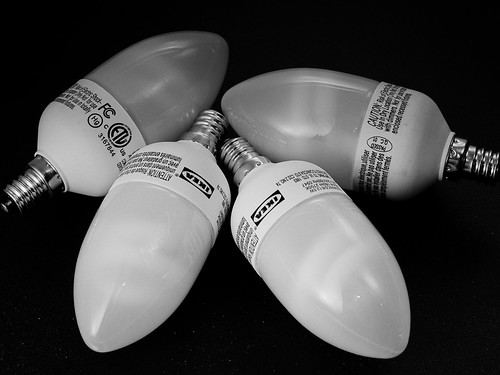
Ikea E12 5W Fluorescent Lamp

Bad Bulbs
Four out of six dead Ikea E12 fluorescent bulbs.

Concept: 2 out of 5
Execution: 0 out of 5
Yeah, but: Don't waste your money.

The Long Version:  I purchase six Ikea E12 fluorescent bulbs from the the Orlando Ikea store in March of this year. According to the advertisement as well as the fine print on the side of the box they came in, they were supposed to have a nominal lifetime of 10,000 hours.

How long is 10,000 hours? If you were to power them for six hours/day, seven days/week, then you would get 1,667 days of illumination. That's a bit more than 4 1/2 years. I would have loved to have gotten even half of that lifespan. Instead, four of the six I purchased, or 2/3rds, are now dead and sitting in the recycling bin for pickup later this week.

This is not the first problem I've had with Ikea electrical and electronic equipment. Earlier in February I tried to return a pair of larger fluorescent bulbs that didn't last 30 days. We were told in no uncertain terms at the Ikea return desk that they would neither give us back our money nor exchange them for a new working pair (the later is what we wanted anyway). In addition I've got an Ikea floor lamp that won't turn on any more. What really stick in my craw are all the Ikea branded AA and AAA rechargeable battery kits I purchased last Christmas for all my electronic devices and that have also gone into the recycling bin. All, and I repeat all, would work for a time, then one day start to overheat during a recharge and then stop carrying a charge at all.

I've never had a series of problems like this with other brands of bulbs, batteries, and small electrical devices from other stores like I've had with Ikea products. I pay a premium for these devices in part because they're supposed to have a long operating life measured in years, not weeks or months at the most. I don't know if Ikea hit a bad batch, changed suppliers, or what. But these were all purchased over a period of time from November 2010 to March 2011, which tells me the problem is systemic, at least at the Orlando store. The combination of poor quality and poor customer service is a loyalty killer. I've purchased my last items at Ikea. For those of you who haven't, caveat emptor.

last updated 16 aug 2011

2010-08-05

Gary Fong Collapsible Lightsphere Packaging


Concept: 2 out of 5
Execution: 0 out of 5
Yeah, but: Just the wrap, man, just the wrap.


The Long Version: Gary Fong is the Ken Rockwell of lighting modifiers. And that's fine - this review doesn't have anything to do with either one of them, or even the actual product that's in the Gary Fong Lightsphere® Collapsible™ box. It's not even about how the hell someone managed to trademark the word 'Collapsible™'. And for the record, yes, the Gary Fong Lightsphere® Collapsible™ does what it says it does. Two ping-pong balls taped to the top of your flash would also do what the Gary Fong Lightsphere® Collapsible™ does, but that's not the point. This review is just about the package that it comes in.


The box itself is thin black cardboard with a sticker that carries all of the text, graphics, and photos. This is a cost-effective way to create the multi-lingual packaging that's needed for international sales, and the box follows the current trend of keeping it as small as possible. It does fall down a bit by having plastic shrink-wrap around it, but that may add enough integrity to let them use a lighter grade of boxboard. There are also some style points involved by having the actual Lightsphere® Collapsible™ wrapped in coloured tissue paper instead of more unnecessary plastics. But that's hardly enough to motivate a review: the photos are where things start to get interesting.


We see an attractive model in the advertising version of the classic Comedy / Tragedy masks, known as the 'before' and 'after' photo. The one labeled "Without" shows a woman who's rehearsing for her passport photo, while the "With" looks like she's just heard a funny joke from a good friend. Sure, it's a blatant and obvious attempt to manipulate the viewer, but it's so clumsily done that it's impossible to take offense. Besides, given what these things look like when they're stuffed on top of a speedlight, I'm sure that lots of people really do laugh and smile when they see them. But let's look closer, shall we?


Here's the "Without / Sans" photo. It's a pretty standard straight-blast flash photo: the hallmark of novice camera users and really abysmal wedding photography. Nothing too remarkable here, so let's move on to the "With / Avec" image.


It's a huge improvement, verging on school portrait quality. It's so good, it's almost impossible to believe that a single on-camera flash could possibly create these results. Take a good look at the catchlights in her eyes in this photo, and compare them to the "Without / Sans" image. It really is impossible to believe that this was taken using a single on-camera light source, no matter how artfully it's bounced. In fact, the soft caressing shadows look even better than in the similar images on the Gary Fong Product Page, where our attractive model has only one catchlight reflected in her eyes.


Fancy that.

2010-03-23

Bio-Life Automatic Dishwasher Detergent


Concept: 1 out of 5
Execution: 1 out of 5
Yeah, but: I'm a hard case.


The Long Version: Life Brand is the store line for Shopper's Drug Mart / Pharmaprix, and they have a huge range of products. (One of which I've reviewed before.) Most of them are quite good, offering cheaper alternatives to The Leading National Brands, even if they don't have Dave Nichol shaking in his boots. They've recently branched out with a line called 'Bio-Life', selling more 'eco-friendly' products. They're competing with brands like Method, which is also sold by Shopper's, as well as specialty lines from other stores.


My dishwasher is old, and not particularly great. Things need to be rinsed fairly well before they go in, and the myriad plastic lunch containers never dry properly. That might be relevant to my experience with the Bio-Life detergent - I have a hard time imagining that it would have ever made into circulation if the test labs results were as bad as mine. Every piece of hard-to-dry plastic comes out coated with a mottled white film. It smudges with handing; for these photos I've carefully polished half of it off with a paper towel. It doesn't seem to be left behind on things like plates and glasses, but it's hard for me to have much confidence in the detergent, and I resorted to re-rinsing everything by hand.


The detergent itself comes in little pre-measured doses, wrapped in a water-soluble packet. There is a cautionary note on the container that the bag needs to be kept closed and handled with dry hands. I can attest to both of those in my brief time using the product. The little bundles glom together when exposed to even modest humidity, which makes them easier to stack but harder to use. And the one time I picked up a pack with damp fingers - I hadn't seen the warning yet - I discovered that the wrap does indeed dissolve instantly on contact with water. Not the most user-friendly product I've ever seen, to say the least.


I suppose I don't seem that smart when I say that I actually tried four loads of dishes before I gave up on this stuff. For the last attempt I waited until the dishwasher was finished before running the rinse cycle again, just to make sure. No luck. The good news is that other brands of lower-impact detergent have worked in my machine without any issues, so it's not a problem with the idea, just this one particular product. But no matter who makes it, I won't be buying this style of water-soluble packaging again. Not a big deal, as big deals go, but I'm just a little bit older and wiser now.


2010-01-09

Product Rumours and The Next Big Thing


Concept: 1 out of 5
Execution: 1 out of 5
Yeah, but: What do we have without anticipation?


The Long Version: We live in an electronic world, and one that's constantly changing. The first day of January's 2010 International Consumer Electronics Show saw forty-five new cameras introduced - and before winter ends there's still PMA in February and CIPA's show in Yokohama in March. The only real news to come out of the 45 new me-too buzzword-compliant press releases is the tidbit that both Sony and Olympus are finally moving to SD cards in their point-and-shoots. Otherwise it's just a collection of new numbers to remember, whether they're meaningless product names or meaningless product specifications.


Press releases that do nothing but announce upcoming announcements are a continuing source of annoyance for me. I have a hard enough time keeping up with the real cameras that actually exist to bother with the constant swirls of rumour and expectations. In November (of 2009) someone told me that they weren't going to buy a Nikon D700 because Nikon had announced that there would be a product announcement in early December. The purpose of this meta-announcement wasn't clear, but the rumour mill went into overdrive. Naturally, people were expecting a replacement for the D700 - with Nikon risking decimating their sales if ample replacement product wasn't ready - just weeks before christmas. It would be either the D700x, with 24 megapickles, or the D700s, with video. The D700x has been anticipated for longer, as people would like a high-resolution camera to undercut the sales of the top Nikon in the same way that they undercut the D3 with the original - and still only - D700. But then the video-recording D3s came out, with the same resolution as the D3, so now a smaller video-capable camera is needed. Exciting times, except that 720P video just isn't good enough any more, and anything less than 1080p will make people wait for the next one.


As the eighteen-month-old D700 remains Nikon's only small-bodied pro camera, I've read one web pundit saying that it's now too late for a simple x/s model bump, and a full-fledged model number increase is in order. No doubt people will continue to not buy a great camera that would do everything that they want simply because there might be another one some day. Personally, I don't understand the willingness to not take pictures between now and then: I know that there will be another strawberry crop in July, but I'll still eat while I wait for it. Naturally, if the tools available won't do the job, or aren't affordable, then find another solution or reframe the problem. People have been taking photos, and even making videos, for years now. They must have been doing it with something.


My biggest consolation is that for everyone who's refusing to buy the right tool now because there will eventually be a new one, there's someone else who's looking for the old model because they heard that it's better. I hear requests for the 40D, D40, and/or G10 on a weekly basis. Oh, and remember that December 2009 Nikon product announcement that was supposed to be an eagerly-but-prematurely expected camera? They were taking the $5000 AF-S 300mm f/2.8VR to version 2, and their 2.0x teleconverter from version 2 to version 3. Exciting stuff.


The champions of product anticipation, and home of the RDF since 1981, is the company formerly known as Apple Computer. They have an Apple Media Event - a term which currently generates 1.23 million hits on Google - scheduled for the end of January (of 2010). There's rampant speculation and eager anticipation, among other cliches, for an Apple Tablet. Apparently that's a new form of computer whose mere possibility makes stocks hit record highs. Regardless, an Apple Tablet is something that was anticipated all the way back to early 2006, when the crowd was wowed by the iPod Hi-Fi. It was even eagerly anticipated back in 2001 when we were calling them Personal Digital Assistants. I still remember the crushing angst of the rumour sites when Apple announced a going-nowhere knockoff of Creative Labs' Nomad instead of reviving the Newton. Who knew?


If only to finally make the experts predict something else, I hope that Apple does produce a tablet computer. But if they update the Apple TV, iPod Hi-Fi, or announce a revival of the LaserWriter, I'll enjoy that too. There's always going to be another Next Big Thing to look forward to, so it's no loss either way. I'll just keep on doing what I'm doing.


contact me...

You can click here for Matthew's e-mail address.