Concept: 3 out of 5 Execution: 2 out of 5 Yeah, but:Foolish consistency is the hobgoblin of little minds.
The Long Version: I'll start this review backwards - the biggest problem with Burrito Bandidos is that the ordering can be hit-or-miss. In the interest of speed, they like to ask for all of the information up front, and as a customer, I'm asked to tell them what I don't want on each burrito. Ordering one is easy enough, but the error rate for my typical two-burrito order can be as high as 20% - about one out of every five has something wrong with it. They're far from being as challenged as Hero Burger, where I no longer think it's worth the effort of getting food, but if Burrito Bandidos can boost their accuracy I'd easily give them a '3' for Execution, and even consider a score of '4'. That's almost stratospheric around here, but they certainly have that potential.
It's hard to break the $10 barrier with a burrito and a beverage, and the quality is very good. The steak uses real steak, and I've never stood there and thought 'I hope they don't use that tomato…' the way I can with some of the submarine sandwich shops in the neighbourhood. I used to go to the original location on Peter Street, back when it was still operating under the inferior Burrito Boyz name, and I think the Burrito Bandidos' Annex location does a better job. Aside from the occasional random ingredient, or random lack of an ingredient, I have no complaints. They've become my preferred replacement for Cora's Pizza, and I usually end up with a burrito about once a week.
The Annex location has a deceptive address. Officially at 362 Bloor Street West, it faces onto Walmer Road and is at the far end of the building, so you'll never find it by walking along Bloor. It's just across the street and a little south of the Walmer Road exit from Spadina Station, which in turn is behind the Shopper's Drug Mart. It's easy enough to find if you know where to look, and it's one of those places that will always get repeat visits.
Concept: 1 out of 5 Execution: 0 out of 5 Yeah, but: "What we've got here is (a) failure to communicate!" The Long Version: I really am glad that Photokina 2010 is finally over. I've been emotionally whip-sawed about by Olympus' announcements leading up to Photokina, first with their special E-P2 kits and two new M.Zuiko µ4/3rds zoomlenses, then with the announcement of the regular 4/3rds E-5, the follow-up to their three-year-old E-3. On the surface all those announcements sound wonderful. It's when you add the context and dig into the details that you realize it's anything but.
In happier times (15 July 2010) I wrote an opinion piece titled "Whither FourThirds?" In that editorial I wrote how I believed that Olympus knew what it was doing, that Olympus was working diligently to merge it's older 4/3rds line with its newer µ4/3rds camera line. Among other things, I wrote:
It all sounds wonderfully grim, and Olympus' critics are rubbing their hands with sadistic glee over what they see as another major Olympus failure in the making. The only problem with this delightfully grim prediction is that it's wrong. Olympus knows it can't just drop regular 4/3rds. They are painfully aware of the repercussions of another mount abandonment. If Olympus were to abandon 4/3rds then they might as well pull out of the entire camera market, because the repercussions of a second major mount abandonment would fatally taint every other camera product they would try to sell going forward...
I believe that Olympus is working hard to merge its two interchangeable lens lines into one, based exclusively around µ4/3rds. They will provide a seamless transition with existing 4/3rds-mount lenses. It's going to take time (I estimate 24 months), but we will see the road-map for this transition starting with Photokina this fall.
As I said, written in happier times, and making assumptions that have come back to haunt me.
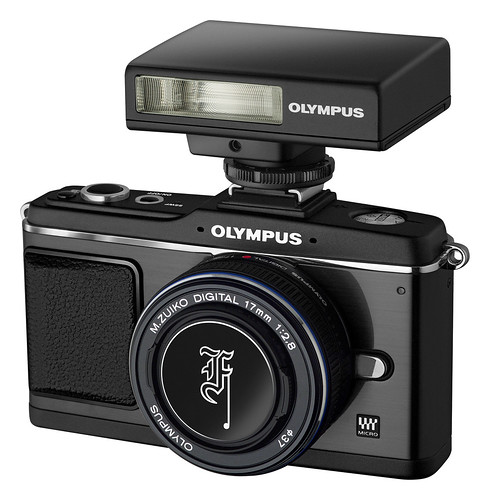
The start of my dissatisfaction came with the release of the two newest E-P2 kits. They cost more, anywhere from $200 to $350, than the original E-P2 kits released in December 2009. And for what? So that you could purchase a black version of the M.Zuiko 17mm f/2.8 with a Pen-branded lens cap, and with your choice of the VF-2 EVF or a black version of the FL-14 flash.
All new, all black E-P2 kit with fancy 17mm lens cover
and black FL-14 external flash.
What would have been far more useful to the Olympus faithful would have been an updated version of the E-P2 that included the sensor tweaks currently in the E-PL1 along with new camera firmware that allowed for faster autofocus with standard 4/3rds lenses.
Just how slow is autofocus with a regular 4/3rds lens mounted on an E-P2? Take, as an example, my ZD 12-60mm HG zoom. On my E-3, with the latest lens firmware upgrade, it snaps to focus so quickly as to be unmeasurable by anything other than fast instrumentation. Put it on my E-P2, however, and I can watch the sweep hand of my analogue watch count out two seconds before the lens finally locks onto focus. That's what I mean by slow. I'm well aware of the differences between phase detect autofocus in the E-3 and contrast detect autofocus in the E-P2 (and the other Pens as well). That's my point. Olympus could have begun to bridge between the two lines with advances in the Pens using a combination of firmware in the body and possibly a new, special adapter. Instead, we got marketing fluff.
Then came two new lenses, the M.Zuiko 40-150mm and 75-300mm. It was the later that raised my eyebrows because of its cost: a cool $900.
All new, all expensive, M.Zuiko 75-300mm f/4.8-6.3
That's a lot of cash for a mighty slow lens. I won't mention the kind of fast quality glass you can get in the regular HG 4/3rds line for that amount or a lot less. That would be pointless because of the slow autofocus performance of regular 4/3rds lenses on µ4/3rds bodies. Later in this post I'll get to why I keep harping on this point. But to continue...
Finally, on September 14th, Olympus announced to the world the new E-5. You can hit the link to read the particulars. Basically, the E-5 was pitched as an improved E-3 for $1,700, body only. Responses in the Olympus user community were almost immediate, and the majority of them weren't good. Ken Norton of Zone-10 best exemplified may reaction by writing the following:
Olympus officially introduces the new E-5. Essentially a warmed-over E-3 or an E-30 in E-3 body. Move along, people--nothing to see here.
On a personal note, I'm extremely disappointed with Olympus for two reasons:
After three years this is the best they could do?
Why didn't they do something like this with the E-1 in those four years before the E-3 came out?
Olympus, you are a creative company that has proven through the years to be the maverick in every industry you compete in. The E-5 is the opposite of what the very fabric of this company is all about.
But not all is bad. At least Olympus finally put a decent LCD on it. Way to step out!
If you are needing to buy a new pro-level Olympus DSLR, the E-5 is fine. In fact, it's probably quite good as it blends the best of the E-3 with the improved imaging capabilities seen in the E-PL1. It will definitely not be a slouch in image quality. However, it is obvious that Olympus has lost all interest in legacy FourThirds. The E-5 is a protection for existing investment in lenses and accessories, but at this point I won't be recommending any non Micro FourThirds products to anybody not already invested in the line.
Then came Simon Joinson's preview on DPReview, and these priceless pearls of witty observation:
Taking what could most politely be described as a 'considered' approach to product upgrades, Olympus has lifted the curtain on the third generation of its professional SLR, in the form of the much anticipated E-5. Olympus introduced the world to the first Four Thirds camera, the E-1, back in June 2003, and finally got round to updating it with the E-3 four years later. We got a sneak preview of the E-3's successor a couple of weeks back - we'll update this short article to a full review as soon as we get a production E-5 in the office.
It is perhaps indicative of where Olympus's priorities lie - or the way the market is headed - that whereas the E-3 took the E-1 back to the drawing board and introduced several new features, the E-5 is probably best described as a warm over of its predecessor. It's also interesting to note that it benefits from a 'trickle up' of technology from the latest developments in the company's Micro Four Thirds cameras - a situation unusual for what is, effectively, the hero product in the E-system range.
Into this swirling brew of disbelief and controversy was dumped a series of poorly translated (read: Google translated) interviews reported via other blogs where English was a second language at best. By the time the smoke had cleared on those little missives, I learned the following:
There would be no more development for new standard 4/3rd lenses. Olympus had decided, for whatever reason, that what they had was good enough, and that the E-5 would finally deliver the image quality the regular line (especially the SHG) were supposed to deliver with regards to sharpness and detail.
All regular 4/3rds DSLRs, from the E-30 on down (E-4x0, E-5x0, and E-6x0) would no longer be manufactured. The E-4x0 to E-6x0 were considered entry-level DSLRs; the Pens could easily substitute (and would be substituted) for them. The E-5 would subsume and replace the E-30 just as it was doing to the E-3.
So there you have it. Olympus showed I was wrong. They are abandoning (however slowly) regular 4/3rds. This time, unlike the OM line, they're providing a half-way transition from the 4/3rds to µ4/3rds lens mount with a mechanical adapter that pulls the electrical contacts straight through to the µ4/3rds mount. This at least gives some feedback for EXIF data as well as some control (slow autofocus, control of the aperture).
They've already started to abandon the Standard Grade lens line by reproducing many of the more popular zooms as M.Zuiko zooms (9-18mm, 40-150mm, 14-42mm, and 70-300mm (as the $900 75-300mm). None of the current Pens and M.Zuiko lenses are weather sealed. If you want weather sealed, then you're left with the lone E-5 (and remaining E-3s still in stock) with the High Grade and Super High Grade lenses.
What am I left with? A very sour taste in my mouth. I shoot primarily Olympus digital (E-3 and E-P2). I've written well of the gear I own (especially the E-P2), and it all continues to operate quite well. The problem is that this is all expensive gear that represents an investment of money and time. Quality gear costs money, and to wring the most out of that monetary investment requires a not-to-considerable personal investment of time and effort. When you make that kind of an investment in a camera brand, you expect the camera manufacturer to make a reciprocal investment in engineering, development, quality, and marketing. Especially marketing. Because, over time, I have this idea I want to add or replace what I have, based on my changing needs. And I'd like to do it with a vital brand and with it's supporting ecosystem.
I give points to Olympus engineering and quality, but their marketing is the worst I think I've ever seen. Instead of providing leadership and vision at this year's Photokina, they gave a series of scattershot interviews to a few enthusiast photography sites, then had to issue a few corrections from the Japanese mothership to tamp down the ensuing controversy. When it came to the E-5, I had to learn about its image quality via informal photographs on forums and at other enthusiast sites. The E-5 might be absolutely fabulous, the bees knees, and hold its own, IQ-wise, against the Canon 7D or the Nikon D300s at equivalent ISOs. And maybe we'll learn that when DPReview publishes its official review. But Olympus could have primed the pump with a full-court press of the E-5 including plenty of sample images and reviews ready to go at Photokina 2010. Instead they pissed away a golden opportunity.
So what about the future? As far as Olympus' future goes, I have absolutely no idea. If I had that kind of perceptive ability, I'd be super rich and this kind of a blog post would be moot. As it is I've barely enough ability to figure out my own future, much less a world-wide Japanese company's. As for myself, I have to echo Ken Norton's conclusion: I won't be recommending any regular 4/3rds equipment (body and lenses) to anyone who isn't already heavily invested. And I mean heavily invested. And I'm going to hold back my enthusiasm for µ4/3rds. Olympus' handling of regular 4/3rds and their lack of a detailed, cohesive and compelling vision regarding the evolution of regular 4/3rds to µ4/3rds has poisoned the well for all cameras for me. All I can say is, be very careful buying Olympus.
I have no idea where I might migrate to, and no desire to sit and slowly stew over all that's happened. I'd much rather go out and use the gear I've got. It still works, and works well. For me, photography is the best therapy.
Update 25 September
These are quotes from trusted sources meant to provide additional background to my rant. I wanted to document them, and then let the reader follow them and draw their own conclusions.
"Twelve megapixels is, I think, enough for covering most applications most customers need," said Akira Watanabe, manager of Olympus Imaging's SLR planning department, in an interview here at the Photo Marketing Association (PMA). "We have no intention to compete in the megapixel wars for E-System," Olympus' line of SLR cameras, he said.
Instead, Olympus will focus on other characteristics such as dynamic range, color reproduction, and a better ISO range for low-light shooting, he said...
"I personally believed, before starting the E-System, that 12 was enough," Watanabe said. "We interviewed many professional photographers, people in studios, about how many they needed in the future. Before we started, the system, we had a rough idea we'd be at a plateau at 12 megapixels. We gradually increased the pixel count," with the newer Olympus SLRs now reaching that level...
Watanabe, though, believes image sensor-based autofocus will outperform phase-detect systems in the future. That's important not just for compact cameras, but also for SLRs that today often have an awkward problem with composing a shot using the camera's LCD: when the sensor is in use to run the display, the phase-detect autofocus subsystem can't be used. That means live view on SLRs today is typically a frustratingly slow process.
"In terms of speed, phase detect is faster. But imager autofocus will exceed phase detect," Watanabe said.
And speed isn't of course the only factor. "In terms of accuracy, imager-based autofocus is much more advantageous. It directly focuses on the surface itself," the exact location where the image will eventually be recorded. "Phase detect focuses not on the real surface but on a virtual surface," the focusing subsystem reached via a moving mirror.
Imager-based autofocus doesn't require the full use of the image sensor area, so it doesn't directly increase power consumption concerns, he said. In Olympus's new midrange E-30 SLR, for example, autofocus uses only a few points on the sensor when autofocusing in live view mode.
In an interview at Photokina, reports quesabesde.com (relayed to us via 4/3 Rumors), Miguel Garcia , Marketing Managing Director of Olympus Europe, has confirmed that Olympus has stopped development of future lenses for reflex 4/3 cameras. Although the E-5 will not be the last 4/3 body, according to Garcia, Olympus will concentrate its future development on Micro 4/3. There will be a professional Micro 4/3 body in 2011, and the lower-end Micro 4/3 camera will be updated as well.
He mentioned that in Japan, mirrorless cameras have already captured 40% of the market, and he emphasized that Olympus has a big lead over some of its competitors in the development of these systems.
About Micro 4/3 lenses for the future, he said Olympus has lenses in development that will be "spectacular for all levels [of photographers], not just consumers."
Olympus will next month launch the Olympus E-5, a DSLR the firm admits may be the last of its traditional Four Thirds cameras as it signals a future without optical viewfinders.
The news appears to support controversial comments made by US DSLR manager Richard Pelkowski earlier this year.
Pelkowski had speculated that the Four Thirds system will be using a mirrorless viewfinder system within the next 24 months, as the quality of electronic viewfinders had improved so much. Speaking at the PMA trade show in the US, Pelkowski had explained that switching from a traditional mirror SLR system would save space and weight in Four Thirds cameras, and would make the incorporation of HD video functions much easier.
However, days later, Toshiyuki Terada, manager of the SLR planning for Olympus Tokyo, refuted Pelkowski's comments, telling AP that the Olympus Four Thirds camera range will continue to use mirror-type viewfinders.
Six months later, the Olympus E-5 is born, boasting the 'reliability' of the E-3 with the 'evolution' of a Pen, according to Olympus – but it could be the last E-series Four Thirds camera.
I would like to point out Olympus' past history with regards to releasing new cameras in a consistent and timely fashion; they don't. Consider the four year span between the E-1 and E-3, and the three year span between the E-3 and E-5. Or the vaporware 100mm Macro that stayed on the regular 4/3rds lens map for so long; it'll never be produced now.
So it's anybody's guess as to what Olympus may introduce in the "professional µ4/3rds" category. We may have to wait as long as PMA 2011 to find out, if ever. PMA 2011 starts in early September.
Update 26 September
On 21 September Focus Numérique posted an interview (Google translated) with Michiharu Uematsu of Panasonic. Keeping in mind this is a Google translation, the translation was clear enough to be interesting in its own right:
Digital Focus: You have to present a contrast detection autofocus very quickly. You announce that GH2 is even in some circumstances faster than some professional SLRs. Do you think these developments agree to end the autofocus system by phase correlation [system and Sony Alpha DSLR 55/33, Ed]?
Michiharu Uematsu: With our new sensor, and a new processor that analyzes 120 images per second instead of 60, we managed to make the autofocus GH2 two times faster than the previous model. In addition, the phase correlation is not very efficient with faint targets, leading to a shallow depth of field if you want a continuous autofocus, video for example. It also poses constraints of aircraft design (?) and precise adjustment of the detection system of phase with respect to the sensor is sensitive. However, on moving subjects and burst, the phase correlation is much higher...
Digital Focus: There are less than 6 months (see previous interview with Mr. Uematsu), you explain that a 12 megapixel sensor was more than enough for a camera public. Yet the GH2 now offers 16 megapixel ...
Michiharu Uematsu: Yes ... For my part, I still think that 12 MP are quite sufficient for our photographic use. In the case of GH2, it is primarily a marketing decision, not a technical choice. We must follow the market trends that impose even now augment the definition of our sensors.
In spite of the mangled translation, some of the points in the interview are clear enough. First is the doubling of autofocus performance in a contrast detect autofocus (CDAF) system. I've read several informal forum postings that the GH2's focus performance matches or exceeds that of the Canon 5D Mk2 and the E-5, which would be astounding if true. What's more interesting is the technical explanation: they have a new processor evaluating 120 frames/sec in order to achieve this. All things considered, I would expect a boost in overall power consumption, with a consequent drop in the number of exposures/battery.
What's more intriguing is the comment that Uematsu still considers 12 MP "quite sufficient", echoing Olympus' sentiments as well. I found it refreshingly honest that a representative of Panasonic admitted that the increase to 16MP was "primarily a marketing decision, not a technical choice."
Finally, there are some key statements with regards to mechanical shutters vs electronic shutters, and optical viewfinders vs electronic viewfinders. In both instances Uematsu noted they ran out of engineering resources to do a good job on both. With regards to the electronic viewfinders, Uematsu noted that "much work remains to achieve the quality of an optical viewfinder."
The problems that Panasonic ran into with the GH2 sensor and EVF probably played a critical part in Olympus' decision to remain conservative with the final design of the E-5.
Bottom line is that it appears that Olympus and Panasonic, at an engineering level, are in mutual agreement. Furthermore, pushing the envelope takes time and resources, where for practical reasons you have to choose which important problems you work on first. Finally, all these advances will take time and will cost when they are released. That means first adopters will pay a premium (as they always do), but reap the rewards earlier than more conservative users.
Video interview with Toshiyuki Terada, SLR Product Planning Manager, Photokina 2010.
Update 2 October
A second video interview with Toshiyuki Terada, SLR Product Planning Manager, Photokina 2010.
There are two new reviews that have caught my eye recently, and both are from Malaysia. The are:
The "On The Streets" review is interesting in that the reviewer finds the autofocus "extremely fast and reliable", the image quality to be "drastically" improved, and "awesome" out-of-camera JPEGs. He also expresses great appreciation for the new Dramatic art filter, which is Olympus' pseudo HDR ability. In particular, the reviewer stated
Another separate note for existing PEN users, now the E-5 can apply the Art-Filters directly with any other camera shooting modes, such as Programme Exposure, Aperture Priority and Shutter Priority. The processing speed for ALL the filters have been improved dramatically, and there was almost no lag at all shooting with Art-Filters. This is one improvement making the photographers’ life much easier, and enjoyable I must say.
The "Zuiko and E-5: Day 1" review, while less effusive, provides a series of test shots, two of which show the capability of the Dramatic art filter.
Standard image without Dramatic art filter.
Same image with Dramatic art filter applied.
Personally, I'm beginning to like what I see and hear about the camera. Some people still complain about the high initial price and the apparent abandonment of the regular 4/3rds line. I have only one comment to counter that; Leica.
I may very well wind up with an E-5 body. Or something very close to it. More to come, I'm sure.
Concept: 2 out of 5 Execution: 1 out of 5 Yeah, but: A lot can change in a year.
The Long Version: I reviewed the SX20 almost exactly a year ago, and there are a few differences this time around. For one thing, I don't own the SX30, and I never will. I also don't own the SX20 any more, having sold it after getting the GH1 which is a superzoom done right. Of course, the SX30IS has the spiffy new 35x 24-840mm-e lens with an image-stabilization system that really does work, which will be the reason why people buy it. Maybe the rest won't matter.
The other big change from the SX20 is the battery. Gone are the four AA batteries, replaced by the same proprietary rechargeable batteries that are used in the G11/G12. The lens is also lighter, making for a camera with very different handling than the previous models. For most people this will be a good thing, good enough that they'll overlook the memory card moving back into the battery compartment. That's the way most compact cameras work, and even a bad design can benefit from the comfort of familiarity.
But man, is this camera ever ugly.
The hand grip is awkward, being simultaneously angular and hard to hold. The SX20 had a substantial grip, partly thanks to the jumbo battery compartment, but the SX30 is too small for my hands without the benefit of it being a diminutive camera. While Canon's SLR's have all been borrowing from the swoopy-slabby stealth-fighter aesthetic recently, this long-zoom plastic case looks like an F22 that's crashed into the ocean, been eaten by a shark, and pooped out the far end. The mode dial is dished out in a way that's unique to the SX30, and there's a red detailing to it that adds to its disco points. And just in case you forget what camera you own, the SX30 has added another branding location on top of the flash, facing backwards, so that there's no escaping this camera at all.
Someone once said that the best the best thing about driving a Pontiac Aztek is that you can't see the cars' exterior. That gives the automotive horror a real advantage over the Canon, because looking through the SX30IS is actually worse than looking at it. It has a mediocre-average 230K 2.8" LCD screen, and the worst electronic viewfinder I've seen in years.
Bad.
Really, really bad.
The rise of mirrorless cameras has created a renaissance for electronic viewfinders. People who swore they'd never use an EVF are coming around, and many cameras have genuinely good ones. This one is nowhere near the Panasonic m4/3 options, and is years behind what Sony has on their upcoming "SLT" A55 camera. In the SX30's own long-zoom class, the arch-rival Panasonic's viewfinder is considerably better than the SX30, and even the Nikon Coolpix P100, which is otherwise an uninspiring little machine, does better. Considering how important the EVF is for controlling and aiming long telephoto lenses, this is a huge problem. Adding additional humiliation, 2003-vintage Sony F828 has a visually larger viewfinder, and it even has 30,000 dots - 15% - more resolution than the 2010 Canon camera. It's appalling. I've never said this about anything before, but from an aesthetic and ergonomic point of view, I'd rather have a Sony Alpha A330. Even people who love Sony don't like that camera - the SX30's viewfinder really is that bad.
As far as the performance goes, there's not much to say. It's a Canon superzoom, so the image quality averages out to a decent but not outstanding result. The big deal is the lens, which is longer than anything else on the market (at the moment). This is something like having a talking dog - it really doesn't matter what it says, its mere existence is remarkable. I can also say that its image stabilization works very well, holding the picture very steady even when at the monstrously long zoom extension. The photo above, of the man with his hand in his pocket as he enters an 'adult entertainment' venue, was taken from the far side of the street and hasn't been cropped at all. The camera handles its primary task as well as anyone could ask, given its intended purpose and market. Those who are able to withstand their first encounter will probably be quite happy with it, or at least grudgingly accept its compromises. But whatever you do, don't even think about buying it without trying it first.
In the immortal words of Opus the Penguin: "Okay, maybe it wasn't that bad, but Lord, it wasn't good." Time could prove me wrong. Style is personal, and some say that taste can't be taught. But man, that viewfinder stinks.
Concept: How good the underlying idea is. Originality counts.
Execution: How well the idea has been realized. Bad ideas can be done perfectly, and vice-versa.
Unless explicitly and prominently noted, any products or services discussed here have been bought with our own money from normal retail channels, and the opinions offered are not sponsored, endorsed, paid for, or compensated in any way.
However, there's no such thing as a truly unbiased opinion. All thoughts here are simply those of the people who write them, and should be given the appropriate consideration and viewed in the context of the individuals' experience.







 Posts
Posts



