2012-01-29

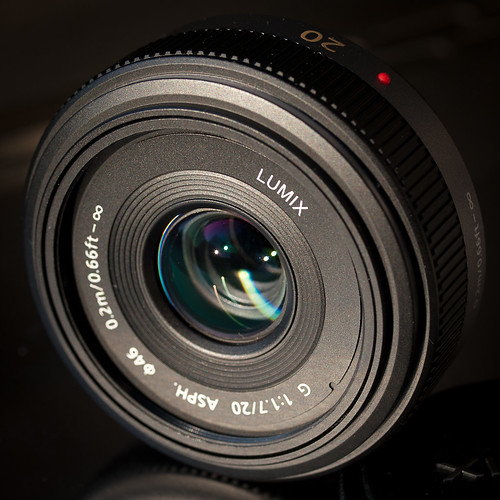
Panasonic Lumix G 20mm F1.7 ASPH.

Panasonic 20mm Side

Concept: 4 out of 5
Execution: 3 out of 5
Yeah, but: So what took me so long?

The Long Version:

This is the second review of this lens. Matthew wrote the first, an excellent review when he purchased his copy over a year and a half ago. Rather than repeat what he wrote, I'll refer you to his review. I'll wait here while you go and read it.

I first considered the 20mm when Matthew wrote his review. Unfortunately the price at that time for the 20mm was its MSRP of $400, or $150 more than the Olympus 17mm. So being the cheap guy that I am I purchased the 17mm and went off happily using it for all sorts of subjects, none the wiser.
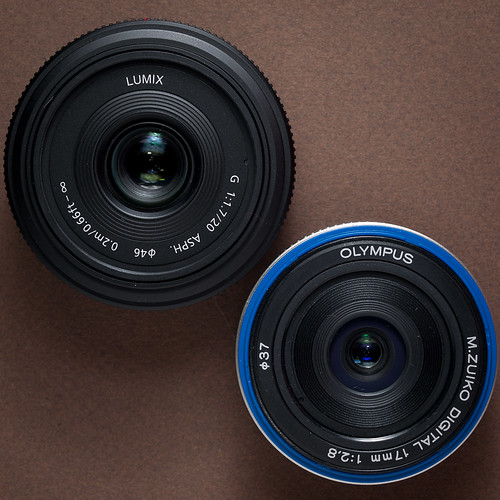
Panasonic 20mm and M.Zuiko 17mm
Panasonic 20mm on the left, Olympus 17mm on the right,
minus its front cosmetic outer ring.

I even wrote a review about the 17mm not long after Matthew wrote his 20mm review, extolling the 17mm's virtues. Over the period I've owned the 17mm I've certainly taken my fair share of photographs with it. Yet, in spite of its lower price and slightly smaller size, there's one key feature that the Panasonic has that's superior to the 17mm; the 20mm is one-and-a-half stops faster than the 17mm. This feature alone makes it superior to the 17mm in very low light situations or situations where excellent separation of foreground subject from background is needed. When the price of the 20mm dropped to near $300 this past December, I finally purchased a copy for myself.

Self Portrait - First Light 20mm
Self portrait - First Light 20mm

As I mentioned one of the two key features I found attractive about this lens is its separation of foreground and background in a very tiny package. When the 20mm arrived the first thing I did was slap in on my E-P2, set it to f/1.7, turn the camera back around to face me and fire off this lovely portrait. Look at the larger version (if you can stand to) and you'll note that elements in focus in the center part of the image are quite sharp and clear, such as my glasses frame, the dirt on my face, and the strands of my thinning hair straggling down over my furrowed brow. I also like the way that focus quite rapidly drops off, which you can see on the shoulders of my t-shirt. I've quickly come to appreciate the quality of this lens wide open, and make it a habit to shoot with it wide open as much as possible.
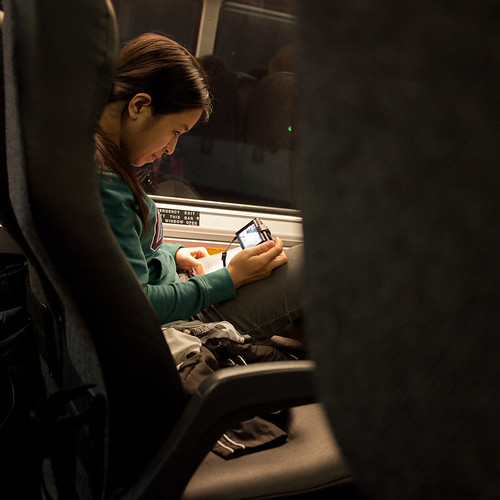
Chimping Her Camera

The lens' wide aperture of f/1.7 comes in handy in low-light situations. In this photo I was able to keep the ISO down to 400, which is only one stop faster than the E-P2's base ISO of 200. If I'd had the 17mm I would have had to move it up to ISO 1,000, where noise begins to show up. I know what's been written elsewhere about the E-P2's high ISO performance and how it's acceptable up to ISO 1,600, but it's been my experience to keep ISO as close to base as possible. So I juggle shutter speed, f-stop, and ISO in these situations, giving priority to keeping the ISO as low as practical. It's a shooting methodology I've had since my first days of 35mm film. After over 40 years of photography I much prefer to shoot no higher than ASAISO 400.

Welcome to Lake City Florida

Another feature I've come to appreciate with this lens is its apparent lack of barrel distortion or pin cushioning regardless of the aperture setting. The 17mm has noticeable pin cushioning wide open (f/2.8), which begins to clean up one stop down and is almost completely gone by f/5.6. But the 20mm doesn't have any to speak of, which makes shooting architecture a real joy, particularly when you don't have to clean up any distortion in post. And if you think you see distortion above, let me assure you that the concrete sidewalk in front of that Greyhound station is actually warped.
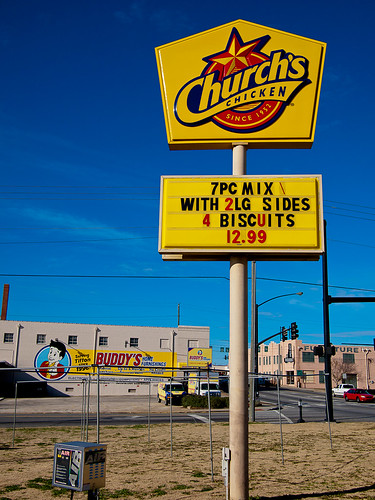
Tifton

The 20mm also has a different color character from the 17mm. I can't quantify what is different about the 20mm, but I like the colors that come out of the 20mm mounted on the E-P2. While the 17mm is quite capable of producing great color under the same lighting, I have to give the nod to the 20mm.

Ride 'em Cowboy

The 20mm makes for a superb all-around travel lens, capable of rendering exquisite detail between f/5.6 to f/8 in broad daylight. The photo above was taken with the E-P2's ISO set to 200. The 20mm coupled with the dynamic range of the sensor at this ISO can produce some pretty remarkable results.
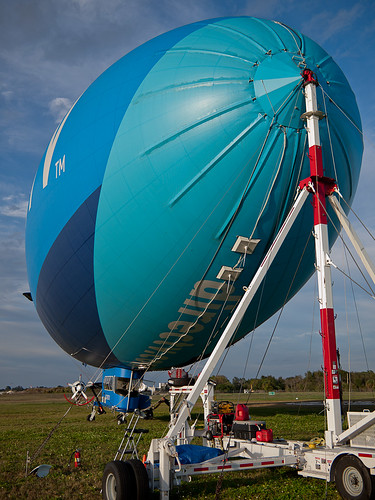
Blimp Starboard Mooring

Although the field of view of the 20mm is definately less than the 17mm (57° vs 65° respectively), it's still wide enough that with careful composition you can dramatically photograph large objects such as the DirecTV blimp. In the photo above the 20mm was stopped down to f/2.8 and ISO once again set to 100. The lighting, the dynamic range, and the depth of field, coupled with the focal point gives the appearance of sharp focus from the mooring tower to the airship's tail. Yet the background is out of focus enough to help hold the viewer's attention on the airship. I can honestly say I could not have achieved this level of image quality with the 17mm at its widest, f/2.8.

Conclusions

As good as the Olympus 17mm is, especially stopped down, the Panasonic 20mm is better, especially when you realize that the 20mm is already closed down 1 1/2 stops at f/2.8. While the 17mm is physically smaller, it's only barely so.

The 20mm actually gives exposure "breathing room" to the E-P2, allowing it to be used at lower ISOs more consistently than with any other µ4/3rds lens except the M.Zuiko 45mm 1:1.8 (which I also now own) and the M.Zuiko 12mm 1:2. And with the drop in price of the 20mm bringing the price differential between the 17mm and the 20mm to less than $100, there's no real reason to purchase the 17mm independent of the 20mm any more.

There's also the issue of build quality. I've groused about this already, but I'll say it again; ever since the early 1980s starting with Olympus OM equipment I've never had bits fall off of any Olympus lens, except for the 17mm. While I was on a trip to Boston last March the front outer ring over the blue plastic you see on the 17mm above simply fell off and onto the ground. I heard it hit but never found it in the street. The 17mm still functions, but the idea of something just falling off bothers me and gives the lens a bad mark in my book. The 20mm looks and feels better built than the 17mm. Hopefully nothing will fall off the 20mm during normal use.

I'm glad I have the 17mm, and I'm glad I had it for as long as I did. It served yeoman duty and was the most used lens of all my regular and micro 4/3rds lenses. But I've got the 20mm now, and it's going to cut into the use of the 17mm considerably, and that seems a bit sad. I wish that Olympus had released an f/2 version of the 17mm, and beefed it up a bit, but Olympus was apparently working on the M.Zuiko 12mm 1:2. At its current price of around $700, I don't think I'll be picking up a copy any time soon, so the 17mm will take the spot the 12 would have if my budget would allow it.

When Matthew wrote his review back in 2010 he called the Panasonic 20mm "the single best lens available for micro four-thirds cameras." While it now has to contend with the Olympus M.Zuiko 45mm and 12mm lenses, it still holds its own quite well with those two lenses. It isn't that the Panasonic 20mm is any worse for the Olympus lenses, it's that Olympus has finally stepped up its game to at least match the 20mm. The 20mm is still well worth the purchase, especially as part of a trifecta composed of the 12 and 45mm lenses.

last updated 29 january 2012

2012-01-27

M.Zuiko Digital ED 40-150mm f4.0-5.6 R

M.Zuiko 40-150mm R on E-P2

Concept: 3 out of 5
Execution: 3 out of 5
Yeah, but: It's just dandy for what it sells for.

Background:
Olympus has a habit of re-introducing two zoom lenses repeatedly. One lens is the 14-42mm 1:4-5.6 kit lens. The other zoom lens that Olympus has released repeatedly is the 40-150mm zoom. It first appeared along with the 14-45mm when the Olympus E-300 was introduced. It was a rather large lens with an aperture range of f/3.5 to f/4.5.  As large as it was I used mine on my E-300 quite a bit and with good effect.

While it was an excellent performing lens for the price, the biggest complaint heard from all over the 'net was how big and heavy it was. When Olympus introduced the E-5x0 series of 4/3rd cameras, it cut the size of the Mark 1 down considerably and gave it a slower maximum aperture range of f/4.0-5.6, producing the Mark 2.

The Mark 2 lens remained a staple of the Olympus stock lens kits for the remainder of the E-4x0/5x0/6x0 manufacturing run. I wouldn't call it popular, but it was certainly ubiquitous, so much so that Olympus sold a combination of the Olympus MMF-2 4/3rds to µ4/3rds and the Mark 2 lens for use with the E-P2. That's the combination I purchased, direct from Olympus, for a modest $199.

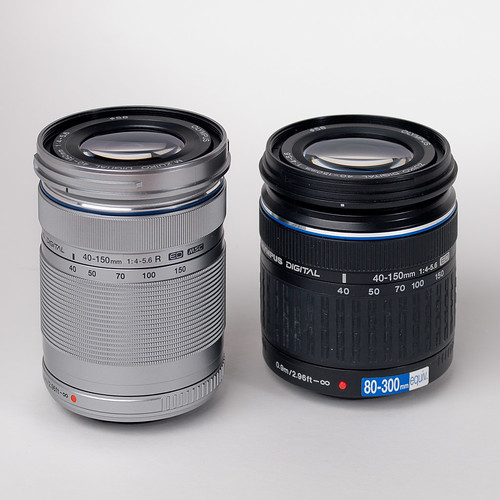
Zooms at 40mm
"R" version on the left (4th version), Mark 2 on the right

I used the Mark 2 quite a bit, both with the E-P2 as well as with my E-3. It was slow to focus on the E-P2, but it was decent enough and helped me to grab good shots when I needed to with the E-P2. And for $200, I got an affordable and adaptable short telephoto zoom. But it wasn't a native µ4/3rds lens. I wanted a native version of the lens if for no other reason than to get a lens with better autofocus speed on the E-P2.

So I waited a bit and sure enough Olympus released a Mark 3 version of the lens that was native µ4/3rds mount. It was engineered to focus quietly and given the MSC (Movie & Still Compatible) moniker. As a consequence the price moved up to $300. Olympus released it with a plastic bayonet mount (like they'd done with the Mark 2). I didn't feel inclined to spend $300 on a lens that didn't have a metal bayonet mount. The M.Zuiko 17mm, which sold for less, had one, and my M.Zuiko 14-42mm Mark 2 kit lens had one as well.

Eventually Olympus released a Mark 4 version when they released the E-P3, this time with the 'R' designation. The 'R' differences from the Mark 3 were a faster focus motor and different lens coatings. And the price went up slightly yet again. This past December, when Adorama surprisingly offered the silver 'R' version for $160, the clamp around my credit card loosened and I purchased a copy for myself.

Build and Performance

Physically the 'R' version is slightly narrower in diameter, but slightly longer, than the Mark 2. It's also lighter. In the hand the 'R' version feels better built than the Mark 2 version, but I wouldn't categorize the Mark 2 version as poorly built. The bayonet is plastic (as it was with the Mark 2 and Mark 3 versions), but it mounts snugly and tightly on the E-P2. How long it will continue to do this I have no idea.

The 'R' version, compared to the Mark 2 with adapter mounted on the E-P2, is blazing fast when it comes to autofocus speed on the E-P2.  Because of its very light weight it balances quite well in the hand, even when zoomed out to 150mm.

M.Zuiko 40-150mm 'R' at 150mm


You'll note that I have the VF-2 mounted on the E-P2. If you intend to use the 40-150mm at 100mm or longer, then you're going to want to use the EVF to help focus and compose. Using the LCD on the back at the longer focal lengths only makes sense if you have the E-P2 on a stable platform, such as a tripod. Otherwise you're going to see the image jump and dance all over the place. The EVF gives you a third point, your head, to help stabilize the whole assemblage (the other two points being your left and right hands).

With my copy I noted that the zoom ring was tight, almost too tight. With its light weight you won't have zoom creep if the lens is pointing down. Focus is focus-by-wire, which isn't all that good or bad. I've yet to have to manually focus this lens, as the 40-150mm and E-P2 always seem to pick the point I want to focus on.

I can't get over how silently this zoom focuses. It's fast and silent focusing performance is a spoiler. The only other lens that focuses this way is the M.Zuiko 45mm, which is also an MSC lens. In bright outdoor light it's a joy to use when it's needed.

Examples

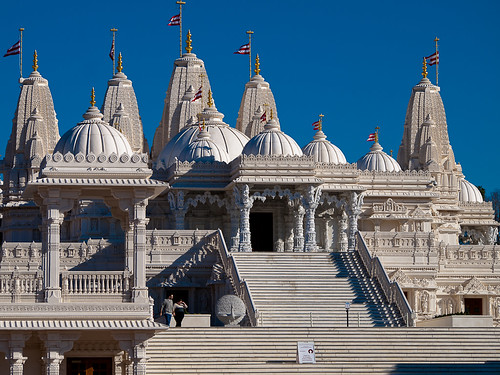
I've taken enough photos with the 'R' version to come to the conclusion that it's as good a performer, IQ wise, as every other version I've owned and used. In bright light and stopped down around a stop the lens will produce nice, clean, crisp, well-colored photos with plenty of detail.

BAPS Shri Swaminarayan Mandir
BAPS Shri Swaminarayan Mandir, Atlanta, Georgia, USA
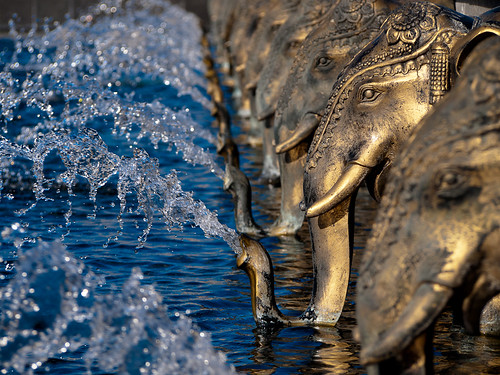
BAPS Shri Swaminarayan Mandir
BAPS Shri Swaminarayan Mandir, Atlanta, Georgia, USA
Link-up
MetLife Blimp docking, Orlando, Florida, USA

While the lens can produce good detail, it's not going to give you the same level of performance of a zoom that's five times its cost (or higher). The image of the tender getting ready to latch the airship to its mooring tower shows the limit of its resolution. This photo was taken late afternoon. If you look closely you'll see the line that connects the tip of the airship, through the tip of the mooring tower, and then back off to the right. It doesn't look quite sharp enough, not enough separation from the background sky. It would have looked better with the 50-200mm but then again, if I had the 50-200mm mounted on the E-P2 it would have handled very awkwardly, and you can rest assured it wouldn't have focus locked nearly as quickly as the 'R' version on the E-P2.

Conclusion

Remember that this is a $200 zoom lens, not the equivalent of the Zuiko Digital 50-200mm SWD (or any of the SHG zooms). But then, it's roughly 1/5 the cost of the 50-200mm and quite a bit smaller and lighter. This is the kind of lens you want in your kit to make your kit as small and light weight as possible.

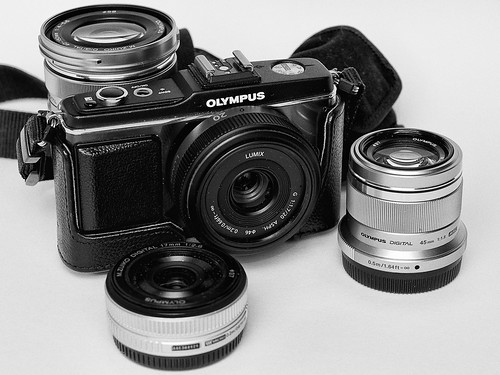
The Travel Kit
Clockwise from top: M.Zuiko 40-150mm R, M.Zuiko 45mm,
M.Zuiko 17mm. E-P2 in center with Panasonic 20mm.

Look at my modest E-P2 kit, and you'll see my copy of the 40-150mm peeking out from behind the E-P2. It's a great little lens for the money, the kind you carry with you on impulse without having to worry about the consequence of it being too heavy or too expensive if something happens. In the right light it works quite well. It is, in my opinion, the best utility zoom for the money, especially if you can purchase it for $200 or less. Especially less.

Technical

I use Olympus, and all different kinds of Olympus. The two photos of the 40-150mm mounted on the E-P2 were taken with the E-1 and Sigma 30mm 1:1.4. The first image was a JPEG taken out of the E-1 and cropped in post 1:1. The photo of the two 40-150mm lenses as well as the kit photo were taken with the E-3, the ZD 50mm, and a pair of FL-50Rs, one in an Apollo 42" reflector and the other using a Rogue FlashBender.

last updated 27 January 2012

2012-01-26

Panera Bread, Yonge Street Location


Concept: 2 out of 5
Execution: 4 out of 5
Yeah, but: My very first Review By Proxy.

The Long Version: I've never eaten at the new Panera Bread location on Yonge street at Edward, and based on what I've heard from other people, I never will. Despite only being open for one week, I've had four of my co-workers spontaneously start to rave about it, and I hear people talking excitedly about it on the street.

Panera, or so I'm told, serves excellent soups and sandwiches. The prices are not quite cheap, but they're not out of line compared to other quick-service restaurants in the area, including the ones that don't leave people misty-eyed at the mention of a "bread bowl". This is exactly the sort of thing that I love, which is why I am never, ever going inside.

A wise man once said: "I've bought crack cocaine three days in a row. I'm starting to worry that I'm a shopaholic."

I'm fighting mightily against a similar shopping issue.

This blog doesn't use the star rating the way Amazon or similar clod-source sites do. Here an average score is only a modest 2/5, which is still a positive recommendation; Panera's basic concept of soup and sandwiches is good but so well established that even donut stores do it. But when I start my unsolicited raving that means a rating of a solid four out of five, which is an exceptional score. Given how many people have been telling me about Panera I had to consider a perfect 5/5 on their execution, but I just can't go that high without trying it for myself.

Which will never happen.

Sorry.


last updated 26 jan 2012

contact me...

You can click here for Matthew's e-mail address.