2012-08-24

Nikon L37c UV Filter


Concept: 1 out of 5
Execution: 2 out of 5
Yeah, but: If it makes no difference then it doesn't matter.

The Long Version: I'm generally known for only having mild and ambiguous opinions, so I should say up front that I don't agree with the premise of using "protective" clear or UV filters. But I know that some photographers swear by them, so I decided to run some tests on an old Nikon L37c filter that I had lying around. It was included with a second-hand lens, so I don't know its history, but it cleaned up nicely and was in perfect condition. I'd consider this to be a medium-to-high-quality filter, with a green reflection from its coatings.

So I broke out the gear and tested this 62mm UV filter for sharpness. The camera was on the wooden Berlebach tripod that normally holds my GX680, and I set up my target on a lighter basalt tripod. Everything was squared and levelled, with the target clamped to a right-angle Manfrotto quick release plate.


The resolution target is my usual subject: a $20 bill. These have lots of fine printing and detail, and although they may not be as definitive as an officially sanctioned resolution charts, they're a lot cheaper and I'm just comparing the results by eye. To keep it flat it's securely taped to a section of marble floor tile. Since I wanted maximum detail, I used a Nikon 60/2.8G Micro lens, kept it at about 1:2, resolution and filled the frame.

I went through a number of different variations. I used Live View to focus, I used the focusing rails with zoomed-LCD manual focus, took three exposures at each setting, used mirror lock up and a cable release, and so on.


The filter made no difference.

I couldn't tell if the filter was on the lens or not just from looking at the results. I knew from the file name and sequence, but that was all.

Now, as I said earlier, this Nikon is a decent and multicoated filter. Just the same, I was quite pleased to see no drop in sharpness in this little trial. Perhaps there's a difference that test-lab gear would be able to detect, but I'm not worrying about that too much.


The second test was for flare and ghosting. I attached an LED flashlight to the target tripod and pointed it directly at the lens. The focus is on the black bar that's in front of the light, and the lens is at f/8 – that nine-bladed circular aperture thing really works. It's also worth noting that I use the D800's cropped DX mode for the sharpness test, since I only cared about the centre, but switched back to full-frame for the flare results.

This flashlight has an inset bulb, but no lens or reflector to blur the source.

Here are the results without the filter:


And here's the same setup, with the filter:


Similar images, and both are bad, but the one with the filter is worse. (Larger: with, without.) What I notice is that the starburst around the flashlight is stronger, there's an extra reflection on the lower-right (in front of the tripod) from the additional surface, there's a halo running around the lower-left corner, and some additional flare/ghosting visible in front of the bar that's about 15cm in front of the light.

I also checked for flare with off-axis light hitting the front of the lens. I switched to a brighter flashlight and flagged it to make sure that it didn't light my test scene. Here's what the setup looked like:


And here are the results, first with the flashlight off:


Bare lens, no hood:


Lens with filter, no hood:


So here the difference matters a little more – it went from bad to worse, rather than very bad to very very bad. But I also tried a comparison with the hood on, which shaded the lens like this:


And the results, with the filter and hood both on, looked like this:


To my eye the results are indistinguishable from the photos where the light was off. I'm pretty impressed – I knew that shading the front of the lens would help immensely, but I still expected to see some additional ghosting from light hitting the inside of the hood. The 60/2.8G has pretty good coatings, but it lacks the extra crushed-velvet lining that can be found on the inside of the more deluxe hoods.

So after an interesting afternoon, I can say that this filter had no visible effect on sharpness, and while it made flare and ghosting worse, it only did it under conditions that the lens was already producing enough to be objectionable. I imagine that better filters would have less flare, and may test that with my bigger B+W MRC filter some day, but I can't see any difference mattering very much if the lens itself shows as much flare as this one has.

And no, I haven't changed my outlook on 'protective' filters, because my argument is simply that the 'protection' that they provide is illusionary and unnecessary. I'm glad that I know a little more about them for people who do want to use them, and see no harm in it if it makes people feel better. But I do know that I'll advocate for proper lens hoods more strongly than I used to.


last updated 24 august 2012

2012-08-22

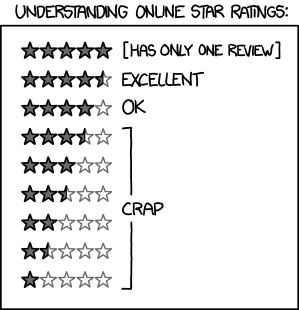
XKCD: Star Ratings


Concept:  4 out of 5
Execution:  4 out of 5
Yeah, but:  Can't give it perfect…

The Short Version:  XKCD is frequently funny, and this is exactly why we don't use the standard five-star rating here.


last updated 22 august 2012

2012-08-20

That Complete F'kin Idiot's Recent "bought locally at retail" Comments


Concept: 0 out of 5
Execution: 0 out of 5
Yeah, but: I don't support link-bait; use google if you must.

The Long Version: Last week the worst individual in photography blogging, someone who has enthusiastically and unapologetically misled and misinformed for years, may have finally jumped the shark. Circa August 14th, 2012, he wrote:

'As usual, most of the people who have shifted focus-points [sic], dead-pixels [sic] or other 'widespread' problems are people who bought locally at retail. Your local dealer or chain lacks the volume of [REDACTED] and other huge online sellers, so they don't get the "A" stock that [REDACTED] does. That's another reason I buy from [REDACTED]: they don't get stuck with the samples with defects sent out to local retail stores with a lot less buying-power than the major online powerhouses.'

Obviously, I've modified the quotation somewhat, but the source is easy enough to find and specifically identifies only one retailer, whose name rhymes with 'Hadorama'. It continues:

'As a general rule, if Nikon or Canon or Sony or whoever [sic] have a few thousand cameras not quite [sic] perfect, but nowhere bad enough [sic] to scrap, they don't get sent to the top couple of dealers who sell millions and millions and millions of cameras. They customarily go to the dealers that sell only tens of thousands of cameras.'

I love conspiracy theories because they're usually unfathomably stupid, and this one is a shining example. Even setting aside all of the absurdly nefarious allegations, what he's alleging is that from the management of the quality-control division to the order pickers in warehouses and distribution centres across the globe, there is a way to identify and track units with substandard performance and choose their specific end destinations. From companies that can't meet their shipping dates in the first place.

Think about the simple logistics of this for a few minutes. This secret stock-tracking system has to be easy enough that everyone in the supply chain can use it, but precise enough to direct individual cameras in an industry that sells over a hundred and forty million units a year. That level of accuracy, let alone specificity, would be astonishing: I've never seen an inventory control system that could even keep an accurate count of the total units after a few months of shipments.

Meanwhile, this global and industry-wide deceptive business practice is enforced under a strict code of silence despite the breadth and scope of the operation. All for a mere 'few thousand units'. Does anyone really believe that 'Nikon or Canon or Sony' – or whomever – are that competent, let alone that motivated?


So with all of that out of the way, I have to admit that what I'm really fascinated by is that this link-hungry troll-whoring novice-exploiting equipmibater might have actually realized that he went too far. After all, while his opinions are frequently unfounded, they usually range only from plausible to merely wrong, and don't extend to such outrageously self-serving allegations of fraud.

While the original text remains easy to find elsewhere, the relevant passage on his personal site has been quietly changed. The entry now reads:

'As usual, most of the people who have shifted focus-points, dead-pixels or other "widespread" problems seem to have been people who tended to have bought locally at retail. I've never had any of these problems buying from [REDACTED], [REDACTED] or [REDACTED], but when people call me wondering why my phone number is in their camera, these have been people silly enough to have bought at a huge electronics chain. (Someone loaded my settings file into a camera, and then the store resold it as new, at full price.)'

All this grafted-on second idea really means is that 'huge electronics chains' aren't bright enough to properly reset a camera, and that his readers are the people dumb enough to shop at said big-box unit-shifters. (Please note that this is something he and I actually agree on.) On the other hand, my local electronics store regularly has "open box specials". I wonder what happens to the cameras that The Affiliated Three get back under their long no-risk return periods. Perhaps they're taken out back and shredded to ensure that they're never resold?

'Local dealers and retail chains lack the volume of the huge online sellers, so they probably don't get the pick of the best stock that the huge online dealers get. That's another reason I buy from [REDACTED], [REDACTED] and [REDACTED]: I doubt they get stuck with samples with defects possibly sent out to local retail stores with a lot less buying-power than the major online powerhouses. I doubt any known bad cameras ever get shipped, but if they do, who knows.'

Notice how he's shifted from alleging outright deception and conspiracy to a more bucolic 'the pick of the best stock', as if we're looking through produce at the local market instead of consumer electronics that ship by the skid. But while he no longer names names, he's not willing to back off the idea entirely – at least, not until the last sentence, where he completely folds. 'I doubt any known bad cameras ever get shipped…'

So he's engaged in blatant FUD-mongering for the sake of driving sales to the links that fund his site, all while swearing that he's unbiased because he doesn't evaluate demo units from manufacturers. (That is at least partially true: sometimes he evaluates nothing at all in the course of writing his reviews.) And when the going gets tough, when there's a stand to take, he silently edits out the worse of his lies and just leaves behind a nasty, slimy trail of insinuation.

I used to have a live-and-let-live attitude. But I work part-time in a locally owned camera store, and spent many years working in high-value warehouses before that. Not only do I know that he's wrong, I take his snide and self-serving allegations as a personal attack against my own professionalism, knowledge, and skill: it's much more than 'just' an attack that's directed at my employer, trying to drive away customers from a legitimate business that continues to exist alongside those who fund his imaginary off-shore tax-exempt empire. As far as I can see, that makes his supporters, admirers – and yes, affiliate retailers – worthy of all of the scorn and derision that used to be reserved for him alone.

Updated 21 August: Never let it be said that I'm not willing to publicly correct myself when I go too far. I've been having a conversation via Twitter with Helen Oster, a Customer Service Ambassador with Adorama. She has used phrases like 'absolutely, completely 100% not true', calls it 'pure conjecture' and puts 'his "facts"' in quotation marks. So forget that bit about subjecting his affiliates to scorn and derision – based on my small inquiries, they're not playing along with this absurd foolishness.


last updated 31 august 2012
updated lead photo

contact me...

You can click here for Matthew's e-mail address.