Showing posts with label Olympus. Show all posts

2014-05-13

M.Zuiko ED 12-40mm f2.8 PRO Tech Note

1240 and 1260
Concept: 5 out of 5
Execution: 5 out of 5
Yeah, but: This is not the review you're looking for.
The Long Version:

Matthew likes to produce the occasional counter review of equipment that he doesn't own but that instead comes across the counter-top of the camera store he works at. He at least gets to handle it before passing judgement. This micro-review, which I'm labeling as a Tech Note, is in that same spirit. I don't own the 12-40mm, but I did own the 12-60mm and used it extensively.

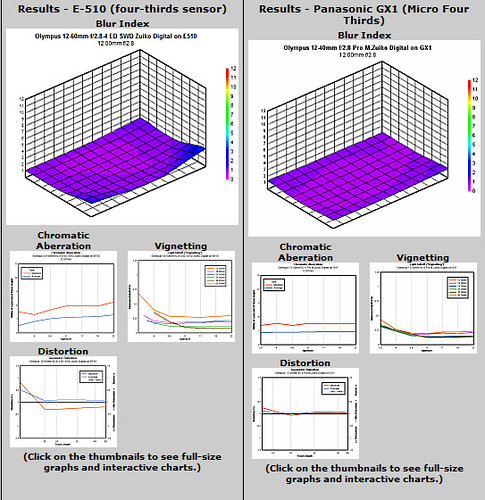
The only reason for writing this short blog post is to talk about the graphic at the top, where the test results of a Digital Zuiko 12-60mm f/2.8-f/4 (on the left) are compared to the new M.Zuiko ED 12-40mm f2.8 PRO lens on the right. I didn't make this comparison, but another photographer did on Flickr (click the image for a larger view and to go to Marty's Flickr stream).

Why do I care about the graphic? I have bellyached for some time about how Olympus isn't making native µ4:3rds versions of various 4:3rds lenses, in particular the 12-60mm and the 50-200mm. Turns out that maybe, just maybe, Olympus has decided to create newer µ4:3rds lenses that are superior to those two regular 4:3rds lenses. The charts show that the optical performance, at least via optical chart measurement, of the 12-40mm is superior to the older 12-60mm. When you compare the two lenses, you come up with the following points:
  • Constant aperture (f/2.8) of the 12-40mm vs variable (f/2.8 to f/4) of the 12-60mm.
  • Smaller and lighter 12-40mm vs 12-60mm.
  • Lower cost 12-40mm vs 12-60mm.
  • Native µ4:3rds mount of the 12-40mm, which means much faster focusing.
  • Silent operation of the 12-40mm, great for video.
The only downside (if you want to call it that) to the 12-40mm is the loss of the longer focal lengths beyond 40mm. It would appear Olympus made the engineering tradeoff to produce a shorter focal length range in order to achieve better optical and physical operation, producing by all accounts the successor to the 12-60mm. Given my personal druthers I'd trade a constant f/2.8 aperture across all focal lengths for 20 less mm in a cold New York minute.

Later this year Olympus will release its second PRO lens, a 40-150mm constant f/2.8 zoom, which just might be the superior replacement to the highly regarded (by me at least) 50-200mm. This will give the Olympus photographer an equivalent focal length range (in 35mm terms) of 24mm to 300mm in two zooms, with decent light gathering performance.

What is interesting is how those two lenses compete head-to-head with the Panasonic 12-35mm f/2.8 and 35-100mm f/2.8 zooms. Now if Olympus can just stay in business long enough to make buying these lenses worth your while...

last updated 13 may 2014

2014-02-15

Olympus OM-D E-M5 Review

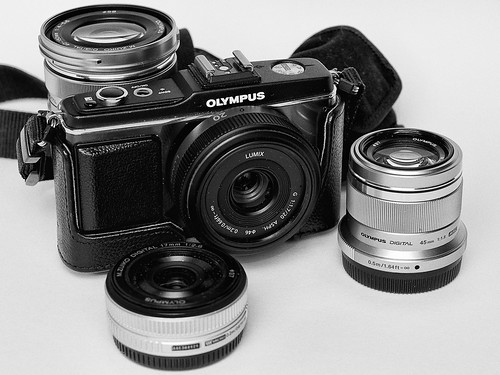
Olympus OM-D E-M5 body only with Panasonic Lumix 20mm
Concept: 4 out of 5
Execution: 4 out of 5
Yeah, but: The last Olympus camera I'll probably buy.
The Long Version:

This is a review that has been a long time coming. The Olympus E-M5 was introduced nearly two years ago on March 2012, and went on to become anointed as Camera of the Year on many photo web sites.. It took me nearly a year to finally purchase my copy in January 2013.

Since that time I've taken about 10,000 images with the E-M5. It has traveled with me down to Key West and half-way across the world to Japan. In all that time the camera has done yeoman duty, delivering images that I've been more than satisfied with. Other cameras have been introduced since (the E-P5, E-M1, and most recently the E-M10), but the E-M5 stands as Olympus' real breakthrough µ4:3rds camera, where everything finally "clicked." Olympus may tweak the design as it has with the newest OM-D cameras, but Olympus will be hard pressed to release the kind of camera the E-M5 represents unless there's a substantial leap in sensor technology, the kind of advance that led to the E-M5.

Prologue

In the past I've harshly criticized Olympus, specifically their E-P3 Pen and their Four Thirds E-5 cameras. I felt at the time of their release (and still feel to this day) that those two cameras were thrown out as a weak sop to their existing user base. They were DOA cameras, iterations built with ageing technology from a camera company that appeared to be growing more irrelevant in a stiffly competitive market.

All that changed abruptly in February 2012 with the announcement of the OM-D E-M5. The Olympus OM-D E-M5 is the complete antithesis of the E-P3 and the E-5. Here was the camera I'd been hoping for, waiting for. It didn't just merely meet my expectations, it exceeded them in so many ways.

The µ4:3rds Olympus E-M5 is the embodiment of the best of Olympus' legendary camera creativity and engineering. It is in my not so humble opinion the best digital interchangeable lens camera that Olympus has ever built. It is an "instant legend", a camera to rank with the OM series of film cameras (specifically the OM-1 through OM-4) as well as the FourThirds E-1, the E-M5's "distant" digital ancestor.

Before we go further let me make one thing perfectly clear: The E-M5 isn't a perfect camera. No camera ever made or currently being made is perfect, regardless of price. The E-M5 can't do everything. But what it can do is does exceptionally well, especially for the price being asked; the E-M5 is worth every penny.

Construction

OM-D E-M5 body cast magnesium alloy frame. Photo courtesy of  Gakuranman

The E-M5 is built around a cast magnesium alloy shell in much the same way as the top-end FourThirds E-1, E-3, and E-5 were built. It's also weather sealed, many say to the same high level as the aforementioned E-1, E-3, and E-5. I have yet to push my luck with the E-M5 in Florida's rainy weather as I once did with the E-3, in part due to the lack of a complete stable of weather-proof lenses in µ4:3rds native mount.

The only weather-proof Olympus µ4:3rds lenses to go with the body are the M.Zuiko 12-50mm zoom, the M.Zuiko 60mm macro, and the PRO 12-40mm zoom. Panasonic makes two zooms they claim are dust- and moisture-resistant; the Lumix 12-35mm f/2.8 and 35-100mm f/2.8. With these five lenses you can build a reasonable weather resistant system, one that's highly portable. Of the five that I mention, the M.Zuiko 12-50mm is the only one I own.

Olympus has a much wider weatherproof lens selection in Four Thirds. For a number of years I had the Zuiko Digital 12-60mm and 50-200mm High Grade lenses out of that collection. Olympus has, for whatever reason, yet to release native µ4:3rds versions of these lenses. While I've certainly missed those lenses, the mitigating factor for me has been the jewel-like µ4:3rds primes I've purchased as alternatives. The emphasis for FourThirds was all zooms, all the time. The µ4:3rds emphasis seems to have shifted back towards a major dependence on primes, such as the Panasonic 14mm and 20mm, the Olympus 12mm, 17mm, and 45mm, and many super-fast primes from third-party manufacturers like Voigtländer and SLR Magic. The only problem is that, with the notable exception of the M.Zuiko 60mm macro, none of the primes are weather sealed.

Operation

The EM-5 body is petite, even with both HLD-6 grips installed.

Olympus OM-D E-M5 decked out with the HLD-6 grips and Panasonic Lumix 20mm

E-M5 with rear touch screen swiveled out

Right-rear edge showing rear controls
HLD-6 Grips

In practice I tend to use the camera with just the horizontal grip installed most of the time to gain a bit more purchase with my right hand. I still have to remove the grip to change the body battery, but that's not a problem. I appreciate the side door loading of the SDHC/SDXC card instead of having to get it out of the battery compartment, like you have to with the newest E-M10 and every other Pen I've ever owned. That's a feature that Olympus has kept only with the E-M1.

Buttons

Many have complained about the squishy buttons. The buttons are not squishy; they're soft. What they lack are the solid detents that non-weather-sealed buttons have. In my case, I've just learned to push until the button stops or else some other visual cue shows that button contact has been made. It's not that big a deal in reality. The only button that really matters on a camera is the shutter release, and all those buttons (on the body and both grips) have the classic half- and full-press detents, which is all that really matters. Reading some reviews you'd think the camera was critically flawed because of its other buttons; trust me it's not.

Shutter

The shutter is remarkably quiet, as quiet as my one remaining FourThirds E-1. That sounds almost like high praise until you realize that the E-1 is nearly 10 years older and is flipping a mirror as well as tripping a shutter. The E-M5 should actually be quieter than the E-1, almost silent. I wish some times the E-M5 shutter were totally quiet, but it's not.  Regardless the sound coming from the E-M5 is what the Brits might call "refined", with absolutely no vibration to be felt in the body.

IBIS

The five axis image stabilization actually works, especially with video. And that's something of a waste on me as I seldom shoot video. As for still images I tend to shoot in fairly bright light with a fast lens, and let the camera auto-select the ISO. The shutter speed thus stays at 1/focal length or faster, negating the need for IBIS. As I said, it really does work if I force it to pick a very slow shutter speed, but for the most part the feature is a waste on me.

As for IBIS noise, I really had to work to hear it, and once firmware upgrade 1.5 landed, I set the IBIS to turn on only when pressing the shutter half-way down. From that point forward it became, for all practical purposes, totally quiet.

Physical Issues

My copy of the camera has developed tiny cracks around two of the three screws along the bottom edge of the swing-out LCD. This was the source of yet another Internet fiasco about the E-M5. It hasn't effected the operation of the LCD in the least, and unless you stick your nose right down into the camera you can't see them. I forgot where I first heard this, but my camera doesn't live in a museum, it gets used in the real world. If it develops a few dings, scratches, and cracks along the way, but continues to operate just fine, oh well...

External LCD

The most productive way I use the camera is with the external LCD swung out so that I can carry the camera at waste level, and touch set up so that I can touch the rear screen to both focus and trip the shutter. Oddly enough I seldom focus through the eyepiece any more, preferring to use the larger back LCD to compose and then touch to expose. I no longer focus, then recompose. The only time I use the eyepiece is in very bright sunlight because the back can get washed out, and in very dark venues to make sure light from the LCD doesn't cause a disturbance. Because of the design issue with the eye-level sensor, I don't have the E-M5 automatically switch. Instead I use the button on the side of the eyepiece to switch manually. Some complain, but I personally prefer it that way anyway.

And the one key feature I like about the rear LCD screen is that it DOES NOT pick up finger grease. Every other camera with LCDs does.

Recommendations

What I'm about to say will probably annoy the few true Olympians who come across this review, but here it is:

(Maybe) Don't buy Olympus.

Why? Because, after nearly a decade using Olympus equipment, from my first E-300 to my E-M5, I think I've had enough. Yes, I do love my E-M5 and won't give it up. But Olympus is now in the exploitative phase of their camera development, and I truly hate that phase. Since the release of the E-M5 they've been dropping a new variant of the E-M5 every six months or so.

I'm tired of being bombarded with how superior/more fun the next release is, and how this specific feature trumps the E-M5's equivalent, etc, etc, etc. Olympus will work really hard to deliver an innovative product (E-1, E-3, E-P1 and E-M5) then spend up to the next three years between innovative releases riffing the same thing over and over again. I consider the E-M1 and E-M10 to be little more than riffs on the E-M5.

When the E-M1 came out, with its built-in grip negating the HLD-6 grip, I knew then what was going to happen. Want to add an E-M1 as a second body? Well, guess what, you can't reuse the grips and possibly other gear. There is no sense of a camera system except at the lens mount.

And speaking of lenses, no matter how many you may have to choose from in µ4:3rds, a lot of them are crap, and duplicate crap at that. Prime example is the 14-42mm kit lens. Just how many 14-42mm kit lenses does Olympus have to keep producing? They're at four right now just for µ4:3rds.

And the 12-50mm kit lens? You can tell how the bean counters got ahold of that design and stripped it down to its bare essentials. Why else do you have macro at 43mm? And f/3.5 to f/6.3? Would it have really killed them to give us f/2.8 to f/4, or possibly f/5.6? And macro at 50mm?

The best all-around lens Olympus ever made in my opinion was the regular FourThirds 12-60mm f/2.8-f/4 lens. We have yet to get that quality of lens in µ4:3rds, the 12-40mm not withstanding. I've given up hoping for a µ4:3rds version that lens, and so many others.

Olympus is in the mode of charging premium prices for very small cameras, and for the kind of money they're asking I'm looking around at other camera makers.

So, if I had to do it over, who would I have bought or who would I buy now, and why?

Buy Nikon

I've owned Nikon. The last Nikon I bought (and still have) is the N90 in 1989. It was rugged enough to survive my use and disuse, and then when my second daughter got it for undergraduate use in 2008, it still worked just fine.

When I started to really buy into digital, it was in 2006 with the Olympus E-300. When I got really serious about digital it was December 2008 and the Olympus E-3. As they say, if I'd only known then what I know now...

If I had to do it over I'd probably have bought a Nikon D-300 instead of the Olympus E-3. Today, if I were getting started, I'd consider the D3300, D5300, and D7100. I know that Thom Hogan rails against the lack of Nikon-made DX lenses, and Ken Rockwell rants against Sigma, but you can build a quite useful DX-based system with any of those cameras and some excellent quality Sigma lenses to fill in Nikon's gaps. Keep in mind that the F mount goes back to the original F-1 of 1959. That means you can put any F-mount lens, good to trashy, on those bodies and shoot away, especially if you learn how to manually focus.

And let's face it, with 24MP and no low-pass filter on the current APS-C sensors across all  three cameras, what you're buying as you move up to the D7100 is better handling and environmental sealing (at the D7100 level). I'm not a big "FF" [sic] sensor fan, don't have the talent to justify spending that much money, and I've never believed in the cost of buying any of the "FF" [sic] bodies from anyone.

APS-C is more than adequate. No matter how much Olympus and Panasonic sensor tech advance, the same advances show up on APS-C sensors, and physics being what it is, the APS-C sensors will always out-perform µ4:3rds. I learned this, ironically, with the Sony NEX-5N, and chose to ignore it (Sony being another brand I would stay away from). Just to further underscore the point the photos of the E-M5 in this review were taken with my Sony NEX-5N and Sigma 30mm f/2.8 at ISO 400. And the NEX-5N has a 16MP APS-C sensor.

Buy Samsung

I've seen a lot of work produced by the NX-300 and its good. Samsung also has a decent range of lenses to choose from. And Samsung isn't going away any time soon, either. There is a new faux SLR mirrorless coming, the NX-30, which has the NX-300 sensor and a built-in SLR-like EVF. Samsung has the sensor portion nailed, at least at the lower ISOs.

What Not To Buy

There are other brands I would stay away from, and they're listed below.

Don't Buy Sony

Sony's biggest problem is lack of a decent selection of decent lenses across all four of their lens lines. They have the original Minolta 'A' mount (APS-C and full frame) and the NEX E mount (again APS-C and now full frame). Sony has four poorly filled out lens lines. Sony would rather toss out a new body (such as the very recent α6000, their replacement for the NEX-6 and NEX-7) with a given mount and sensor size than some decent lenses. Unless you have the patience of a saint waiting for a given prime or zoom not currently covered, you're better served by just about anybody else, even by the cameras I don't recommend.

Don't Buy Canon

My issue with Canon goes back to 1987 when they switched mounts, and I've never gotten over it. They're certainly a larger camera company than anybody else, including Nikon, but I just get the impression they're the GM of the camera world, and they're selling the camera equivalent of Chevy cars and trucks; boring, poorly made, and asking too much. You may like your Chevy, but the last Chevy I owned was a 67 Nova, and it was so bad I bought an import (Honda CVCC) in 1978 and have never bought domestic since. I dislike Canon about as much as I dislike GM.

(Maybe) Don't Buy Fuji

This will probably engender consider hate on the Internets. But I have my reasons. You're paying too high a premium for smallness in cameras, and not getting all that much back. I'm speaking primarily about all the original X series cameras, which I have held and used, and not the X-T1, which I haven't held nor used. The X-T1 may be Fuji's saving grace, so I reserve the right to change my mind on this one.

Fuji's true saving grace is their growing lens line. Lenses made with the same style throughout, and made of metal. That, and the fact you can buy Sigma and Zeiss lenses to fill out any holes in the Fuji X mount line, to name but two one third party makers of note.

What Next?

I'm emotionally and financially tapped out when it comes to buying camera equipment. I haven't bought a single thing in µ4:3rds in some time, not body nor lenses nor specialist gear. I'll use what I've got until it either breaks or I just give it up. The E-M5 is an excellent camera, and I have more than enough lenses to cover the focal lengths I care about.

And perhaps that's as it should be. Stay off the forums, stay out of the stores, and stay out shooting with the gear.

Update 12 May 2014

Olympus' financial results for the Imaging Group (the groups that makes cameras), for the last quarter and fiscal year, have been reviewed by Thom Hogan on his web site, Sans Mirror.  Needless to say they're very ugly. The highlights are:
  • Olympus failed to meet its own mirrorless forecast by 41%
  • Olympus lost money again, to the tune of 4.2 billion yen, and have forecast another loss this coming fiscal year.
  • One third of all Olympus cameras are being sold in Japan, and that was down 5%
  • SG&A (selling, general and administrative) were over 50%, meaning it costs more to make each camera than it makes selling each camera.
If you're into championing underdogs, then Olympus is the best example going in that category. But if you're concerned that the company you buy your camera from is going to be around for a while, then you might want to look elsewhere. I personally have been eying Sony, since (at this point in time) you can get a Nex 6, on discount, with a 16-50mm power zoom, for around US $530. And that's not a bad price. And for those who point out the lack of Sony lenses, might I point out that you can buy Zeiss and Sigma E-mount lenses to fill the gaps.

I love my E-M5 and will use it until it will work no more. But as for buying anything new from Olympus (like an E-M1 or E-M10), I won't unless some miracle occurs at Olympus.

Update 17 May 2014

Maybe I should follow my own advice (see above) about Sony. Or use the same financial yardstick on Sony I used on Olympus. Whether it's Sony's overall corporate losses that have mounted into the tens of billions over the past years, or just the losses in single billions over the past three years in Sony Imaging, Sony isn't doing well.

In imaging alone, Sony has racked up their third consecutive fiscal year loss of $1.29 billion (FY14 ended this past March). They peg that loss to declining sales in video cameras, and an overall decline of 2% in cameras in general.

In the midst of all this they've managed to introduce a refresh of the RX100, the MK III for $800, which is drawing rave reviews for its latest features that photographer's really give a damn about, such as a faster zoom at the telephoto end and a built-in pop-up EVF. And they've announced a selling price of $2,500 for the α7s. But still no new E-mount lenses.

As for Samsung, my definite buy has shifted to a maybe buy. I'm seeing too much flogging of the cameras. I finally got to hold an NX30, and to be honest I wasn't all that impressed with the NX30 in person. I'm a big Samsung booster when it comes to notebooks (Series 5 and Series 7), Android devices (Galaxy Tabs and Galaxy S4) and HDMI TVs. But that's based on personal use. Before I spend the amount of cash Samsung is asking for the NX30 it has to pass the personal feel test, and the NX30 isn't making it.

That leaves Canon, Fuji, Nikon, and Panasonic. And the last two are facing their own corporate fiscal challenges. Photokina is later this year, so Canon may pull off new hardware to excite me. Something worth the financial hit, something more worthwhile than a white SL1. Or I may lay hands upon the Holy and Blessed Fujifilm X-T1 and finally fall under the sway of its Reality Distortion Field and buy it.

last updated 17 may 2014

2014-01-09

A year of LensRentals

For 364 days this year, I didn’t buy a new camera.

It’s not that I didn’t want to. I misplaced my Canon S100, which I enjoyed using. And my other digital system is a Panasonic G1 with a small collection of Micro Four-Third lenses. I like the G1, but it’s over five years old, which may as well be fifty in digital sensor years. It’s time to move on.

However, for a variety of reasons, I’m having trouble deciding what should take its place. And because you can only learn so much from reading reviews online, I’ve been leaning on Lensrentals all year to get more hands-on experience with a wide variety of gear.

What follows are some brief impressions of all the toys I played with in 2013.

Before starting, I’ll fully own up to dilettantism here. A week or two is not nearly long enough to truly judge any camera or lens, particularly with how I was flitting about between brands and formats. And the smarter use of my time would be to just use the stuff I already own. But it can also be quite a bit of fun—even inspiring—to try something new or uncomfortable every now and then. And it (usually!) doesn’t hurt to know what else is out there.

This is also something of a fool’s errand as exciting new cameras are being released faster than I can try them all out without quitting my job or selling my dog.

Finally, Google overlords be damned, I’m not putting any hyphens in product names. I’ve had to look up where they go in “OM-D E-M5” or “X-Pro1” for more often than I'd prefer to admit. It’s gone too far. I’m tired of it. I’m fighting back.

Zeiss ZM C Sonnar 1.5/50

What Matthew said.

I’m having a bit of a love affair with 50mm at the moment, and this may be the most romantic 50mm lens you can buy.

I didn’t spend nearly enough time with this one.

(Although, in my heart of hearts, I think I might be more of a 2/50 Planar type of person.)

Panasonic G5

I went long about the G5 on this very site and concluded:

The G5 checks a lot of boxes but it does so without a lot of pizazz, like an above-average PowerPoint from the accounting department.

Michael Johnston recently called it “very capable but quite bland but very capable”, which is exactly right.

The newer G6 appears to address some of my nits with the G5: the EVF got an update, you can finally (I’m told) disable the toggle button on the command dial, and the camera’s updated look is snazzier – like a mini Leica S2 instead of Frankenstein’s camera. It doesn’t look so much like the bargain that it is.

If you want an EVF and the cost of an EM5, EM1, GH3, GX7 or EP5+VF4 is a bit dear, the G6 looks like a screaming deal.

Fujifilm X100S

The adulation this camera receives is mostly justified. It looks great, feels great, and the autofocus, menu system, and control layout are light years ahead of the original X100.

Image quality is astonishing. I spent a lot of time in Lightroom gobsmacked at the detail and lack of noise at ISO 6400. The 35mm equivalent f/2 lens is well matched to the sensor. It’s also more or less my ideal walk-around setup, but that’s maybe because I’ve been walking about with a Zeiss Ikon and the 2/35 Biogon for a few years.

The aperture ring has firm whole-stop clicks that feel much nicer than the mushy third-stop clicks on the 35mm XF lens I used.

As with the XPro1, fumbling between viewfinders is still a point of friction for me. I had more fun if I forced myself to use only one and lived with its limitations. I’m also certain that with more experience I’d better be able to predict when I’m about to brush up against those limitations.

I lusted after this camera so badly … right up until I tried a Ricoh GR.

Fujifilm XPro1 & Fujinon XF 35mm f/1.4

I wrote a longer review of this pair. I'd call it tough but fair.

I would like to give the XE line a try; with only an electronic viewfinder my suspicion is that the XE will be slightly easier to use—if slightly less fun without the optical viewfinder, also.

Olympus OMD EM5

I understand why people adore this camera.

It’s a lot of camera packed into a tiny space. The pictures online can mislead you into thinking it’s the same size as any other DSLR, but hold one for yourself and you’ll probably be as astonished as I was.

The specs are great. The pictures are wonderful. The new stabilization system is a miracle worker. You can customize nearly every aspect of its operation. Everything is super responsive, with a “yessir!anythingyouwantsir!” zippiness. It’s built like a fine precision instrument: quality and choice of materials is top-notch everywhere.

Again, I totally understand why people love the little thing.

But …

(here come the emails)

… together with our oversize brains, our hands have kept us humans on top of the food chain for two million years. So it is with some alarm that I report that our hands have a new enemy: the OMD EM5.

I could not get comfortable holding it. I don’t mean it like “well the corner pokes a little” (it does) but rather much worse: it outright hurts to hold it for longer than a minute. I didn’t find the textured area on the front sufficiently grippy, the thumb rest forces your hand into a cramped position, and it’s an awkward reach to both command dials, especially the rear one. The angles are just all wrong for my hands.

(Your mileage on this will vary, but I was relieved to find out that I’m not the only one that feels this way.)

The HLD6 add-on grip helps some. But if you determine that you’ll need the grip, you might as well buy an EM1. You’ll even get a bigger, more awesome viewfinder as a bonus.

All this to say: definitely spend a decent chunk of time holding an EM5 (or any camera!) before you drop a grand on one.

Panasonic GX7

My initial impression is that this is the current Micro4/3 sweet spot in balancing handling, advanced features, customizability, performance, image quality, size, and price.

I still want to take the GH3, EM1, and maybe a G6 for a spin, but unless they really impress me I think the GX7 will be the next system camera I buy.

Pentax K5 & 35mm f/2.8 Macro Limited

I wasn’t sure such a camera existed: the K5 has all the physical controls I want in exactly the place I want them.

This includes the Pentax-specific “Green”/“*” button, which powers the ridiculously named but seriously powerful Hyper-Program and Hyper-Manual modes. Lemme tell ya: every semi-serious photographer should take those modes for a spin. Hyper-Program is your basic Program mode but with instant access to Aperture Priority or Shutter Priority, no mode dial required; Hyper-Manual gives you the stability and predictability of full Manual mode but with vastly less needle-chasing. Either might totally change how you shoot. I can’t believe other brands haven’t copied these.

The camera is solid, heavy, and reassuring for those times when you need a bigger dick to swing around. But it’s still a soft touch: the shutter and mirror are shockingly quiet for a DSLR.

As for the 35mm Macro, no one makes DSLR lenses like the Pentax Limiteds anymore. It backs up the forged good looks with excellent image quality and almost no flaws. It even has a built-in hood, which is handy. Shame it’s not weather-sealed to match the camera.

This mostly confirms my suspicion that Pentax makes the only APS-C DSLRs worth looking at.

Ricoh GV2 28mm viewfinder

It’s tiny! But I had difficulty seeing the entire frame with glasses on. So it’s not very fun.

Also you’re missing out on the toy-camera good looks of the larger GV1 viewfinder.

Pass.

Ricoh GR

Matthew’s recent ongoing praise is not even a little out of line: The GR is the smartest, best thought-out digital camera I’ve ever used. It treats an advanced photographer with respect instead of ambivalence or (too often!) hostility. Because I haven't used any of the GR's predecessors, I'm so astonished at the design and usability that the huge image quality packed into a tiny box is almost the least impressive thing about it.

A major flaw is that I don’t think I see well with a 28mm-equivalent lens. I could learn.

In fact, I better: I ordered one for keeps on New Years Eve and it showed up yesterday.

2013-02-04

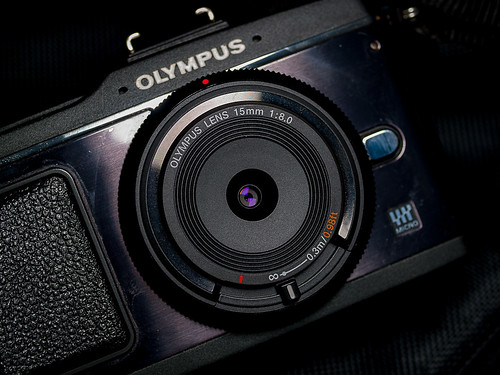
Olympus BCL-1580 15mm 1:8 Body Cap Lens

Olympus BCL-1580 Body Cap Lens
Concept: 5 out of 5
Execution: 5 out of 5
Yeah, but: So what if it's ranked 2,872nd by DxOMark.

The Long Version: There's really not a lot to say about an all-plastic µ4:3rds prime that has just three lens elements, two focusing stops, and costs a mere US$49. You can read all the more flowery prose about this optical wonder on the web by those who've purchased their copy and then written about the experience. This lens was priced so low that even I, Mr. Penny Pincher Photographer (P3), was able to buy a copy without giving it a second thought. And I can honestly say it's worth every pinched penny I spent.

In a world where Holga and Instagram seemingly reign supreme, the BCL-1580 15mm prime is a down-to-earth non-pretentious alternative that will make quite reasonable photos (given enough daylight) if you concentrate on composition and story telling instead of the affectations of ultra-sharpness, shallow depth of field, and damnable bokeh (for which there is a special place in the ninth circle of Hell for the man who coined that term).

The BCL-1580 has no autofocus. You select either the infinity hyperfocal point or the close focus point at around 1 foot from the camera. 99% of the time it'll stay on infinity. It has only two glass elements, a small outward facing lens and a slighter larger inner lens facing the sensor. The aperture is a simple hole in a piece of plastic that sits centered between the two lens elements.

Even though it's not a Zuiko branded lens, somebody at Olympus still had the good sense to at least put some simple lens coating on at least the front glass element. It doesn't need much more than that, considering its one and only aperture setting is f/8. Because it has no focus motor it absolutely has no focus noise, and with its simple hole-drilled-in-a-plastic sheet aperture it has no aperture chatter (like the far more expensive Panasonic Leica 25mm 1:1.4). When it's mounted on a Pen there is no delay in turning the entire camera on or off, thus saving battery power because you don't have to wait to turn the camera back on. And if you break the BCL-1580 or it gets stolen, so what? It's cheap enough that you can go buy a new one.

The Photographer
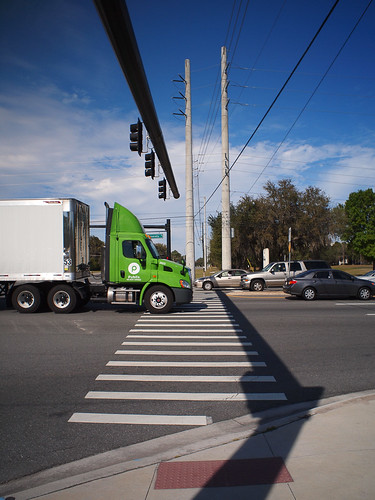
The Cross Walk
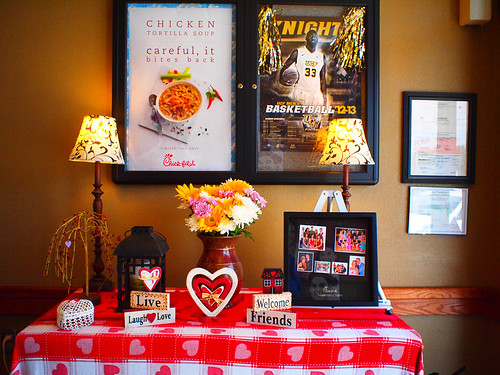
Local Chick-fil-a
Fifteen Experiments Group 1
Streaking Home

It's a lens that will work with any Pen, from the original E-P1 to the latest Pens and OM-D. It can breath new life into a µ4:3rds body that's taken to sitting unwanted on the back shelf or unloved in the bottom of your bag. The lens, combined with any of the Pen's art filters, can produce any number of charming, interesting, Holga- and Instagram-beating photographs, with any subjects ranging from the urban core to what's left of the not-so-great out doors.

Some are want to call it the ultimate street photography lens. I use a less grandiose description; to me it's just about the best documentary lens I reach for when I want to go out and not have to worry about anything. The only other µ4:3rd lens I own that comes anywhere close is the Panasonic Lumix 14mm 1:2.5. Using the BCL-1580 strips away all vanity and pretense. It makes photographs, not a statement.

This little $49 gem is the ultimate µ4:3rds lens worth owning. If you can't use this lens and take simple enjoyment in using it, then you don't deserve to own or use any other. This is camera optics stripped down to its bare essentials. All other lenses are just more expensive and gilded versions of this little 15mm.

Technical

Top hero photo taken with an Olympus E-1 and Zuiko Digital 50mm 1:2 macro, lit by a single LED light panel. The next three photographs were taken with the 15mm mounted on my E-P2, the next four with the 15mm mounted on my E-PL1, and the last with the E-P2 + 15mm.

last updated 5 feb 2013

2013-02-01

Olympus 75-300mm 1:4.8-6.7 II

M.Zuiko MSC 75-300mm 1:4.8-6.7 II zoom (photo Olympus)
Concept: 2 out of 5
Execution: 2 out of 5
Yeah, but: Here we go again...

The Long Version: You're looking at the Mark II version of Olympus' only long native µ4:3rds zoom lens of any description. You can look over at Olympus' older 4:3rds mount lenses and note Olympus has at least three to choose from; the SG 70-300mm 1:4-5.6, the HG 50-200mm 1:2.8-3.5 and the SHG 90-250mm 1:2.8. Unfortunately, not so much choice with µ4:3rds.

In the beginning all µ4:3rds Olympus zooms stopped at 150mm (14-150mm 1:4-5.6 and 40-150mm 1:4-5.6). It wasn't until the original 75-300mm was released 31 August 2010 that Olympus had a "real" zoom that gave the Pen user a long focal length that at least matched the 4:3rds reach. The problem with the original 75-300mm was the initial MSRP of $900, for what was perceived by many (including me) as small and optically slow, especially at 300mm. I for one even refused to consider buying the lens because of the cost, its slow speed (especially when compared to the 50-200mm for just $200 more) and the unforgivable lack of weather sealing, especially for a lens that cost that much.

MZD-ED75-300mm_09m_Black_XL
Original M.Zuiko MSC 75-300mm 1:4.8-6.7 zoom (photo Olympus)

At the time of the original zoom's release I was greatly unimpressed, so much that I even refused to go to a nearby camera store and even try it out.

Time passed and it would appear that the original 75-300mm languished on many a store shelf. Panasonic released it's own long zoom, the Lumix 100-300mm 1:4-5.6 zoom. The Panasonic zoom was interesting in that it was a half to two-thirds of a stop faster at both ends. Depending on who's review you read, it would appear that the Zuiko might have an edge in overall image quality, but then the Panasonic was good enough and was (and continues to be) offered for a mere $500, $400 less than the Olympus equivalent. A large majority have voted with their pocketbooks and purchased the Panasonic, while a very few, such as Torontowide, have embraced the 75-300mm and created quite good work with it. Yet here we are, 2+ years after its initial release, with the second version close to the Panasonic 100-300mm in price. Things that make you go "hmmm".

I actually need at least a 200mm native µ4:3rds lens, and the 75-300mm II is at least inexpensive enough to pull me into a camera store to try it out. Even though the optical speed is still the same slow values as before, the release of the Olympus E-M5 with excellent image quality all the way to ISO 3200 takes some of the sting out of the slowness of the zoom. Granted I would love to purchase a native µ4:3rds equivalent to the 50-200mm 1:2.8-3.5, I can live with a zoom that's one stop down from that.

Here's one for anyone who's listening in Olympus' marketing department: I would have paid $900 for the Mark I if it had been 1:4-5.6, it had come with a lens hood, and if it had been weather sealed. In fact, if they'd kept the price for the Mark II as the same for the Mark I and added weather sealing (and a lens hood) it would have drawn my credit card out of my wallet. I swear it appears form the outside that the Olympus lens engineering group and the body engineering group don't talk to one another. The E-M5 was released a year ago January 2012, which means that this new release could have been the third weather sealed lens to go with the E-M5, along with the 12-50mm and the 60mm macro. It isn't the amount of money I object to spending, it's the value for money spent. The older 75-300mm just didn't have a high enough value for the asking price, while the Mark II just barely based on the printed specifications...

I will probably try out the Mark II when it arrives on local camera store shelves, but I will not pre-order one. I'll put it on my E-M5 body and see how it performs. If its IQ is reasonable, especially at 200mm and beyond, then I'll more than likely purchase a copy. If anything, all Olympus has done is convince me to give the Mark II a try, something I never did with the Mark I.

Update 2 February

Call me fickle. I went to my local camera shop, the one that has the Mark I in black. They pulled it out and handed it to me to look at, and I have to admit it was very well built and of very high physical quality. Every seam was tight, and with the barrel fully extended to 300mm there was no play in the inner barrel. I almost broke down and and purchased it right there except someone had left a scratch (a rather noticeable divot, actually) on the front element. I guess the universe really doesn't want me to own this lens.

last updated 2 feb 2013

2012-03-24

Olympus M.Zuiko 9-18mm Wide Zoom Lens


Concept: 3 out of 5
Execution: 2 out of 5
Yeah, but: I love lens names like "M.Zuiko Digital ED 9-18mm f4.0-5.6".

The Long Version: Bill has already spent some time with the Olympus 9-18mm lens for Micro Four Thirds, and came away with mixed opinions. So when a friend of mine offered me a chance to borrow his copy, I couldn't resist – so this marks the first time on Thewsreviews that two different people have reviewed something that we don't actually own.

And a note for Four Thirds users about the product photos used in this review: the softness and blur that you see is not a defect. It's an optical quality called "shallow depth of field" that can happen when using a lens with a wide aperture on a large sensor. There's no need to remember all that, though, since the term "shallow depth of field" and "Olympus 9-18mm lens" will never again be used in the same sentence.


My first impression of the M.Zuiko 9-18 is that there's a lot of plastic involved. I've previously owned the godlike SHG Olympus 7-14, and currently have the well-built Panasonic of the same focal length. But moving to the little Olympus 9-18 is another step down in terms of feel and handling, and that's an impression that's hard to shake when it comes time to start taking photos.

And speaking of shaking when taking photos, there's a distinct wobble in the 9-18's lens barrel. It's not floppy, but when I shake my wrist I could feel the movement. I could usually tell when it was extended to its longest physical length, at 9mm, versus when it was at its shortest length at 18mm. With practice I might be able to distinguish the intermediate focal lengths as well, but I didn't have that much time with the lens.


A lot has been made of the collapsable lens design. This does make it smaller in storage, but bigger in use; personally I don't think that the tradeoff in the fit and finish of the lens is worth it. The resulting small size also something of a trick – or perhaps an illusion – because the Olympus lens is actually larger than the Panasonic 7-14 when it's in use, especially when the hood is included.

It's also worth noting that the lens hood that's on my test lens is "optional" in the sense that it's not included and costs extra, not optional in the sense that it's a take-it-or-leave-it thing that doesn't really matter either way. While flare is remarkably well controlled even with the sun in the frame, I was happy to have it for the extra shading and physical protection that it provides. For people with variable-aspect Panasonic sensors, it's good to know that the hood doesn't vignette even when the camera's set to a 16:9 ratio.


When people talk about the optical quality of the micro 9-18, they usually start by saying how small it is. That's not a good sign.

But perhaps I expect less from my Micro Four Thirds cameras than Bill does, as I tend to use my GH1 more for snapshots and casual photography, leaving the IQ-critical tasks to my other cameras. As a result the sharpness, flare resistance, and aberration suppression of the 9-18 was perfectly serviceable for me. Not stellar, but solid. I can't really say that I took any "wow" photos in the four-day weekend that I had it for, but wide angles are notoriously hit-or-miss to begin with.

What I did see in from the lens didn't leave me burning to spend a lot more time with it. It's essentially a 'kit lens' in ultra-wide form, and the slow 4-5.6 aperture isn't an endearing characteristic. That's usually justified in exchange for smaller size and lower cost, but the Olympus achieves only mixed success with that compromise.


My huge stumbling block was the amount of distortion at the wide end of the 9-18's range. Wide lenses on little cameras are a natural choice for cities and interiors, making this very objectionable. And while it could be user error, I consistently found the distortion more pronounced on the right side of the frame. I needed to minimize the appearance of the barrel distortion by composing at jaunty angles, which was fun for the weekend, but not something I would want to see in every photo of a far-off city.

What makes the poor distortion correction even worse is that the 9-18mm is a really useful focal range. At 9mm it's wide enough to create some very powerful perpective exaggeration, while 18mm is a standard slightly-wide lens that provides a very natural point of view. I would be happy with having only this range for a day's walk, while I'd want to carry the 20mm along with the 7-14 to give me the same flexibility.
 Olympus M.Zuiko 9-18mm on Panasonic GH1

The Olympus 9-18 remains a difficult lens to recommend. It's not as expensive as the Panasonic 7-14, but a well-known New York camera store currently lists the Olympus at $700 and the Panasonic for under $900. Frankly, that should be too small a difference to be significant when deciding on a lens that will provide years of service. So it comes down to practical considerations of the focal length range and optical quality.

In most respects the Panasonic 7-14 lens is better than the Olympus 9-18. Better built, brighter, better corrected: as a specialized ultra-wide it wins without question, but that's not the only consideration.

The Olympus has a range that can stand on its own as a general purpose wide-standard zoom lens, perhaps replacing a 14-42, especially if it's paired with a long zoom or the bright Olympus 45/1.8 prime. I wouldn't buy it as an ultra-wide, but rather as a short zoom with the occasional extra-wide option when it would suit the subject and the photograph. But even for that more modest goal, the price to performance ratio is a tough sell. I want to like this M. Zuiko lens more than I do, so like Bill, I remain conflicted.


last updated 24 mar 2012

2012-03-05

Olympus M.Zuiko MSC Digital ED 9-18mm µFourThirds Zoom Lens


Concept: 3 out of 5
Execution: 2* out of 5
Yeah, but: A conflicted lens and a conflicted review.

The Long Version: Over a three week period, from mid-May to early June of 2011, I was given the opportunity by B&H Camera to test the Olympus M.Zuiko (MZ) 9-18mm µFourThirds lens on my Olympus E-P2 body. I used the lens to photograph my corner of the world in Orlando, Florida. All of my testing was done under available light, most of it out-of-doors. It was an opportunity to not only experience the MZ 9-18mm, but to compare it to the original Zuiko Digital (ZD) 9-18mm for regular Four Thirds which I own. So be warned that this is an “experiential” review, devoid of any technical testing what-so-ever.

Overview
Released in the first quarter of 2010, the M.Zuiko version is the second 9-18mm 1:4-5.6 zoom that Olympus has released, and the third µFour-Thirds lens after the 14-42mm and 17mm kit lenses. The first was the ZD regular Four Thirds lens a full year before that. To appreciate the difference a year can make, let’s perform a brief comparison of the two designs.

Design comparison between the two versions

While it appears at first glance there’s little to differentiate the two, a closer inspection reveals important differences. The ZD 9-18mm is built with 13 elements in 9 groups, of which three are of special glass. The MZ 9-18 is built with 12 elements in 8 groups, of which five are of special glass. Note that the diagram of the µFour Thirds shows the lens in its collapsed, or stowed, position. When extended to its operational length, the µFour Thirds version is a long as the original version, although noticeably smaller in diameter. Of greater significance is how the lenses operate.

The ZD 9-18mm is a ‘fixed’ non-expanding lens in which the front element moves in concert with the other lens groups for focusing. If you look directly at the front of the ZD you’ll notice a narrow gap between the section where the front element is mounted and the outer edge of the lens barrel where you would attach a screw-on filter. This allows the front element to freely move while focusing. In contrast the MZ version’s front element is a solid part of the outer barrel; only the central element moves for focusing. It’s this design that contributes to the MZ’s ability to focus quickly and silently (more on that later).

What the diagrams can’t convey are the major differences in the two lenses overall size and weight. The original 9-18mm has an 80mm diameter (requiring 72mm filters) and weighs 280g. The µFour Thirds version has a 57mm diameter (requiring 55mm filters) and weighs 155g. Those differences in size and weight are profound when mounted on a µFour Thirds body such as the E-P2. Whether retracted or extended for use, the µFour Thirds MZ lens truly belongs on a µFour Thirds body such as the E-P2. The original 9-18mm lens, with its required adapter, does not.

Operations
My first exposure to the Olympus collapsing lens design was with the MZ 14-42mm Mk 1 kit lens. It came as part of the E-P2 bundle. The purpose of the collapsible design was to create a package that was easily transportable. I won’t say pocketable, because unless you’re wearing a large coat with large pockets, the E-P2 with kit lens won’t fit into any kind of regular pocket I’m aware of.

The µFour Thirds 9-18mm is a collapsible design like the M.Zuiko 14-42mm Mk 1 kit lens. What is interesting is that the M.Zuiko 9-18mm lens, both collapsed and extended for use, has the same lengths as the M.Zuiko 14-42mm Mk 1 kit lens in its collapsed and extended modes. If you’re comfortable with the kit zoom you’ll have no issue with the MZ 9-18mm.

A less-pleasant aspect of the MZ Mk 1 kit lens is its inexpensive construction. You know when you’re opening and closing that lens; you hear it clicking and can feel it as it moves from stowed to operational position. And once deployed, various elements of the 14-42 are, shall we say, not quite mechanically tight.

Not so with the MZ 9-18mm. It extends and collapses with silent smoothness. I could barely feel the lens barrel as it moved across the mechanical switch. Unlike the kit zoom, there was no flexure of the zoom ring whatsoever. From the time I put the lens on the E-P2 until I took it off to send it back to B&H, the operation of the zoom mechanism was smooth as silk and for all practical purposes totally silent.

Focusing
There are two aspects to focusing with this lens; speed and silence. Among the alphabet soup of letters on the MZ barrel there are three new letters to designate new capabilities for this lens compared with all other Olympus lenses: MSC. MSC, or Movie and Still Compatible, is the latest µFour Thirds lens designed specifically for both video and still photography.

As I mentioned earlier the MZ 9-18mm has a different internal focusing design from it’s regular Four Thirds ancestor. That design allows for quick and silent focusing operation. While it was mounted on my E-P2 it was the fastest focusing lens, faster than any of the µFour Thirds lenses I’ve used to date.

It was also the absolute quietest. For testing purposes I used am EMA-1 external microphone adapter with the ME51S dual electret condenser stereo microphone plugged directly into the adapter. The microphone sat directly above the lens. I put the E-P2 into video with autofocus, and swung the camera back and forth a number of times from a near object to infinity. On playback of the recorded video I could not hear the lens focusing at all. My copy was totally silent. All my other lenses make a mess of the sound being recorded with the video.

General Photography
You can find all sorts of charts and learned opinions about the optical quality of the lens all over the web. The question is, does it really matter? How does the lens behave under standard operating conditions, especially when compared to the first version?

One of my first acts with the purchase of my E-P2 was to purchase the Olympus Four Thirds to µFour Thirds adapter, the MMF-1. I used the adapter to test my regular lenses on the E-P2 body, specifically the 9-18mm. While the autofocus operation of the lens wasn’t ideal, I couldn’t fault its image quality. With the MMF-1, the ZD 9-18mm was as well behaved optically on the E-P2 as it was on my E-3.

I can’t say that about the M.Zuiko version. Both lenses are slow, with a maximum aperture of f/4 at 9mm. As a consequence I tend to shoot the regular Four Thirds lens wide open as much as possible. If I do stop down it’s usually to f/5.6, at which point the lens become a constant aperture zoom for all practical purposes.

When I tried to use the M.Zuiko version in the same fashion as the regular version, I found center sharpness of the MZ version was indistinguishable from the original, but  I was disappointed in the noticeable corner softness of the MZ lens, especially when close focusing. My original version was much sharper. Stopping down to f/5.6 helped, but I didn’t achieve the same level of sharpness with the MZ version until I'd stopped down about a stop and two-thirds to f/7.1. Those differences tended to minimize as the lens was used for regular distance photography (outside architecture and landscapes). The corner issues began to show up when shooting interiors wide open, such as small to medium sized rooms, or something down close like flowers. Then I could see the difference.

With either lens wide open there is some vignetting, more so with the MZ than the ZD versions. But considering you can add vignetting to your photos during post processing with applications such as Adobe’s Lightroom, I find concerns about lens vignetting somewhat amusing. It might be there but for all practical purposes it’s irrelevant.

Barrel and pincushioning are complex on this lens. While I can certainly find situations to point them out, I don’t find it particularly noticeable. When I do there’s Lightroom to fall back on to clean it up.

Chromatic aberration, if it does show up, only shows up around the edges under extreme light contrast. Once again, if it is noticeable it can be cleaned up in post.

All of these comments presume you shoot raw and post process. For those who want SOOC images, just realize your mileage will vary, and you should probably borrow a copy and see if you can live with its JPEG output.

Recommendation
This lens is best suited for videographers who want to use this lens for creating movies with the Pens and who feel they need a zoom lens that zooms to 9mm. Its totally silent operation is a boon to those particular videographers.

For still photographers, the best group this lens would serve are those who again need 9mm in a zoom lens and place a premium on light weight for travel and/or outdoor hiking, or for those photographers in settings where they wish to be as discrete as reasonable. This lens’ small size and silent operation are a great help in those areas.

For my own personal use I’m not so sure. The question you’re probably thinking is “Bill, would you buy this lens?” And my answer is “No.” I won’t buy it due to its higher than expected cost, especially for a lens that is heavily composed of plastic. Its overall quality is certainly head and shoulders above the 14-42mm kit lens, but it didn't have far to stretch. I’m not interested in paying more for the M.Zuiko version than I did for the Zuiko Digital, especially when the M.Zuiko is considerably smaller and lighter (using less materials in manufacture). Add to that my dissatisfaction with the M.Zuiko’s image quality under certain conditions, conditions in which the original is a stellar performer, and I find I’m not inclined to spend the money. You can argue my sample copy might have had mechanical issues with regards to image quality in the corners under those peculiar circumstances, but that doesn’t answer my criticism with regards to size-vs-price.

What would be the "ideal" price be for this lens? Probably around $400, not the $600 or more I’ve seen it advertised for. For what you can spend on the MZ 9-18mm you can pick up two faster Panasonic pancakes, or Olympus’ lovely 45mm with plenty of change to spare. If you’re intent on spending that much on the 9-18mm you should at least consider two alternatives, the Olympus 12mm 1:2 or the Panasonic 7-14mm 1:4. They both cost more, but these are lenses that are worth the investment. In my opinion, the M.Zuiko 9-18mm at its current price point, not so much.

Apologia
This review has been a long time coming. It was originally destined for another µFourThirds enthusiast site. That site owner set up a sweet deal where I would get equipment on loan from B&H for 30 days, enough time to use it and then review it. The MZ 9-18mm was to be the first of many µFourThirds lenses. I thought I'd hit the big time.

But as I got to know the lens I realized I couldn't give it a sweeping recommendation like I originally thought I would. Just as I've written, I had the original FourThirds 9-18mm lens and found it to be a sweet little performer. I expected no less from the µFourThirds version. But for me it didn't turn out that way.

That left me in a real ethical quandary. How could I pan an expensive piece of kit that was given to me? I'm sure a lot of other reviewers don't have this problem, but being very new to this I had no idea what to do. As a consequence it took quite a while for me to write it before sending it to the site owner who'd originally commissioned it. In the end the site owner allowed me to publish the review here. And before you ask, it's an excellent site, and they're not pushing for rosy reviews on gear. It's just me with the hangups.

This is the first and last piece of free kit I'll ever review. Every other review of gear on this blog (or my own) has been and will be bought and paid for by me. Normally I pepper my reviews with sample photographs taken with the item under review. This time, if you want to see the results of what I shot, you can follow the link to my Flickr set and judge for yourself: http://www.flickr.com/photos/wbeebe/sets/72157626668272915/

* It is now a qualified 2 (think of baseball). I relented somewhat based on the conversation in the comments and thinking about it for a while. Even though it's been raised from a 1, I still won't rush right out and buy a copy.

last updated 8 march 2012

2012-01-29

Panasonic Lumix G 20mm F1.7 ASPH.

Panasonic 20mm Side

Concept: 4 out of 5
Execution: 3 out of 5
Yeah, but: So what took me so long?

The Long Version:

This is the second review of this lens. Matthew wrote the first, an excellent review when he purchased his copy over a year and a half ago. Rather than repeat what he wrote, I'll refer you to his review. I'll wait here while you go and read it.

I first considered the 20mm when Matthew wrote his review. Unfortunately the price at that time for the 20mm was its MSRP of $400, or $150 more than the Olympus 17mm. So being the cheap guy that I am I purchased the 17mm and went off happily using it for all sorts of subjects, none the wiser.

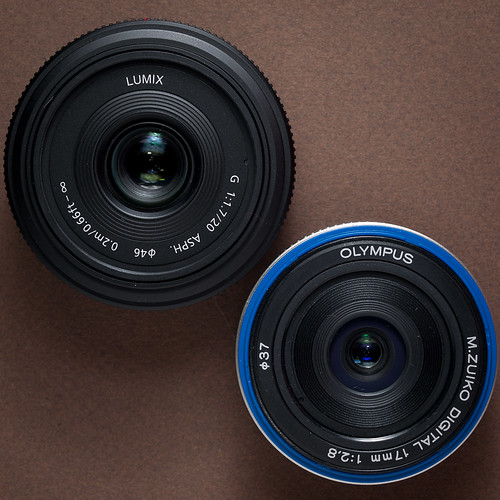
Panasonic 20mm and M.Zuiko 17mm
Panasonic 20mm on the left, Olympus 17mm on the right,
minus its front cosmetic outer ring.

I even wrote a review about the 17mm not long after Matthew wrote his 20mm review, extolling the 17mm's virtues. Over the period I've owned the 17mm I've certainly taken my fair share of photographs with it. Yet, in spite of its lower price and slightly smaller size, there's one key feature that the Panasonic has that's superior to the 17mm; the 20mm is one-and-a-half stops faster than the 17mm. This feature alone makes it superior to the 17mm in very low light situations or situations where excellent separation of foreground subject from background is needed. When the price of the 20mm dropped to near $300 this past December, I finally purchased a copy for myself.

Self Portrait - First Light 20mm
Self portrait - First Light 20mm

As I mentioned one of the two key features I found attractive about this lens is its separation of foreground and background in a very tiny package. When the 20mm arrived the first thing I did was slap in on my E-P2, set it to f/1.7, turn the camera back around to face me and fire off this lovely portrait. Look at the larger version (if you can stand to) and you'll note that elements in focus in the center part of the image are quite sharp and clear, such as my glasses frame, the dirt on my face, and the strands of my thinning hair straggling down over my furrowed brow. I also like the way that focus quite rapidly drops off, which you can see on the shoulders of my t-shirt. I've quickly come to appreciate the quality of this lens wide open, and make it a habit to shoot with it wide open as much as possible.

Chimping Her Camera

The lens' wide aperture of f/1.7 comes in handy in low-light situations. In this photo I was able to keep the ISO down to 400, which is only one stop faster than the E-P2's base ISO of 200. If I'd had the 17mm I would have had to move it up to ISO 1,000, where noise begins to show up. I know what's been written elsewhere about the E-P2's high ISO performance and how it's acceptable up to ISO 1,600, but it's been my experience to keep ISO as close to base as possible. So I juggle shutter speed, f-stop, and ISO in these situations, giving priority to keeping the ISO as low as practical. It's a shooting methodology I've had since my first days of 35mm film. After over 40 years of photography I much prefer to shoot no higher than ASAISO 400.

Welcome to Lake City Florida

Another feature I've come to appreciate with this lens is its apparent lack of barrel distortion or pin cushioning regardless of the aperture setting. The 17mm has noticeable pin cushioning wide open (f/2.8), which begins to clean up one stop down and is almost completely gone by f/5.6. But the 20mm doesn't have any to speak of, which makes shooting architecture a real joy, particularly when you don't have to clean up any distortion in post. And if you think you see distortion above, let me assure you that the concrete sidewalk in front of that Greyhound station is actually warped.

Tifton

The 20mm also has a different color character from the 17mm. I can't quantify what is different about the 20mm, but I like the colors that come out of the 20mm mounted on the E-P2. While the 17mm is quite capable of producing great color under the same lighting, I have to give the nod to the 20mm.

Ride 'em Cowboy

The 20mm makes for a superb all-around travel lens, capable of rendering exquisite detail between f/5.6 to f/8 in broad daylight. The photo above was taken with the E-P2's ISO set to 200. The 20mm coupled with the dynamic range of the sensor at this ISO can produce some pretty remarkable results.

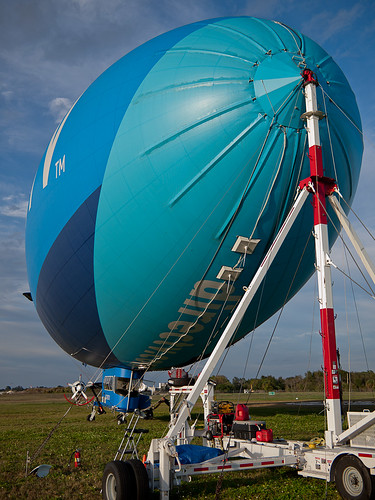
Blimp Starboard Mooring

Although the field of view of the 20mm is definately less than the 17mm (57° vs 65° respectively), it's still wide enough that with careful composition you can dramatically photograph large objects such as the DirecTV blimp. In the photo above the 20mm was stopped down to f/2.8 and ISO once again set to 100. The lighting, the dynamic range, and the depth of field, coupled with the focal point gives the appearance of sharp focus from the mooring tower to the airship's tail. Yet the background is out of focus enough to help hold the viewer's attention on the airship. I can honestly say I could not have achieved this level of image quality with the 17mm at its widest, f/2.8.

Conclusions

As good as the Olympus 17mm is, especially stopped down, the Panasonic 20mm is better, especially when you realize that the 20mm is already closed down 1 1/2 stops at f/2.8. While the 17mm is physically smaller, it's only barely so.

The 20mm actually gives exposure "breathing room" to the E-P2, allowing it to be used at lower ISOs more consistently than with any other µ4/3rds lens except the M.Zuiko 45mm 1:1.8 (which I also now own) and the M.Zuiko 12mm 1:2. And with the drop in price of the 20mm bringing the price differential between the 17mm and the 20mm to less than $100, there's no real reason to purchase the 17mm independent of the 20mm any more.

There's also the issue of build quality. I've groused about this already, but I'll say it again; ever since the early 1980s starting with Olympus OM equipment I've never had bits fall off of any Olympus lens, except for the 17mm. While I was on a trip to Boston last March the front outer ring over the blue plastic you see on the 17mm above simply fell off and onto the ground. I heard it hit but never found it in the street. The 17mm still functions, but the idea of something just falling off bothers me and gives the lens a bad mark in my book. The 20mm looks and feels better built than the 17mm. Hopefully nothing will fall off the 20mm during normal use.

I'm glad I have the 17mm, and I'm glad I had it for as long as I did. It served yeoman duty and was the most used lens of all my regular and micro 4/3rds lenses. But I've got the 20mm now, and it's going to cut into the use of the 17mm considerably, and that seems a bit sad. I wish that Olympus had released an f/2 version of the 17mm, and beefed it up a bit, but Olympus was apparently working on the M.Zuiko 12mm 1:2. At its current price of around $700, I don't think I'll be picking up a copy any time soon, so the 17mm will take the spot the 12 would have if my budget would allow it.

When Matthew wrote his review back in 2010 he called the Panasonic 20mm "the single best lens available for micro four-thirds cameras." While it now has to contend with the Olympus M.Zuiko 45mm and 12mm lenses, it still holds its own quite well with those two lenses. It isn't that the Panasonic 20mm is any worse for the Olympus lenses, it's that Olympus has finally stepped up its game to at least match the 20mm. The 20mm is still well worth the purchase, especially as part of a trifecta composed of the 12 and 45mm lenses.

last updated 29 january 2012

2012-01-27

M.Zuiko Digital ED 40-150mm f4.0-5.6 R

M.Zuiko 40-150mm R on E-P2

Concept: 3 out of 5
Execution: 3 out of 5
Yeah, but: It's just dandy for what it sells for.

Background:
Olympus has a habit of re-introducing two zoom lenses repeatedly. One lens is the 14-42mm 1:4-5.6 kit lens. The other zoom lens that Olympus has released repeatedly is the 40-150mm zoom. It first appeared along with the 14-45mm when the Olympus E-300 was introduced. It was a rather large lens with an aperture range of f/3.5 to f/4.5.  As large as it was I used mine on my E-300 quite a bit and with good effect.

While it was an excellent performing lens for the price, the biggest complaint heard from all over the 'net was how big and heavy it was. When Olympus introduced the E-5x0 series of 4/3rd cameras, it cut the size of the Mark 1 down considerably and gave it a slower maximum aperture range of f/4.0-5.6, producing the Mark 2.

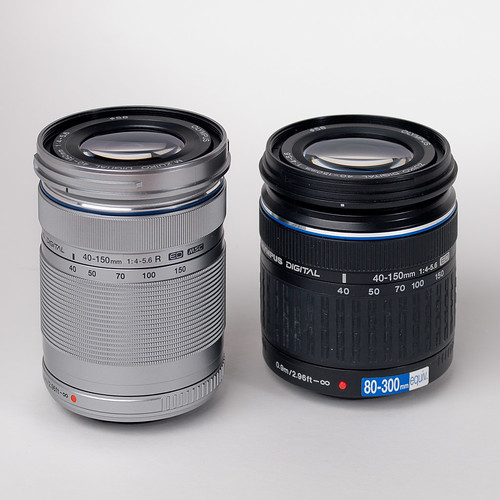
The Mark 2 lens remained a staple of the Olympus stock lens kits for the remainder of the E-4x0/5x0/6x0 manufacturing run. I wouldn't call it popular, but it was certainly ubiquitous, so much so that Olympus sold a combination of the Olympus MMF-2 4/3rds to µ4/3rds and the Mark 2 lens for use with the E-P2. That's the combination I purchased, direct from Olympus, for a modest $199.

Zooms at 40mm
"R" version on the left (4th version), Mark 2 on the right

I used the Mark 2 quite a bit, both with the E-P2 as well as with my E-3. It was slow to focus on the E-P2, but it was decent enough and helped me to grab good shots when I needed to with the E-P2. And for $200, I got an affordable and adaptable short telephoto zoom. But it wasn't a native µ4/3rds lens. I wanted a native version of the lens if for no other reason than to get a lens with better autofocus speed on the E-P2.

So I waited a bit and sure enough Olympus released a Mark 3 version of the lens that was native µ4/3rds mount. It was engineered to focus quietly and given the MSC (Movie & Still Compatible) moniker. As a consequence the price moved up to $300. Olympus released it with a plastic bayonet mount (like they'd done with the Mark 2). I didn't feel inclined to spend $300 on a lens that didn't have a metal bayonet mount. The M.Zuiko 17mm, which sold for less, had one, and my M.Zuiko 14-42mm Mark 2 kit lens had one as well.

Eventually Olympus released a Mark 4 version when they released the E-P3, this time with the 'R' designation. The 'R' differences from the Mark 3 were a faster focus motor and different lens coatings. And the price went up slightly yet again. This past December, when Adorama surprisingly offered the silver 'R' version for $160, the clamp around my credit card loosened and I purchased a copy for myself.

Build and Performance

Physically the 'R' version is slightly narrower in diameter, but slightly longer, than the Mark 2. It's also lighter. In the hand the 'R' version feels better built than the Mark 2 version, but I wouldn't categorize the Mark 2 version as poorly built. The bayonet is plastic (as it was with the Mark 2 and Mark 3 versions), but it mounts snugly and tightly on the E-P2. How long it will continue to do this I have no idea.

The 'R' version, compared to the Mark 2 with adapter mounted on the E-P2, is blazing fast when it comes to autofocus speed on the E-P2.  Because of its very light weight it balances quite well in the hand, even when zoomed out to 150mm.

M.Zuiko 40-150mm 'R' at 150mm


You'll note that I have the VF-2 mounted on the E-P2. If you intend to use the 40-150mm at 100mm or longer, then you're going to want to use the EVF to help focus and compose. Using the LCD on the back at the longer focal lengths only makes sense if you have the E-P2 on a stable platform, such as a tripod. Otherwise you're going to see the image jump and dance all over the place. The EVF gives you a third point, your head, to help stabilize the whole assemblage (the other two points being your left and right hands).

With my copy I noted that the zoom ring was tight, almost too tight. With its light weight you won't have zoom creep if the lens is pointing down. Focus is focus-by-wire, which isn't all that good or bad. I've yet to have to manually focus this lens, as the 40-150mm and E-P2 always seem to pick the point I want to focus on.

I can't get over how silently this zoom focuses. It's fast and silent focusing performance is a spoiler. The only other lens that focuses this way is the M.Zuiko 45mm, which is also an MSC lens. In bright outdoor light it's a joy to use when it's needed.

Examples

I've taken enough photos with the 'R' version to come to the conclusion that it's as good a performer, IQ wise, as every other version I've owned and used. In bright light and stopped down around a stop the lens will produce nice, clean, crisp, well-colored photos with plenty of detail.

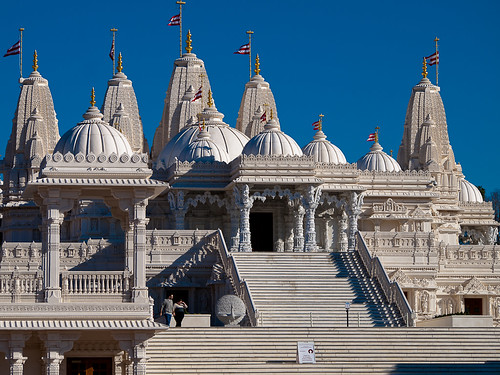
BAPS Shri Swaminarayan Mandir
BAPS Shri Swaminarayan Mandir, Atlanta, Georgia, USA
BAPS Shri Swaminarayan Mandir
BAPS Shri Swaminarayan Mandir, Atlanta, Georgia, USA
Link-up
MetLife Blimp docking, Orlando, Florida, USA

While the lens can produce good detail, it's not going to give you the same level of performance of a zoom that's five times its cost (or higher). The image of the tender getting ready to latch the airship to its mooring tower shows the limit of its resolution. This photo was taken late afternoon. If you look closely you'll see the line that connects the tip of the airship, through the tip of the mooring tower, and then back off to the right. It doesn't look quite sharp enough, not enough separation from the background sky. It would have looked better with the 50-200mm but then again, if I had the 50-200mm mounted on the E-P2 it would have handled very awkwardly, and you can rest assured it wouldn't have focus locked nearly as quickly as the 'R' version on the E-P2.

Conclusion

Remember that this is a $200 zoom lens, not the equivalent of the Zuiko Digital 50-200mm SWD (or any of the SHG zooms). But then, it's roughly 1/5 the cost of the 50-200mm and quite a bit smaller and lighter. This is the kind of lens you want in your kit to make your kit as small and light weight as possible.

The Travel Kit
Clockwise from top: M.Zuiko 40-150mm R, M.Zuiko 45mm,
M.Zuiko 17mm. E-P2 in center with Panasonic 20mm.

Look at my modest E-P2 kit, and you'll see my copy of the 40-150mm peeking out from behind the E-P2. It's a great little lens for the money, the kind you carry with you on impulse without having to worry about the consequence of it being too heavy or too expensive if something happens. In the right light it works quite well. It is, in my opinion, the best utility zoom for the money, especially if you can purchase it for $200 or less. Especially less.

Technical

I use Olympus, and all different kinds of Olympus. The two photos of the 40-150mm mounted on the E-P2 were taken with the E-1 and Sigma 30mm 1:1.4. The first image was a JPEG taken out of the E-1 and cropped in post 1:1. The photo of the two 40-150mm lenses as well as the kit photo were taken with the E-3, the ZD 50mm, and a pair of FL-50Rs, one in an Apollo 42" reflector and the other using a Rogue FlashBender.

last updated 27 January 2012

contact me...

You can click here for Matthew's e-mail address.