2010-07-17
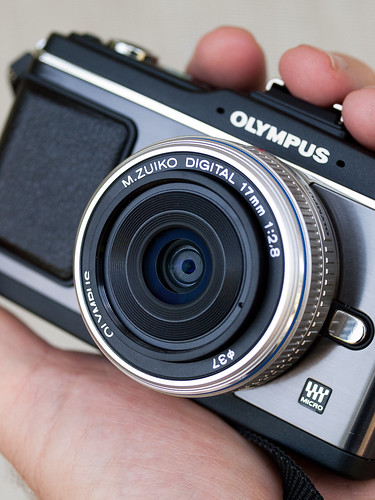
Olympus M.Zuiko Digital 17mm f/2.8
Execution: 3 out of 5
Yeah, but: Inexpensive and a blast to use.
The Long Version: If you're a reader of this blog you've no doubt read Matthew's earlier review of the Panasonic Lumix G 20mm F/1.7 ASPH. Matthew described the 20mm as "perhaps the single best lens available for micro four-thirds cameras." There's no denying that at a maximum aperture of f/2.8, the Olympus pancake is a good stop-and-a-half slower than the 20mm at f/1.7. And coupled with the GH1, the combination is, again quoting Matthew, "a dominant force in the mirrorless market segment." High praise indeed.
I'm not here to counter points that Matthew makes in his review. It's in bad form (I am, after all, an invited guest blogger) and it's pointless. The 17mm is matched for the Olympus Pen series (currently the E-P1, E-P2, and E-PL1) in much the same fashion that the 20mm is matched to the Panasonic line of micro four-thirds cameras. Both the 20mm and 17mm, measurebation and specifications notwithstanding, are for all practical purposes equally capable instruments when used competently.
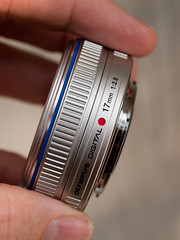
The 17mm, like it's Panasonic cousin, is a minor marvel of engineering. At 57mm diameter by 22mm length, and weighing a rather wispy 71g, it's almost too small to comfortably hold. When it's mounted on one of the Olympus digital Pens, the combination fits comfortably in the palm of my hand, and is small enough to easily slip into a jacket, coat, or (if you're wearing cargo pants or shorts) small enough to fit into a large pants pocket. Its equivalent 35mm focal length is 34mm; in days of yore when I shot film with primes, the 35mm lens was my favorite focal length, allowing me to include more of the world in my photographs without the undue distortion of wider angle lenses such as the 28mm or 24mm. In its own way purchasing the 17mm was like coming home again.
The 17mm is constructed primarily of plastics (or "composites" as they're called in some quarters), which includes the focusing ring, outer lens body, and front facing elements (but not the front lens). The mount is well-machined and chromed metal; it mounts smoothly and tightly on my E-P2, with no play or wiggle once mounted. The plastics used in the lens are of excellent quality, with crisp molding across the entire lens. In spite of the extensive use of plastics (or perhaps because of it) the feeling of the 17mm is one of quality and precision, in keeping with the E-P2 body.
With the latest firmware available for the digital Pens, the 17mm is quick and accurate to automatically focus on just about any subject, or in my case, on every subject I've taken with the lens to date. The only problem regarding autofocus with the 17mm is the same problem you'll find with the M.Zuiko 14-42mm kit lens; autofocus noise. For stills it's not an issue. For video it's noisy enough to be heard on the audio track. I'm certainly no expert on video photography; when I use the E-P2 and 17mm for video, I don't use continuous autofocus, prefering instead to compose, then let the camera single focus on the subject, then record. Nothing annoys me more than to see a camera hunt for focus lock on a video. And if you must have silent continuous autofocus, then Olympus has two new silent focusing micro four-thirds lenses for you to choose from; the M.Zuiko Digital ED 14-150mm f4.0-5.6 tele-zoom and the M.Zuiko Digital ED 9-18mm f4.0-5.6 UWA zoom.
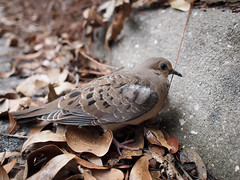
The E-P2 and the 17mm combine to create an almost sublime picture taking machine, a device that melts into the hand, that's so small and unobtrusive that it gives a sense of intimacy with the world that is almost impossible to achieve with a regular DSLR such as the Olympus E-3 or its many similar kindred. Big cameras enslave you to a particular regimen with regards to photography; put the camera up to the eye in front of your face, between you and the world, spend critical moments manipulating the camera, then record the image. With the E-P2 and 17mm, I can hold the camera away from me, then use live view out of the corner of one eye to judge basic composition while keeping the majority of my attention on the world in front of me. The injured pigeon above was taken with my hand and the E-P2 less than a foot away, in my hand, while I kept the rest of my body away from the bird in order to minimize spooking it.
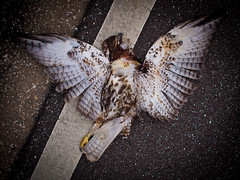
And sometimes its good to be able to hold the camera away from the body; while attempting to photograph the hawk, I held the E-P2 in front and above the subject while I kept a weather eye on the multiple lanes of traffic that kept passing by me at every green light.
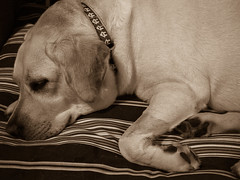
When I purchased the E-P2 in December of 2009, I purchase it in a kit that included the 14-42mm kit zoom and the VF-2 electronic viewfinder. For a time, I used the VF-2 almost religiously, aping my SLR/DSLR technique of holding the camera in front of my face. The 17mm has broken me of that habit, allowing me to continually approach a subject unobtrusively, seeking the best point of view without looking like a hunched over idiot and drawing attention to myself. With the 17mm on the E-P2, I can quietly and quickly take those special moments without physically intruding and thus disturbing the moment I'm trying to capture.
So is the 17mm good enough to invest in? Absolutely. Although it isn't cheap, it's cost is much less than the 20mm, allowing you an easier entrée into a whole different technique of photography, allowing easy and experimental perspectives for photographing the world around you, a way to more closely inspect the world around you. Both pancake lenses are superb, and will reward the user when used properly. Which one you choose comes down to purely a matter of personal taste and/or budget.
2010-07-16
Old Crow Medicine Show Concert, Toronto, 13 July 2010

Concept: 3 out of 5
Execution: 4 out of 5
Yeah, but: Yes, I like Bluegrass. Is there a problem?
The Long Version: Concerts in particular, and music in general, are things that I really shouldn't review. I hardly ever go to concerts, don't really know anything about them, and yet somehow I've been to three of them in the past nine months. Each one has been a lot of fun and very loud, but it's hard to compare them since the genres have been so different. Still, one of the great things about the internet is the universal ability for people to speak beyond their authority - and it's far too late for me to stop doing that now.
Old Crow Medicine Show is a band that's a little tricky to pin down. They're a string band with at least a couple of banjos, acoustic guitars, and an occasional harmonica as well. A couple of cowboy hats were in evidence, but nobody was trying too hard: they certainly look a lot like a Bluegrass band. And of course they sound like a bluegrass band as well; I have to admit that listening to Willie Watson speaking reminded me of Boomhauer on King Of The Hill. I don't know if he was just mumbling through muddy speakers or if it was a legitimate accent, but dang ol', man, I could barely make out a word he said.
But just the same, this is far from a traditional jug band. They're decidedly modern, with roots as solidly in rock and roll as in bluegrass. So while there were some loud "yee-haw!" noises coming from the audience, it was hardly a New Country revival with wall-to-wall white suburbanites wearing snakeskin boots and checkered shirts over their Garth Brooks Souvenir Belt Buckles. It was more wall-to-wall pale folks in ball caps and the occasional sex pistol t-shirts, who might also listen to Nirvana or reggae in their spare time. What can I say? I fit in okay.

The doors to the very large, very dark main room at the Phoenix Concert Theatre opened at 7pm, and the band came on at twenty after eight. There was no opening act, just a solid hour of music followed by a bar break. Old Crow came back on again and played hard for about another hour and a half; the show wrapped up after a single encore slightly before eleven - just about right for a Tuesday night. Here's the setlist for the show at the Pheonix; songs that I didn't recognize and haven't been able to track down are simply left with a placeholder question mark, those marked '*' have been added with thanks to the thread at Old Crow Fans.
• Hard to Love
• Down Home Girl
• I Hear Them All
• Wheeling Breakdown (Instrumental)
• My Good Gal
• Humdinger
• Caroline
* We're All in This Together
• Next Go Round
• My Bones Gonna Rise Again
• Gospel Plow
• Big Time in the Jungle
• Minglewood Blues
Break - 30 minutes
* Shortnin' Bread
• Alabama High Test
• Let It Alone
• Highway Halo
* Trials & Troubles
* Raise a Ruckus
• New Virginia Creeper
* Reubins Train
• Mary's Kitchen
• Four Strong Winds (a Canadiana song written by Ian Tyson)
• Crazy Eyes
• Hard to Tell
• CC Rider
• Wagon Wheel
• Tell It To Me + band intro
Encore:
* Cowgirl in the Sand
• Fall On My Knees
• Tear It Down
There's lots of places online to hear anything from snippets to full songs, so I won't worry too much about describing the music. I like it, others won't, and that's life. What really impressed me at the concert was the sheer power and enthusiasm of the musicianship. It was stunning to watch them play - whether it was on a banjo, mandolin, or acoustic guitar, their fingers were often blurred to the point of invisibility. Ketch Secor shredded the bow for his fiddle during the first half, came back from the break with a new one, and had it shredded by the end of the show as well. Poor Willie Watson had to replace and tune a guitar string during the band intro. While Secor and/or Watson sing most of the main vocals, everyone but Morgan Jahnig – who had his hads full with the Upright Bass – lead at least one song. This is a very talented and hard-working band.
There were a couple of people in the audience - literally, two of them - hooting all night for 'Crazy Eyes', which surprised me because I've never particularly cared for it. On the other hand, I would have loved to hear 'Take Em Away' and 'Methamphetamine', which somehow didn't make it into the set. But hearing 'Hard To Tell' and 'Tear It Down' live was awesome, with huge energy from the audience, and 'Wagon Wheel' was probably the biggest hit of the night as a giant sing-along. The two blatant ode de pénis songs weren't quite as popular with the two women to my left, but upbeat numbers like 'Humdinger' kept us busy fending off drunken dancers for most of the night. Good times.
Having seen the band roaring through their two-plus-hour set, and knowing who's doing what, has made me like their recorded music even more. When hearing voices in harmony, I can now picture them singing together instead of suspecting that they're layering tracks in post-production. And while many of the songs were played faster at the show, I can absolutely imagine them rocking just as hard in the recording studio.
Next time they're here, I'll be there.
2010-07-15
Honeywell Turbo Fan

Concept: 3 out of 5
Execution: 3 out of 5
Yeah, but:The Old Version Was Better, Except For...
The Long Version: After trying different fans over the course of many years in the music business, I started noticing several of my drummer friends using this same model of Honeywell "Air Circulator" with "Turbo Force Power".
It's small and therefore doesn't take up much space onstage or in your vehicle.
(11" high, 7" diameter 3-blade rotor)
The airflow can be adjusted from horizontal to vertical, which is also perfect for stage use.
3 speeds, the highest of which is rather astonishing and must not be pointed towards an open microphone lest you hear some serious wind rumble from your subwoofers and have to buy a windscreen, which won't help much.
I've been a huge fan of this "Air Circulator" for 10 years at least, and have just bought my fourth or 5th one, as seen below on the right:
Going back to the top photo, you'll notice that it's now 25% Quieter.
I agree.
In fact, using my digital decibel meter I came up with the following:
(C-weighted & Slow Response settings, measured 6" behind the fan to eliminate wind noise)
Old Fan:
Slow Speed = 71db
Medium = 73db
High = 76db
New Fan:
Slow = 67db
Medium = 70db
High = 73db
To make this comparison valid it should be noted that the day I brought home the new fan, I disassembled the old one and gave it a good cleaning, including the motor which also got some new lube.
Essentially they are the same age now, or as close as it's possible to make them.
Looking at the db readings, you can see that the new design is quieter at all settings.
Since decibels are a logarithmic scale, and an increase of 10db equals double the perceived volume, "25% Quieter" is a pretty accurate claim.
But is it odd that the new fan's medium speed is the same volume as the older version's slow?
Not really, because the new fan's medium speed puts out the same amount of air as the old one's slow.
Likewise, the new fan's high speed = medium on the older unit.
The new version runs slower, and therefore quieter.
For household use, this is fine.
If you're in a band, work in your garage a lot, or don't have air conditioning, this reduction in power gets a big thumbs down.
When you really need the big blast of wind that used to be found on the highest setting, be advised that it just isn't there anymore
Getting back to having cleaned and lubed my older fan for the decibel test--another feature mentioned on the box is "Removable grille for easy cleaning".
To me, this was always an important feature since I use these fans in our home 24/7, and quite often in smokey bars or on dusty outdoor stages.
When the blades get heavy with nasty stuff that adds weight, they spin slower.
Also, when the grille gets clogged with dust-bunnies and hair the flow is blocked.
Thrice a year I blow out the accumulated dust and gunk with my air compressor (or leaf blower) and every summer I take them apart for a complete cleaning and motor tuneup.
But when I tried to take apart the white(ish) one a few years ago, I discovered a design change had been made.
Two of the six screws that secure the grille had been changed from Phillips head to Allen Security head, so you needed a special (hard to find) hex wrench with a hole in the center to accomodate the security pin!
This fastener is highlighted below, in a chart I found at Intructables:
(click to enlarge)
I remember being furious!
My fan was in desperate need of servicing, and I was locked-out!
So I used a Dremel tool's cutting wheel plus an ExActo knife to completely remove the offending screws and all the surrounding plastic, too!
Security Screw YOU, Honeywell!
It's funny that they now consider this a noteworthy feature when a few years ago their legal counsel decided that it was a liability.
Looks like I wasn't the only one who was offended and angered.
It's a stupid fan, not a Wii.
Only 17.3% of the population is dumb enough to get hurt while opening up a fan to clean it, or so I've heard.
The fan's base has been scalloped front and back, which might make it easier for air to reach a place where it can be circulated, but I'm going to go out on a limb and say that this is to save a few cents per unit on plastic and shipping weight.
There are now two keyholes (vs 1) on the base for mounting the unit on a wall.
Bottom line is that the new black fan is for the house, and the older white one is for work.
I'm going to try and keep it running for as long as possible, to enjoy it's higher velocity airflow.
My suspicion is that the motors are the same and that the only difference is in the high/medium/low switching circuitry, which means that I can hopefully keep the older one blowing harder for years to come.
The fan blades spin clockwise--the CCW spiral grille seems to counter their turbulence which results in very smooth output that can reach long distances.
This small Honeywell Air Circulator's retail price varies from $20 in the springtime to $12 in mid-summer, to as low as $5 at clearance in the early fall.
Larger versions are available, and they offer some incredible airflow.
contact me...
You can click here for Matthew's e-mail address.


