2014-05-19

Godzilla (2014) ゴジラ

Actor Ken Watanabe as Dr. Ishiro Serizawa
expressing my exact sentiments about this latest film.

Concept: 3 out of 5
Execution: 2 out of 5
Yeah, but: A US$200 million mindless cinematic weekend juggernaut, to which I contributed $6.
The Long Version:

Everybody in Hollywood who has nothing to do with real cinematic creativity is going absolutely ape-shit over the latest Godzilla iteration because it has generated a monstrous pile of cash for its studio investors. Once again, this movie overwhelmingly proves that in today's Hollywood, cinematic quality and merit are inversely proportional to earning power.

It would seem after the critic's caterwauling over Roland Emmerich's 1998 version, everyone was so desperate to see a "better" Godzilla treatment that they blindly stampeded into every movie house on Earth that showed it. And I mean just about everybody.

In backwater Orlando, Florida, I tried to see the movie Saturday night on International Drive, but it was so crowded I couldn't find a place to park and went home unfulfilled. I got to see it by hitting the earliest Sunday morning matinee I could find. And it cost $6, even with my senior discount.

Rather than hash out all the spoilers, I'd like to just touch on a few points (with spoilers) that stick out like a sore paw.
  1. Bryan Cranston as Joe Brody. Mr. Cranston was in nearly all the trailers. In fact, I went into the movie thinking that his character would somehow help find a way to defeat Godzilla, especially after the way he lost his wife. Imagine my surprise to see his character die less than a third of the way into the movie. That left me with mostly Aaron Taylor-Johnson, who played USN LT Ford Brody, who played his son. After fifteen minutes with the son, I almost got up and left and not even bother to ask for a refund. Seriously.
  2. Supremely stupid nuclear bomb tricks. Rear Admiral William Stenz (played by David Strathairn( Sneakers, Bourne, Alphas)  hastily devises a really bad plan to use nukes on a cheap tour boat to attract all the monsters out into San Francisco bay and then just blow them up. You'd think time, being of the essence, would call for the use of some of those C-17 Globemaster IIIs (there's a video at that link of a C-17 on a training run air dropping four Humvees and 50 troopers) that we see flying all through the film. You know, the really big strategic airlifters. The C-17 in real life is cavernous on the inside, capable of carrying, well, capable of carrying both the train and the nuke it was transporting. But I guess the Navy doesn't believe in big fancy aircraft. So instead we get a slow diesel locomotive pulling a flatbed with said nuke, rolling cross country and across bridges for the express purpose of being attacked by a M.U.T.O.
  3. Film length. The 2014 version is 123 minutes (two hours three minutes). Add in 20-plus minutes of commercials and trailers (insult to injury), and the time in your seat is close to two-and-a-half hours. The original 1954 release was 98 minutes (one hour, 38 minutes). The first time I saw the 1954 version in a theater (1973) they had a pair of Warner Brother cartoons to start off, lasting all of ten more minutes. Stripping back to the core running time, there's no reason why the 2014 movie needs another 25 minutes. The 2014 movie needs/needed a good editing. Unfortunately, when the Director's Cut comes out in about a year, it'll get another 10 to 15 minutes.
  4. Aaron Taylor-Johnson. Maybe I'm too old to appreciate such young talent, but I've seen better in that age bracket (Emma Stone (Zombieland, Amazing Spider-Man). For a fresh change of pace it would have been nice to see a woman (again, Emma Stone comes to mind) in that role, someone with sparkle and energy and intelligence, instead of the typical dumb brute force movie male. But lest we forget this is, after all, a movie about Godzilla, the ultimate incarnation of dumb brute force.
I think I'm about movied out for 2014. I saw Captain America, and I've now seen Godzilla. The hype machines for the rest of this year's movies are spinning at near light speed and throwing out tremendously overwhelming waves of, well, hype. But I think I've reached a point in my long life where I've developed considerable immunity. I know this to be when I can keep my money in my back pocket, where it belongs, when I pass one of these current blockbuster epics.

Update 24 May

Matthew Broderick as Dr. Niko Tatopoulos and Maria Pitillo
as journalist Audrey Timmonds in the 1998 Godzilla movie,
can't believe that little changed in 16 years either.

I came across a wonderfully refreshing comparison and review of the 2014 Godzilla, showcasing five substantive advantages the 1998 version had over this latest version. 'Godzilla': 5 Things Roland Emmerich's 1998 Version Did Better touches on what I found annoying in the 2014 version; characterization and development and clearly defined objectives that were key plot points in the 1998 movie but totally lacking in the 2014 version. In the 1998 movie, even the Gogira name drop really was way cooler, far more in keeping with the old 1950 and 1960 monster movies than the 2014 version.

Lest I forget, the 1998 'Godzilla' had an intelligent and powerful female role in Audrey Timmonds, played by Maria Pitillo. Barbs and criticisms notwithstanding, there was a lot more brainy action going on in 1998's 'Godzilla' than in 2014's. Even the 1998 Godzilla was leaner, more agile, and seemingly more intelligent. The 2014 Godzilla could be more aptly called Blubberzilla.

last updated 24 May 2014

2014-05-13

M.Zuiko ED 12-40mm f2.8 PRO Tech Note

1240 and 1260
Concept: 5 out of 5
Execution: 5 out of 5
Yeah, but: This is not the review you're looking for.
The Long Version:

Matthew likes to produce the occasional counter review of equipment that he doesn't own but that instead comes across the counter-top of the camera store he works at. He at least gets to handle it before passing judgement. This micro-review, which I'm labeling as a Tech Note, is in that same spirit. I don't own the 12-40mm, but I did own the 12-60mm and used it extensively.

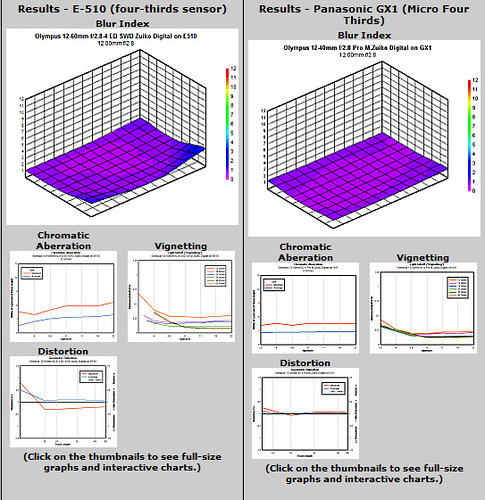
The only reason for writing this short blog post is to talk about the graphic at the top, where the test results of a Digital Zuiko 12-60mm f/2.8-f/4 (on the left) are compared to the new M.Zuiko ED 12-40mm f2.8 PRO lens on the right. I didn't make this comparison, but another photographer did on Flickr (click the image for a larger view and to go to Marty's Flickr stream).

Why do I care about the graphic? I have bellyached for some time about how Olympus isn't making native µ4:3rds versions of various 4:3rds lenses, in particular the 12-60mm and the 50-200mm. Turns out that maybe, just maybe, Olympus has decided to create newer µ4:3rds lenses that are superior to those two regular 4:3rds lenses. The charts show that the optical performance, at least via optical chart measurement, of the 12-40mm is superior to the older 12-60mm. When you compare the two lenses, you come up with the following points:
  • Constant aperture (f/2.8) of the 12-40mm vs variable (f/2.8 to f/4) of the 12-60mm.
  • Smaller and lighter 12-40mm vs 12-60mm.
  • Lower cost 12-40mm vs 12-60mm.
  • Native µ4:3rds mount of the 12-40mm, which means much faster focusing.
  • Silent operation of the 12-40mm, great for video.
The only downside (if you want to call it that) to the 12-40mm is the loss of the longer focal lengths beyond 40mm. It would appear Olympus made the engineering tradeoff to produce a shorter focal length range in order to achieve better optical and physical operation, producing by all accounts the successor to the 12-60mm. Given my personal druthers I'd trade a constant f/2.8 aperture across all focal lengths for 20 less mm in a cold New York minute.

Later this year Olympus will release its second PRO lens, a 40-150mm constant f/2.8 zoom, which just might be the superior replacement to the highly regarded (by me at least) 50-200mm. This will give the Olympus photographer an equivalent focal length range (in 35mm terms) of 24mm to 300mm in two zooms, with decent light gathering performance.

What is interesting is how those two lenses compete head-to-head with the Panasonic 12-35mm f/2.8 and 35-100mm f/2.8 zooms. Now if Olympus can just stay in business long enough to make buying these lenses worth your while...

last updated 13 may 2014

2014-05-02

Sigma DP3 Merrill First Impressions


Concept: 5 out of 5
Execution: 2 out of 5
Yeah, but: Pixel = Picture Element. Sensel = Sensor Element.

The Long Version: This is not a review of the Sigma DP3 Merrill. It has already been scrutinized by some of the best and there's really not much to add; these cameras are not creatures of nuance and subtlety. The DP series, and the 75mm-e DP3 in particular, is so unambiguous that anyone who has looked into it should have no doubts about whether or not it's a suitable camera for them. Anyone who hasn't looked into them already should probably stop reading now, because nothing good will come of it.

As I said, there are already some great reviews out there. But I'd like to single out their essence, which comes from Lensrentals: "if you want some amazing images, but not a lot of them and never very close together, this camera is a blast."

But there is a question I can address: Why not hold out for the recently-announced Quattro?


There is value, both financial and personal, in being a late adopter. This is something that I learned from Bill, although naturally it has taken me time to appreciate his wisdom.

Sigma's Merrill generation is a known known – none of its many flaws or strengths should surprise any purchaser with an internet connection. (Any purchaser without an internet connection is in for a nasty shock when they learn that the necessary raw-processing software is download-only.) But despite being superseded by the Quattro the DP3M can still have its age measured in months. So why hurry to pay the highest price for an early production unit of an unproven design? Cameras are invariably rushed to market with insufficient testing, and problems can strike anyone. Canon, Fuji, and Sony have all had light leaks, Nikon had the D800 autofocus misalignment, Sigma had the SD1 Merrill pricing, and so on.

Yes, I'm sure the Quattro will be a better device with less mid-iso noise and slowness, but it doesn't add what I miss most with the Merrill. There's still no EVF or tilting LCD screen, and there's still no cable release or even WiFi triggering option. And some of the dpQ's improvements don't help me: the bigger batteries will let it record more rolls of film per charge to its memory card, but the Merrill takes the battery that I already use in my pair of Ricoh GRs. Synergy matters.

Besides, the dpQ doesn't have that old Foveon three-sensels-per-colour nostalgia – I've wanted a Foveon camera since I first tried an SD9 a decade ago, so the Quattro sensor design feels like a very very small betrayal. And in another generation or two the technology pioneered in the dpQ will be even better, making the upgrade more significant when a cable release or EVF finally make an appearance.


For what it's worth, the DP3M reviews are absolutely right, but it still takes some experience with the camera to really appreciate them. The battery life is dreadful; I exhausted one by taking six photos and going through the initial setup process. Autofocus is at least as slow as any compact camera made in the past few years. Shadow noise at iso500 in indoor lighting requires countermeasures. And yet when it all works the files really are amazing.

The Sigma DP3 Merrill is a best-case camera. What's wrong with that? When I have worst-case needs I'll pick up my D800 and its suite of excellent prime lenses. If I want a more normal pocket camera I have the ultra-sharp wide-angle GR. And when I need versatility over image quality I have my Nikon V1, which is perfectly capable of producing mediocre results across an expansive range of focal lengths. The DP3M is a city-friendly camera that can produce exceptional results when used appropriately, and it just so happens that its comfort zone and mine are almost identical.

I just need to buy more batteries.


last updated 2 may 2014

contact me...

You can click here for Matthew's e-mail address.